In the years following the Dawn Raids, many Pacific families lived with an unstable sense of belonging. Invited for labour, welcomed in rhetoric, yet targeted through policy and policing, communities occupied an uneasy space between gratitude and fear. The legacy of that era still raises a vital question: what does it truly mean to belong?
Tongan teacher and punake, a master artist of poetry, music and choreography, Mele Suipi Fakatava Lātū reflects on this question through a powerful journey between being a beneficiary of Aotearoa-New Zealand and becoming tangata Tiriti. Her personal journey offers a lens through which to understand the long work of establishing place.
This blog is an edited excerpt from a longer personal essay by Mele Suipi Fakatava Lātū titled Enriching Aotearoa–New Zealand as a Tangata‑Tiriti with my Tongan Indigenous Heritage of ‘Punake’. It has been edited for length.
Before tangata Tiriti, a beneficiary
I say this with pride, humility and deep gratitude. My initial connections with Aotearoa–New Zealand happened nearly three decades before I was granted the legal right to settle here. Long before residency, long before I became a migrant settler in 2002, New Zealand was a place that shaped my life in ways that were profound and enabling.
My initial connection reaches back to the early 1970s, when a lifeline was thrown to my family in Tonga through a relative already living in New Zealand. My eldest brother was given a work visa to come and work, helping our family survive at a time of great need. He returned to Tonga a few years later, and though this was the right thing to do during the time of ‘overstayers’, it did end the best provision we had to meet our desperate time of need as a family.
Later, New Zealand’s support came to me personally in 1979 through a fully funded scholarship to study at the University of the South Pacific (USP), an opportunity that changed my life’s trajectory forever. The scholarship was part of New Zealand’s aid to developing countries in the Pacific, including Tonga. It covered everything from fees, accommodation, food, travels and even pocket money for 5 long years. I graduated with a Bachelor of Arts, majoring in English with a minor in Sociology. I also gained a Graduate Certificate in Education. It was while at USP that I discovered my future career; I have been an educator and secondary school teacher for the last 38 years.
My first visit to Aotearoa took place in 1981 when I decided to come straight from Suva and visit family. A year later, I was flown over in haste for medical treatment, surgery at Greenlane hospital for a tumour suspected to be cancerous. But with God’s blessings, it was not. Series of trips in later years during school holidays brought my family and I to Aotearoa-New Zealand for breaks and to visit other families. The most special one of those happened in 1996. That was unique because while we were in Auckland, I gave birth to my only son, who was blessed with becoming a New Zealand citizen.
This is why I say that for many years, I felt like New Zealand was like a benefactor to me, and I—a grateful beneficiary.
Being a beneficiary means receiving benefits, generosity and goodwill from a donor. I received education, healthcare, opportunities and professional formation that enabled me to grow socially, intellectually and spiritually. For all of this, I will be forever grateful.
But being a beneficiary was not the same as belonging.
What was missing was a sense of relationship. There was no deep sense of responsibility, either on my part, or on the part of the nation toward me. I had no sense of obligation to give back in practical ways, no sense of being woven into the identity of the land itself. My connection was real, but it was not yet relational.
Becoming tangata Tiriti and a beneficiary
That changed when my family and I migrated to Aotearoa–New Zealand in 2003.
Through the pathway envisioned and legalised by Te Tiriti o Waitangi, I was adopted into the land of the long white cloud. I became, by legal right, Tongan tangata Tiriti of Aotearoa–New Zealand.
This was not simply a shift in immigration status; it was a profound shift in identity.
To me, becoming tangata Tiriti is like being adopted as a person. In Tongan culture, adoption, ‘ohi’ or ‘pusiaki’, is not casual or temporary. When a child is adopted, they leave one family and enter fully into the privileges, identities and responsibilities of another. The adoptive parents have fatongia (responsibilities) to nurture and raise the child. The adopted child, in turn, has entitlements, but also obligations: to give back, to care for the parents until the end of their lives.
This analogy helped me finally understand my relationship with Aotearoa–New Zealand.
As tangata Tiriti, I now had entitlements, but more importantly, I had responsibilities. I was no longer monocultural or monolingual. I had become an intercultural being, learning to feel, think, believe, act and live alongside tangata whenua and other tangata Tiriti. My identity was being continually shaped.
And with that came a deep sense of obligation: to give back to the land and to the people with the same devotion that one gives within a family.
Cultural inheritance and responsibility: becoming a Punake
Long before I ever became tangata Tiriti, I was born into another inheritance, one I resisted for many years.
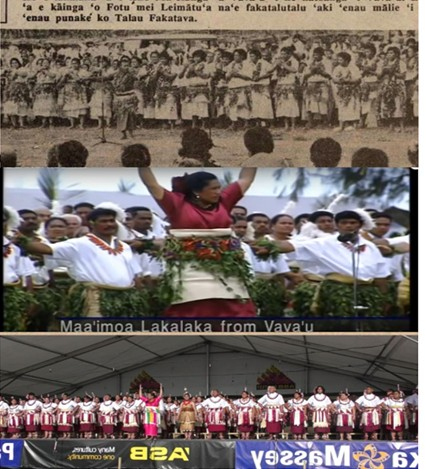
I was born in 1958 into a lineage of Tongan Punake, who were composers, choreographers and custodians of faiva (dance). This heritage was mapped by my grandfather, Melikiola Fakatava, and later carried powerfully by my father. Punake, in our family, was not merely artistic practice; it was fatongia, a responsibility to God, to the land, and to the people of Tonga.
Yet for much of my life, I did not want this role.
My world revolved around faith and education, lotu and ako. Punake felt like a distraction, something heavy and demanding. When my father asked me to transcribe his and my grandfather’s compositions, I declined. When he gently suggested I might one day become a Punake, I shut the door firmly.
Out of obligation, my first faiva in 1994 felt like duty completed, not destiny discovered. But life has a way of insisting.
In 1998, I was entrusted with composing and choreographing a lakalaka for the 80th birthday celebrations of King Tāufa‘āhau Tupou IV, a moment of extraordinary cultural responsibility. Standing before the King, the royal household, and the people of Tonga, I was publicly recognised as a Punake. No certificate was issued; the recognition was etched into collective memory.
On that day, I also sanctioned myself. Punake was no longer an obligation to be endured. It became a service I embraced with conviction, passion and commitment. My father’s long‑held hopes were realised, even in his absence.
Belonging through contribution
Today, as a Punake and as tangata Tiriti in Aotearoa–New Zealand, I understand that heritage does not exist in a vacuum. Culture lives in people.
When the Punake is present, the heritage of faiva is present, ready to be practised, shaped, and enriched. The poetry, the melody, the choreography all dwell in the person. Ka ma‘u koe, ma‘u kotoa—when you have the person, you have it all.
This is how I see my responsibility now.
Through teaching, adjudicating, mentoring, composing and training young people, I serve both my inherited Tongan heritage and the land that has adopted me. Being a Punake is my way of giving back to family, to culture, and to Aotearoa–New Zealand.
I no longer see myself simply as a beneficiary of this country’s goodness. I see myself as a contributor, a custodian, and tangata Tiriti, bound in relationship, responsibility, and belonging.
By Mele Siupi Fakatava Lātū, 2025