The Polynesian Panther story is the story of Pacific in New Zealand, and also the story of New Zealand becoming more and more aware of its real self.
--Melani Anae
Origins of the Polynesian Panthers
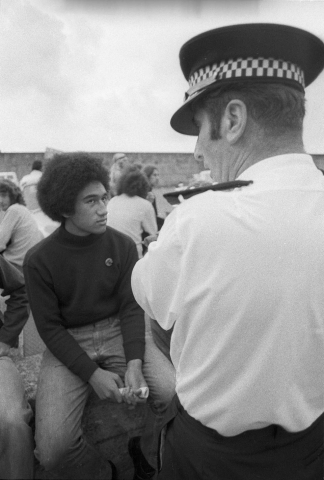
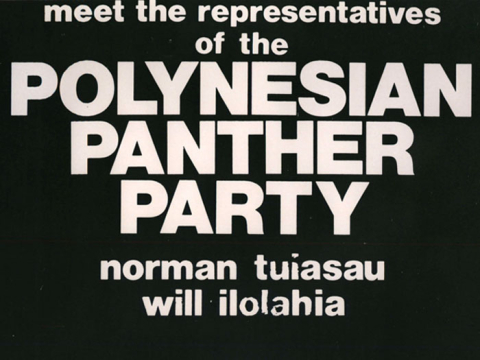
The Polynesian Panthers was a socialist activist group that fought against discrimination and racism in Aotearoa. The movement was founded in Auckland on 16 June 1971 by six young Pacific Islanders: Paul Dapp, Will ’Ilolahia, Vaughan Sanft, Fred Schmidt, Nooroa Teavae and Eddie Williams. The Panthers included Samoans, Tongans, Cook Islanders, and a few Māori, many of whom were university students. Their headquarters was in Ponsonby, then the heart of the Auckland Pacific Island community.
Growing a movement
Throughout the 1970s, the influence of the Polynesian Panthers grew, with chapters formed in South Auckland, Christchurch, Dunedin and Sydney. Inspired by the Black Panther Party in the United States, the Panthers drew direct comparisons between the systemic oppression faced by African Americans and the discrimination experienced by Polynesians in New Zealand.
Their platform was based in freedom through self-determination. It called for an end to the exploitation of Pacific communities, an end to police brutality, access to decent housing, and the inclusion of Pacific history in New Zealand’s education curriculum.
Empowering community action
Before and during the dawn raids, the Polynesian Panthers worked tirelessly to combat racism and police brutality. They sought to ‘overcome racist policies which were hindering equitable access to quality education, health, housing and a variety of other social conditions.’
Their manifesto was one of revolution: ‘The revolution we openly rap about is one of total change. The revolution is one to liberate us from racism, oppression and capitalism.’
To advance this vision, the Panthers undertook a wide range of community-based initiatives, including:
- Establishing homework centres, in partnership with the Citizens Association for Racial Equality (CARE)
- Speaking at schools and hosting community meetings
- Organising street parties and concerts for the elderly
- Working with the Ponsonby Peoples’ Union to create a food cooperative
- Providing transport for families and visitors to Paremoremo Prison, where the Panthers also established a chapter. Inmates received support, advice and often accommodation upon their release.
Once a Panther, always a Panther
Self-determination sat at the heart of the Panthers’ philosophy. Wayne Toleafoa described its importance:
To many young Polynesians like myself, the only way forward for us as a migrant people was ‘self-help’. We would have to stand up for ourselves and our people, and not wait for others to do it for us… The Panthers provided the platform for us to do just that.
The spirit of the Panthers lives on in those who were part of the movement—often captured in the saying, ‘Once a Panther always a Panther’. Melani Anae credits the group with empowering her and shaping her lifelong values, particularly her commitment to using education ‘as the tool that will lead us out of oppression and darkness and into the light’.
The opening of Fale Pasifika at the University of Auckland in 2004 stands as a visible testament to the presence of Pacific culture, language and learning within Aotearoa’s tertiary institutions.
Legacies and connections
The Polynesian Panthers’ activism can be compared with that of Ngā Tamatoa and other social justice movements that emerged during the 1960s and 1970s. Both the Panthers and Ngā Tamatoa worked to enhance the mana and the political, social and legal rights of their communities. On issues such as the Dawn Raids and the 1975 Land March, they stood shoulder to shoulder.
Together, these movements challenged the New Zealand myth of ‘one nation, one people’ and the country’s long-held claim to have the ‘best race relations in the world’.
Apology and ongoing impact
In 2021, the Polynesian Panthers Legacy Trust formally requested a government apology for the Dawn Raids, timed to coincide with the movement’s 50th anniversary. The request was supported by a petition led by Josiah Tualamali’i and Benji Timu, who also collaborated with the Trust to reflect on the Panthers’ history in a documentary series.
Further reading and other resources
Whakaako kia Whakaora / Educate to Liberate
The Polynesian Panthers: What you need to know — thecoconet.tv
Polynesian Panthers: Pacific protest and affirmative action in Aotearoa New Zealand 1971–1981 (Huia Publishers)
Anae, Melani, The Platform: The Radical Legacy of the Polynesian Panthers, Bridget Williams Books, 2020
Teaching about the Polynesian Panthers and the dawn raids
By Ricky Prebble
This story is part of an ongoing effort to record, and share lived experiences of the Dawn Raids era. Community stories are vital in ensuring this history is remembered, understood, and passed on. If you would like to share a story on our platform, please get in touch at [email protected]