Primary sources are helpful for understanding the Dawn Raids as they were experienced by those who lived through them. This category includes 1970s photographs, newspapers, artefacts, government reports, and community communications, offering direct insight into events, perspectives, and social conditions of the era.
These items reflect the language and perspectives of the time, which may differ significantly from today’s views. We invite users to consider the material thoughtfully and understand the historical context within which it was created.
Newspapers
Historical newspapers can provide insights into New Zealand’s societal dynamics and key events. Many are available through the Alexander Turnbull Library’s National Newspaper Collection or via your local library.
Amnesty
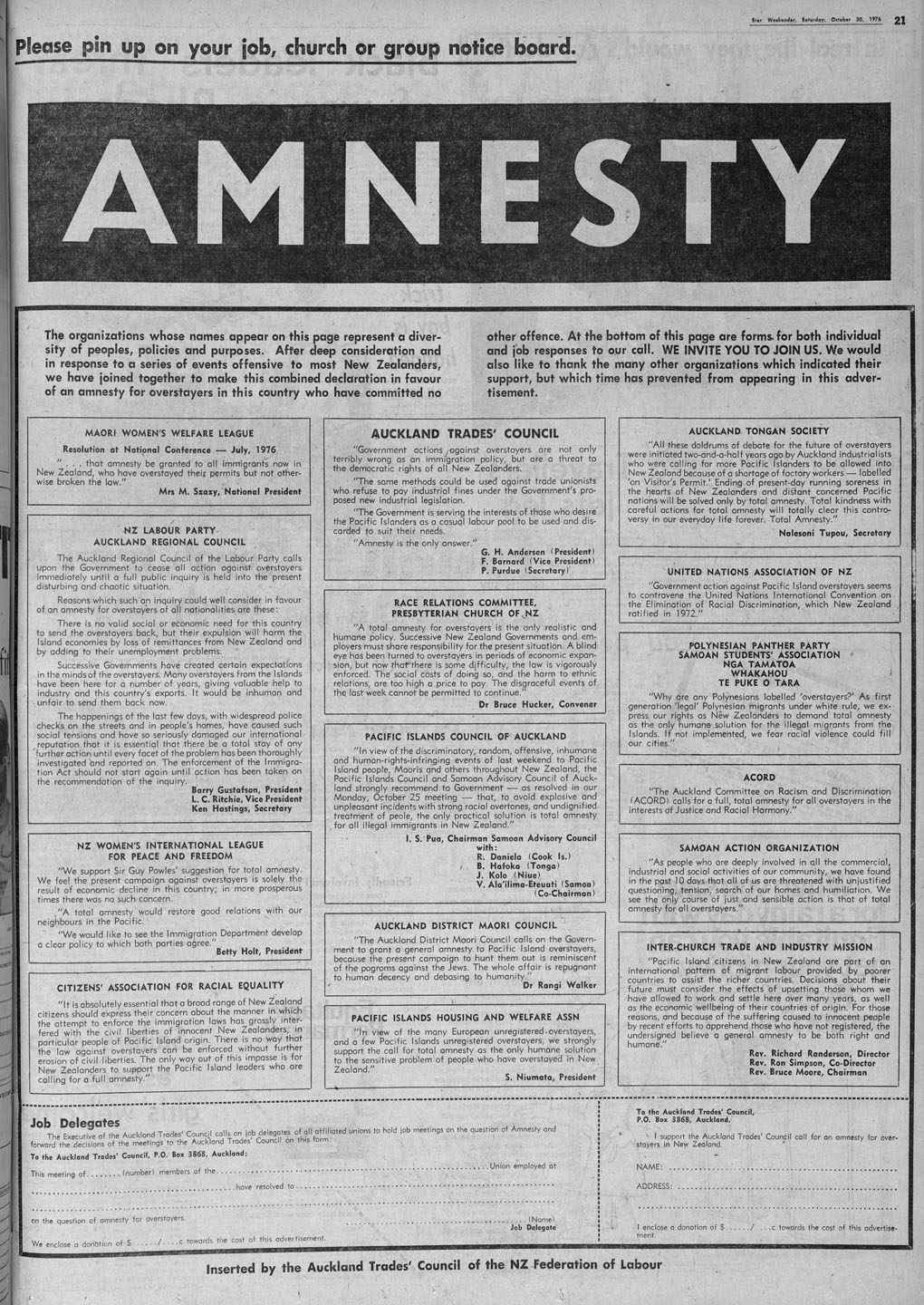
This full-page advertisement advocating amnesty for Pacific Island overstayers expresses a unified community response to the Dawn Raids by highlighting the active involvement and endorsement of 19 diverse pressure groups.
If you’re unable to visit this resource in person, you can search selected newspapers digitised on Papers Past, or request copies through local library interloan services.
National Newspaper Collection (National Library)
Papers Past (National Library)
Mana (1977–78)
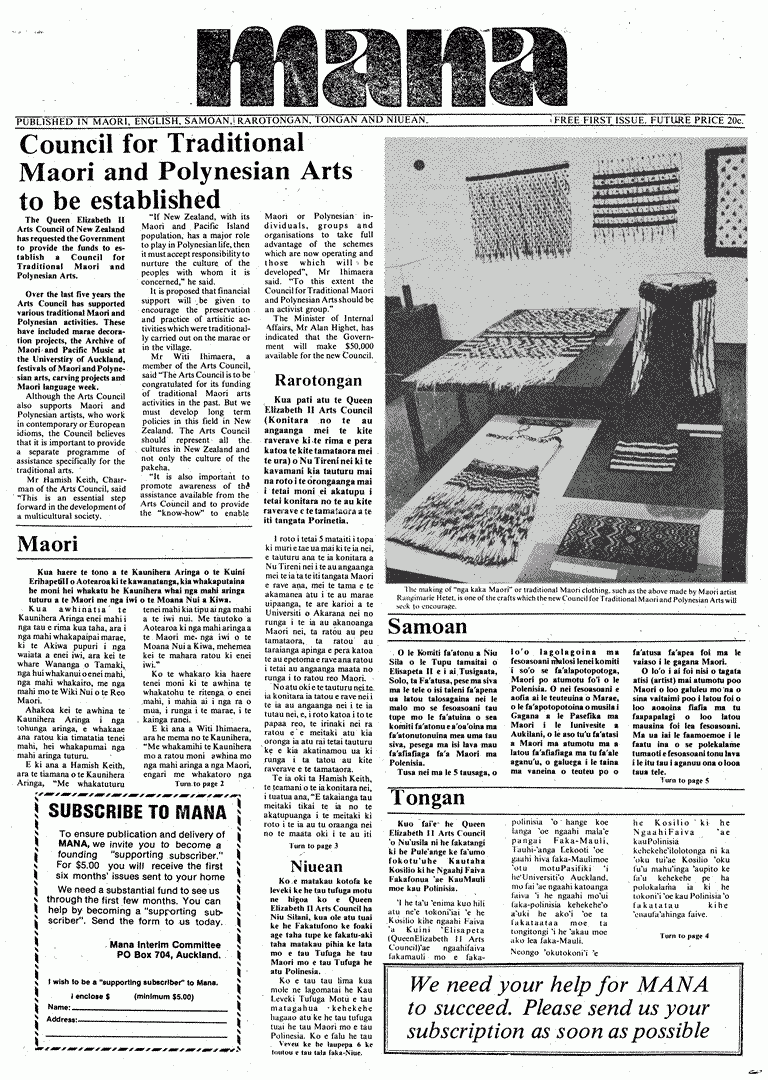
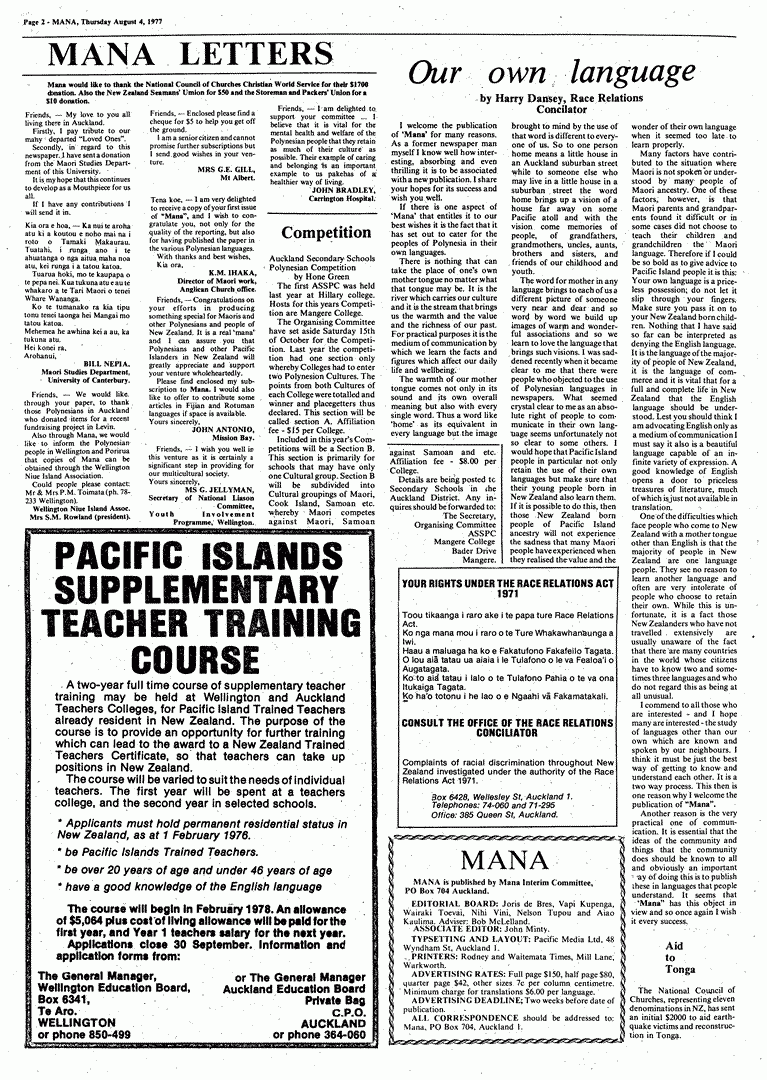
In June 1977, Tāmaki Makaurau Auckland saw the first issue of Mana, New Zealand’s first multilingual Polynesian newspaper. Mana aimed to reflect Māori and Pacific Island lives and provide news in Polynesian languages alongside English. Each issue featured unique content for specific communities, always paired with English translations.
You can explore digitised versions of Mana online.
Historical photographs
Photographs are powerful primary sources that capture historical moments and lived realities. They offer a direct and, often emotional glimpse into the past, revealing details and contexts that may be absent from written records.
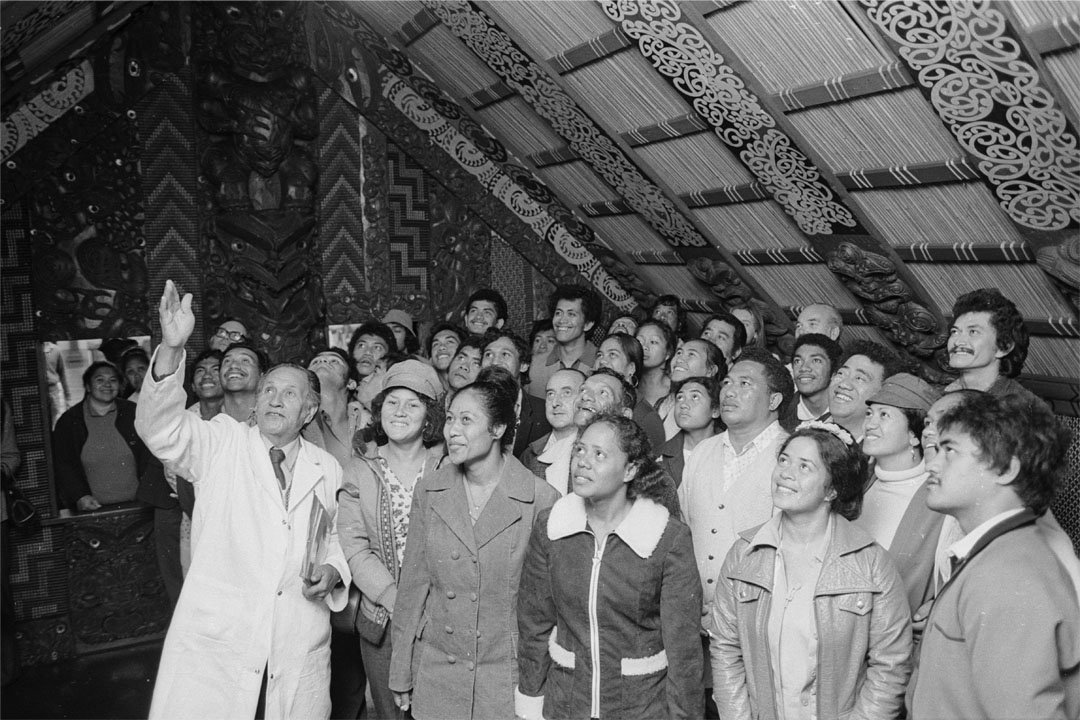
The first photograph is from the Evening Post, a daily newspaper published in Whanganui-a-Tara Wellington from 1865 until 2002, and is held in its photographic collection, now housed in the Alexander Turnbull Library following the newspaper’s merger with the Dominion to create the Dominion Post. The image shows Charles Tuarau, master carver at the National Museum, with a group of Cook Island cultural practitioners inside the meeting house Te Hau Ki Turanga in 1976 – a moment of cultural education and connection against a backdrop of political tension and social unrest.
The Evening Post photographic collection (Blog about Evening Post Photographic Collections)
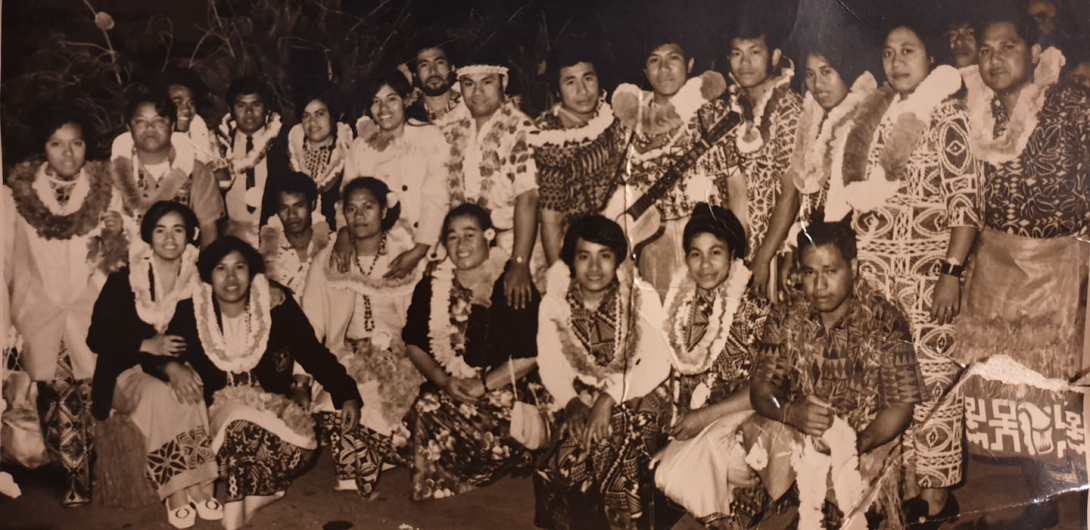
The second photograph comes from St Paul’s church in Ōtautahi Christchurch and shows the local Samoan Catholic community who were active in the 1970s.
Canterbury Stories consists of digitised material from Christchurch City Libraries archives, publications, newspapers, and donors. It includes both digitised physical collections and digital material.
Canterbury Stories (Collections)
Historical audio
Ngā Taonga Sound and Vision is the audiovisual archive of Aotearoa New Zealand. It has identified key audio resources in its collections related to the Dawn Raids.
Te Mana Maori, 1976 audio
In this episode of the current affairs programme Te Mana Maori, entitled ‘The Overstayers’, Hamuera Mitchell and Wiremu Kerekere explore the plight of illegal Pacific Island immigrants. Featuring insights from Lani Tupu, Andrew Afeaki, Clive Edwards, an anonymous overstayer, and Minister of Immigration Frank Gill, the programme addresses the hardships driving people to overstay their permits, the fear of dawn raids, and the call for a general amnesty.
Te Mana Maori, 1976, 47156 (Ngā Taonga Sound and Vision)
Other audio:
Dawn Raids in the Archive (Ngā Taonga Sound and Vision)
Tongan lawyer Clive Edwards discusses the panic caused by the 1974 amnesty for overstayers (Te Ara)
Interview with Samoan overstayer in 1994 (Te Ara)
Reports and submissions
Government submissions and research reports like those below were printed in limited runs and are now mostly found in libraries. These resources offer valuable insights into the social norms, values, and concerns of the time they were created. They can also have legal or policy significance, providing evidence of government actions, public opinions, influencing decisions and outcomes.
How Tonga aids New Zealand
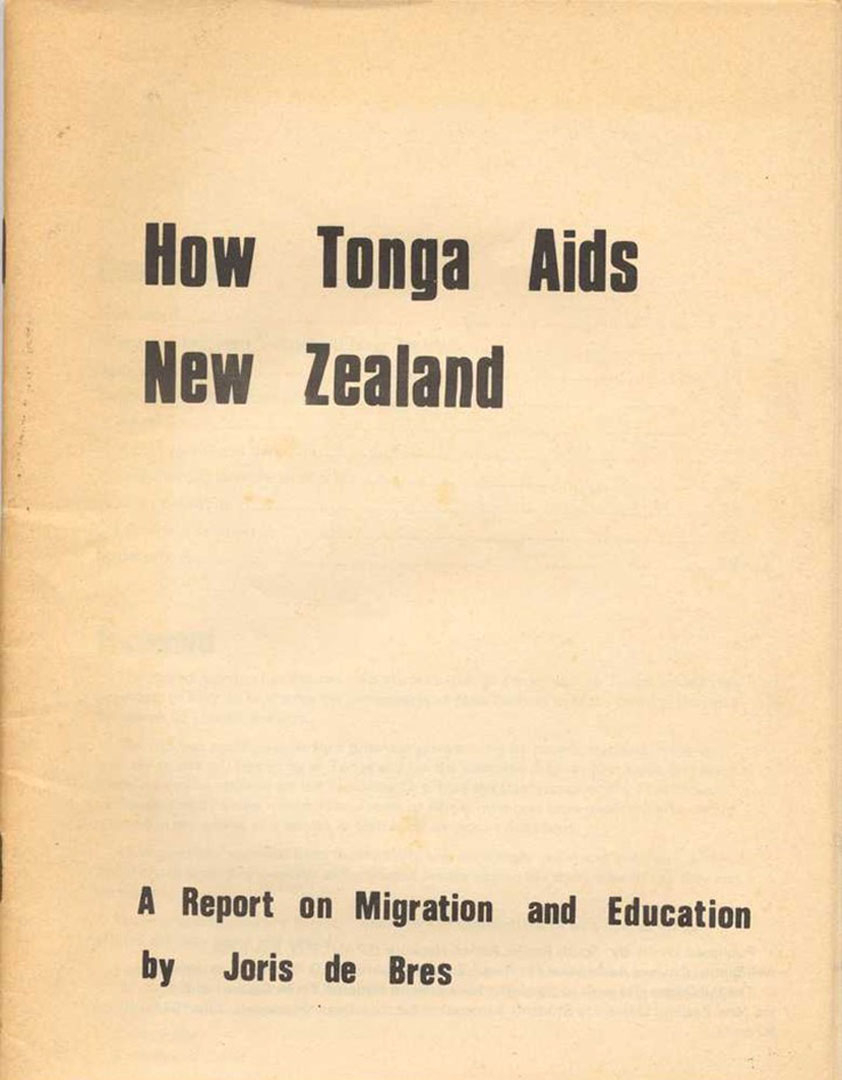
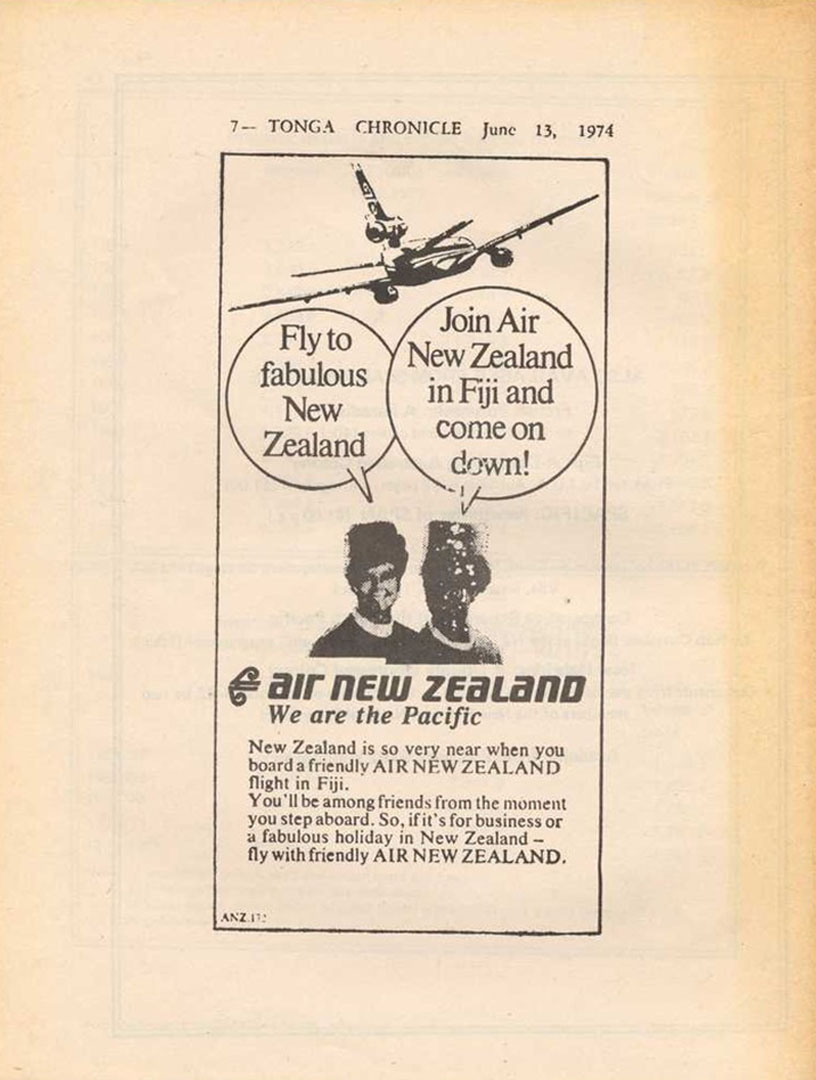
How Tonga Aids New Zealand: A Report on Migration and Education by Joris de Bres, South Pacific Action Network (SPAN), Wellington, July 1974. Electronic version created in 2005 by Victoria University of Wellington, NZETC.
In this 1974 report, Joris de Bres of the Citizens Association for Racial Equality (CARE) examined the immigration controversy involving Tongan workers in New Zealand. He discussed the historical background and current challenges, and proposed solutions to ensure fair treatment and the protection of the rights and freedoms of Tongan migrants.
This resource was digitised by the New Zealand Electronic Text Collection - Te Pūhikotuhi o Aotearoa (NZETC), curated by Victoria University of Wellington Library and now available as a web archive via the National Library of New Zealand. The site also offers digitised copies of the student newspaper Salient, which includes student commentary on the 1970s Dawn Raids.
How Tonga Aids New Zealand (New Zealand Electronic Text Collection)
New Zealand Electronic Text Collection
Amnesty Aroha submission
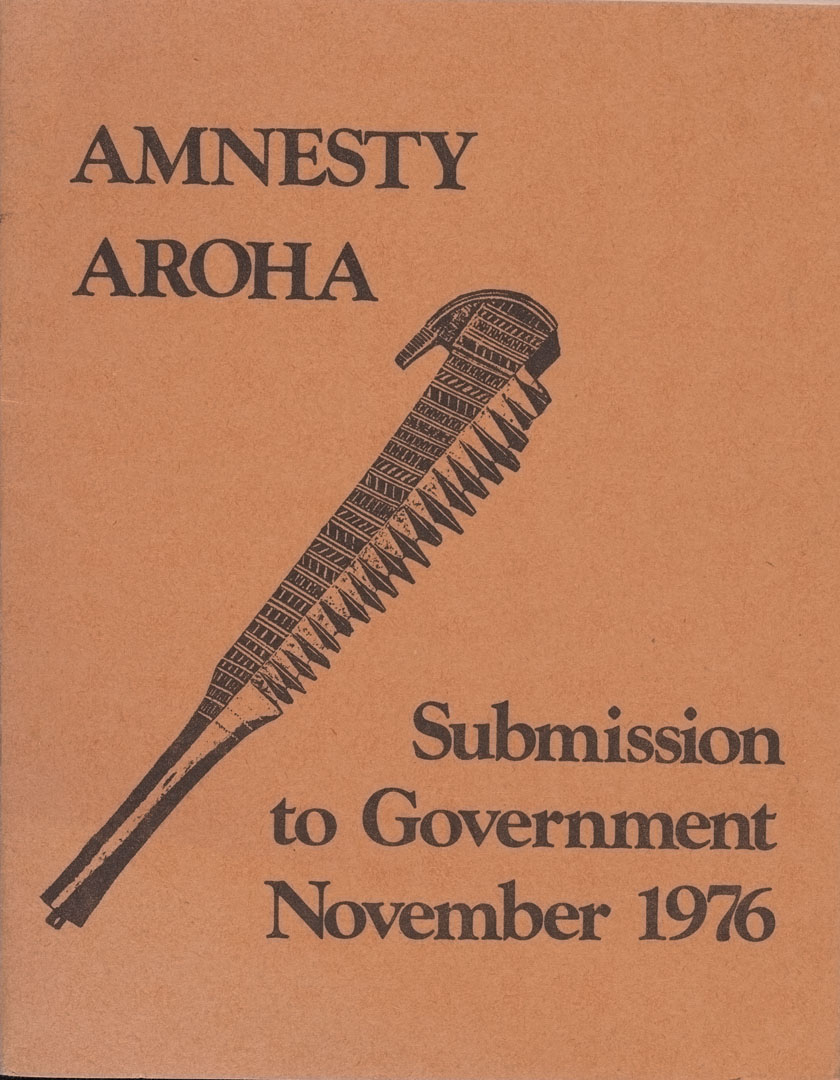
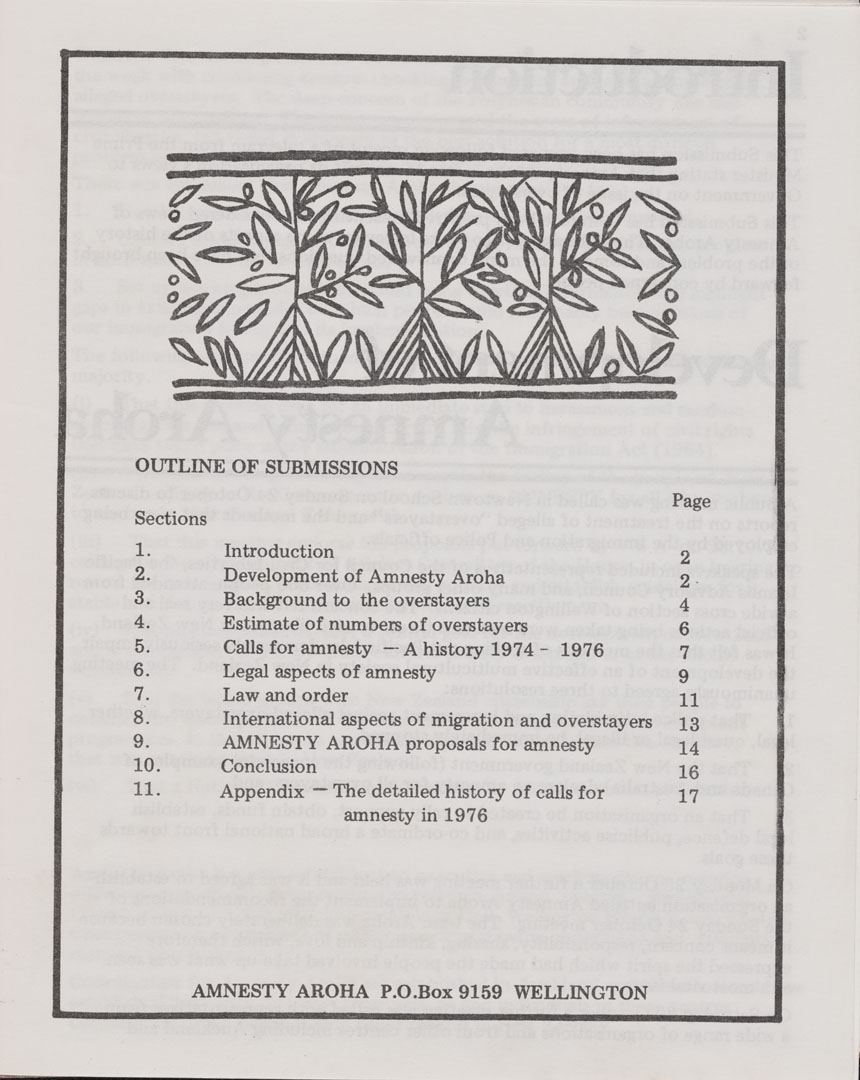
The human rights group Amnesty Aroha was set up after a public meeting on 24 October 1976 at Newtown School in Te Whanganui-a-Tara Wellington. More than 500 people attended this meeting to discuss the recent treatment of overstayers, in particular the methods used by immigration and police officers.
Soon after its establishment Amnesty Aroha was invited to submit a document to the government addressing the issue of overstayers. The 23-page submission helps illuminate the legalities and unresolved questions surrounding the issue. It advocates for the protection of civil liberties and fair treatment for all individuals in Aotearoa New Zealand.
A copy can be found at the Alexander Turnbull Library and through Archives New Zealand.
Material relating to Amnesty Aroha MS-Papers-12830 (National Library Catalogue)
Other digitised documents published by Amnesty Aroha at the Alexander Turnbull Library include:
Information sheet - Dawn raids, the ugly reality (Front page)
Information sheet - Dawn raids, the ugly reality (Reverse page)
Amnesty Aroha: They're neighbours, not criminals
The Overstayers: Illegal Migration from the Pacific to New Zealand
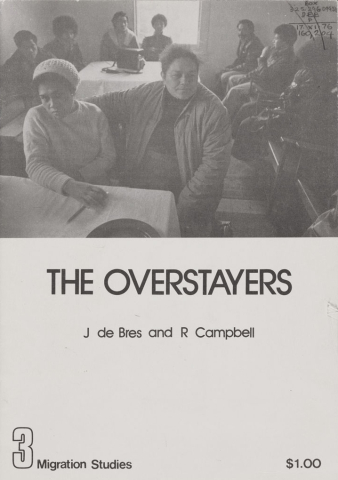
Exploring a range of perspectives, this publication sought to contextualise the overstayers issue within the global conversation on illegal migration. It offered a thought-provoking exploration of how attitudes and decisions about Pacific migrants shaped the social, legal and political landscape.
If you’re interested in understanding key underlying factors of this complex issue, this resource is a must-read.
The Overstayers (National Library copy)
Pacific Islanders’ Educational Resource Centre (PIERC)
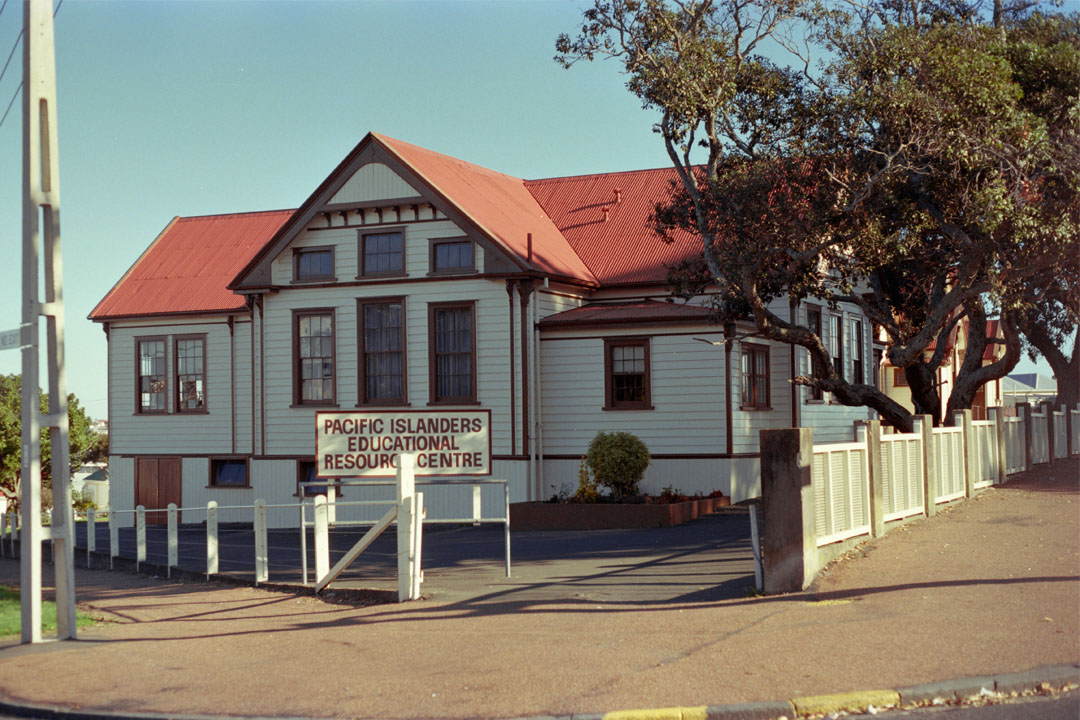
Explore at your local library resources created by the Pacific Islanders’ Educational Resource Centre (PIERC). Now known as the Centre for Pacific Languages, the centre was launched in 1978 under the leadership of Le Mamea Sefulu Ioane in partnership with the Department of Education (now the Ministry of Education).
Resources created from the late 1970s through the 1980s have a focus on adaptation and integration. Information in various formats such as picture cards, song and story books, educational handbooks and directories of information emphasise language acquisition and maintenance and social cohesion as they help Pacific migrants navigate a new way of life in Aotearoa New Zealand.
Handbook for teachers of Pacific Island children, Sefulu Ioane (Te Puna)
Museum collections
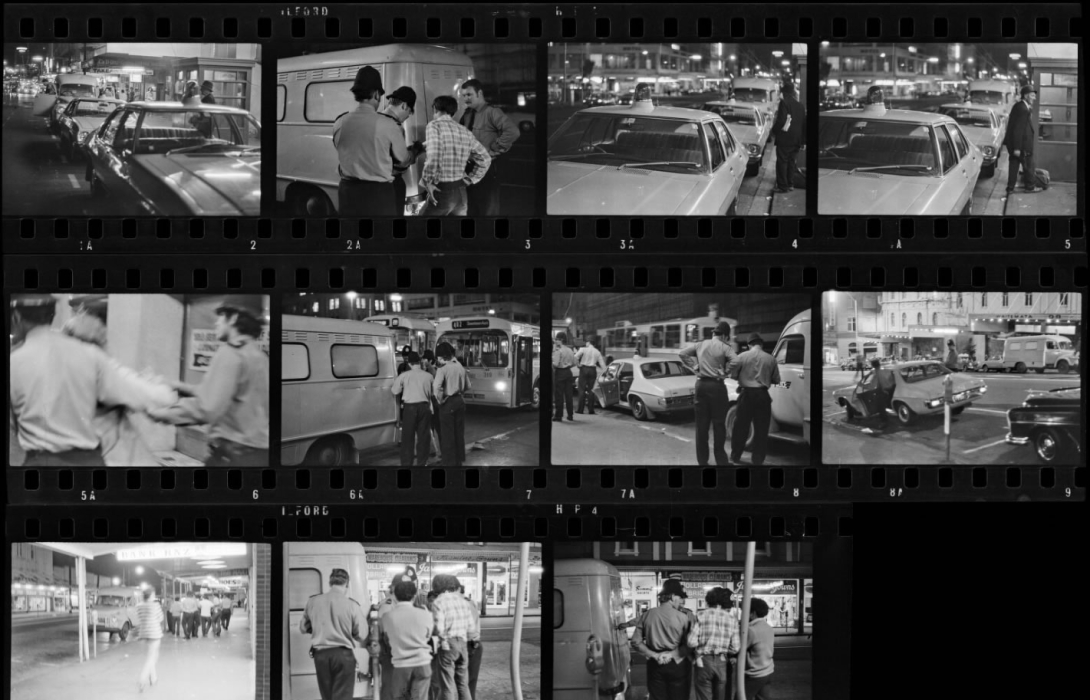
Museum collections provide archives of primary sources that deepen our understanding of history. Everyday items like T-shirts, lapel badges, and even an unassuming pen can become powerful manifestations of historical moments. Check out the links below for more information on these objects.
Dawn Raids in Aotearoa New Zealand (Te Papa Tongarewa Museum of New Zealand)
The pen that was used to highlight police racism | The Single Object | The Spinoff (Auckland Museum)
At the Break of Dawn (Dr Andrea Low, Auckland Museum)
Cartoons
Cartoons are visual narratives that offer compelling and often satirical reflections on the issues of the time. They serve as powerful tools for viewing historical events, providing unique perspectives and commentary.
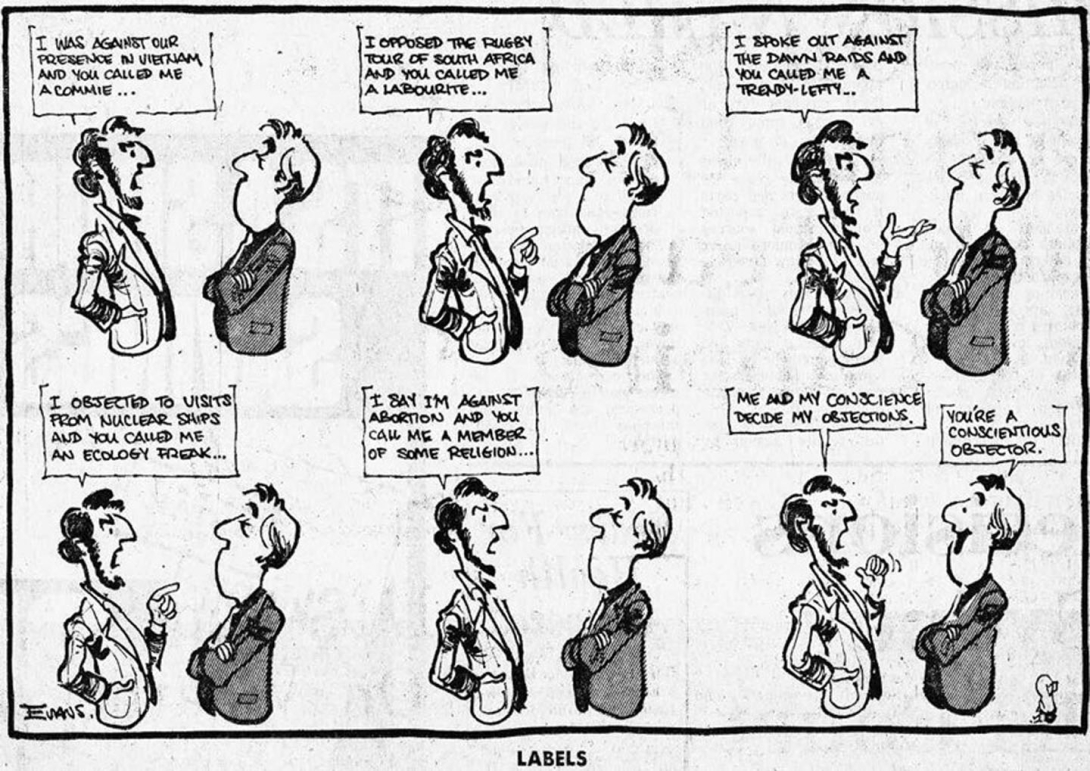
This cartoon places the Dawn Raids alongside other major issues of the time, such as the recently ended Vietnam War, apartheid in South Africa, and nuclear ship visits. It illustrates how people who spoke out on these matters were often labelled in ways that dismissed their views. Like other protests, criticism of the Dawn Raids was met with dismissive labels.
Other primary resources
Below you’ll find a list of additional primary resources related to the Dawn Raids and their broader historical context housed in various repositories and collections. These resources are listed in chronological order and will offer you valuable insights and primary materials to deepen your understanding of the Dawn Raids.
National Library of New Zealand
Topic Explorer page. National Library, Website.
Ephemera of Quarto Size, Relating to Polynesian Peoples and Culture in New Zealand and the Pacific. 1970-1974, Eph-B-POLYNESIAN-1970/1974, National Library of New Zealand.
‘Through the Eyes of the Islander’, Listener (Wellington, NZ). 25 Oct 1975, v.80.1873.16-17, National Library of New Zealand.
National Party 1975 General Election Policy. 1975, Eph-A-NZ-NATIONAL-1975, National Library of New Zealand.
1975 National Party Manifesto. 1975, PAM 329.9931 NEW 1975, National Library of New Zealand.
‘Barren Times for Race Relations: New Zealand's Campaign to Attract Wealthy Migrants is Having Painful Social Costs’, Time International (New Zealand edition). 17 May 1993, v.141 n.20.40-41, National Library of New Zealand.
‘6.30’s not dawn says official’, Auckland Star. 1976, National Library of New Zealand.
Ephemera of Quarto Size, Relating to Immigration to New Zealand, Problems and Issues of New Immigrants and Refugees. 1970-1999, National Library of New Zealand.
Alexander Turnbull Library
Newsletters and Other Material Relating to PPP Activism. ca. 1973-1974, 95-222-1/09, Alexander Turnbull Library.
University of Auckland (Manuscripts and Archives)
Papers Connected with Polynesian Immigrant Workers in New Zealand. 1974-1977, MSS. Archives. A-193. Series B, University of Auckland.
Te Papa Tongarewa Museum of New Zealand, Wellington
‘Immigration – Important Notice’. 1976, FE012416, Te Papa Tongarewa Museum of New Zealand.
Beret with Polynesian Panther Party Badge. 2022, FE013657, Te Papa Tongarewa Museum of New Zealand.
Listener (Wellington, NZ)
‘If You Don’t Like It Here Why Don’t You Go Home?’ 1976, vol. 84, no. 1928, pp. 14–16, Listener (Wellington, NZ).
National Library of Australia
‘When Visitors Are Not Welcome’, Pacific Islands Monthly. August 1991, N 919 PAC, National Library of Australia.
‘“Gestapo in our streets”, the Aucklanders cry’, Pacific Islands Monthly. 1976, National Library of Australia.
‘A Special Survey of NZ in the Pacific. NZ and the Islands: “United we stand, divided we fall...”, Pacific Islands Monthly. 1982, National Library of Australia.
‘NZ Immigration Scheme Strains Relations with Islands’, Pacific Islands Monthly. 1987, National Library of Australia.
‘Target: Illegal Immigrants’, Pacific Islands Monthly. 1988, National Library of Australia.
‘Western Samoa: The Last Waltz’, Pacific Islands Monthly. 1989, National Library of Australia.
‘Who Will Turn Out the Lights?’, Pacific Islands Monthly. 1989, National Library of Australia.