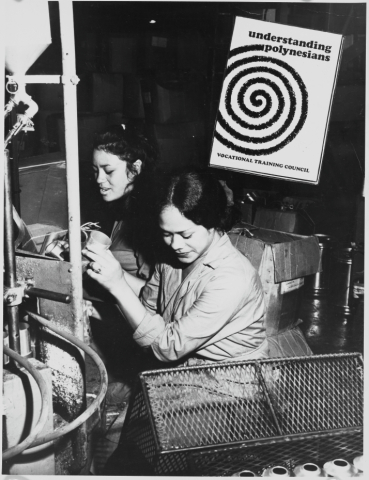
The title ‘Understanding Dawn Raids’ draws inspiration from Understanding Polynesians (1974) and Understanding Pakehas (1975), booklets produced by the government’s Vocational Guidance Council at a time of social tension and growing concern about race relations in Aotearoa.
These publications were intended to foster greater cross-cultural understanding during a period of significant demographic and social change.
In the introduction to Understanding Polynesians, written by the Council’s Polynesian Advisory Committee, the authors observed:
Improved race relations requires understanding and the acceptance of cultural differences...Awareness of cultural differences should lead to sensitivity and understanding, not to stereotyping based on blanket generalisations.
Produced in the social and political context of the 1970s, these publications reflect the concerns, language and approaches to cultural understanding of their time. They speak to a specific historical moment. More than 50 years on, they continue to resonate and reflect an enduring desire for meaningful exchange across cultures.
Walking backwards into the future
As part of the 2021 Government apology for the wrongs committed during the Dawn Raids era, Manatū Taonga has developed ‘Understanding Dawn Raids’ to support public understanding of this history. Central to this work is how we choose to understand and present the past. How history is framed matters.
Historians and staff from Manatū Taonga travelled across Aotearoa to meet with Pacific peoples. Community members generously shared their experiences and offered advice on how the Dawn Raids should be presented online. The site was developed with direct guidance from those communities including Tongan scholar Professor Hufanga Dr ‘Okusitino Māhina.
Professor Māhina describes history as a way of ‘walking backwards into the future’. From this perspective, the past and future are continually shaped in the present. We took this thinking to heart, as it reminds us that how we understand the past shapes how we act today and informs our responsibilities as state historians.
‘Understanding Dawn Raids’ presents this history through multiple perspectives, including lived experiences of the raids, close examination of the immigration enforcement practices, and consideration of their lasting impacts.
Acknowledgements
Manatū Taonga would like to acknowledge the many Pacific families and communities who generously shared their time, knowledge, and experiences for this project.
We extend our particular thanks to our project navigators and community partners:
The Family Centre, Lagi-Maama Academy & Consultancy, and Tohoa (Mahmah) Tetini.
We also acknowledge designer Noelle Moa of Ulaandherbrothers for her contribution to the project.