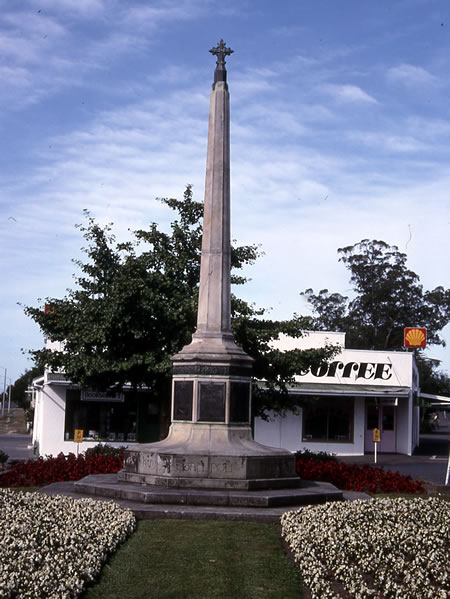
Havelock North war memorial c1986.


Havelock North war memorial, 2010.
The Havelock North War Memorial is a Cross of Sacrifice dedicated on Armistice Day 11 November 1924 during a service presided by Mason Chambers, Chairperson of the War Memorial Committee. The dedication was led by Reverend R. Waugh with an address from Mr W.A.G. Penlington who said:
To ensure the memory of our men who died in the war no monuments are needed. We have placed this monument here, not for any fear that otherwise they might be forgotten, but because we must make an expression of those feelings with which they have filled us.
For they put aside all interests of self. They left their possessions and those most dear to them. They endured great hardships and faced many perils. They stood steadfast. And finally, they gave the greatest thing they could. Their achievement was the noblest possible to man—they laid down their lives for their friends.
The money to pay for the memorial was raised through public subscription by the Hawke’s Bay Fallen Soldiers’ Memorial Committee, which also raised money for the Hastings Cenotaph dedicated on Armistice Day 1923, and the Hawke’s Bay Fallen Soldiers’ Memorial Hospital opened on Anzac Day 1928. The land for the memorial was gifted in 1922 by Mr. C. Ellison of Ellison & Duncan and it is designated a Memorial Reserve.
The Havelock North Town Board decided that the memorial would be chosen through a design competition managed by the New Zealand Institute of Architects. The competition was opened in November 1922, and 15 entries were received and judged by prominent architect William Gummer. The winning design was by Keith Draffin, of Auckland, whose octagonal plan suits the triangular Memorial Reserve, strongly fulfilling the ‘conditions of the competition’ to place emphasis on the peculiarly English village of Havelock North.
Raised on three steps the octagon base has four bronze panels, three of which hold the names of those whose memory it is desired to honour and preserve, the fourth being used for the purpose of dedicatory inscription.
Above is a symbolical garland of Rose, Oak, Laurel, and Fern modelled and cast in bronze. The Rose to signify that the Cross is erected for love. The Oak for valour, the Laurel for victory and the Fern intertwining and associating Hawke’s Bay and New Zealand with the offering and the feelings which have inspired it.
The monument is built of grey Hawkesbury River (Sydney) sandstone in a very graceful structure of Gothic design, capped by a small Cross of Sacrifice, and stands 7.4 metres from the ground, on octagonal steps, the lowest being of concrete, the next of stone.
Around the base of the monument is cut lettering for:
First World War Campaigns: GALLIPOLI / EGYPT / PALESTINE / FRANCE
Second World War Services: ARMY / AIR FORCE / MERCHANT NAVY / NAVY
The WWI Dedication Plaque:
TO / OUR MEN / WHO DIED / AD / 1914-1919
The WWII Dedication Plaque:
IN / REVERED MEMORY / OF / THOSE WHO FELL / IN WORLD WAR II / 1939-1945 / “COURAGE MOUNTEH / WITH OCCASION”
The bronze bas-relief of Rose, Oak, Laurel and Fern wrapped around the cornice relief are sculpted by Richard Gross CMG who also sculpted the Clive Soldier statue of Coromandel granite.
The bronze plaques attached to the eight-sided die are also forged by Richard Gross. These plaques carry the dedication inscription and Roll of Honour for the First and Second World Wars. The raised lettering is in Gothic Revival Serif font complementing the overall Gothic aesthetic of the memorial.
In 1926 a low-level concrete wall with pillars holding iron pipe rails, and an iron gate was installed to provide for planting a garden and to protect it from wandering stock. The responsibility for planting and caring for gardens was voluntarily taken up by the Havelock North Girl Guides.
In 1924 Keith Draffin faced challenges procuring one stone large enough to fashion the memorial. Instead, it is constructed from multiple sandstone blocks with a concrete core, three-part pillar, and cross, stacked and held together with pipe dowel and lead strips. This constructed method was tested during the 1931 Hawke’s Bay Earthquake with upper part of the pillar being toppled.
The memorial was reconstructed in May 1932 with a steel rod inserted through the core of the monument for strengthening. The work was completed by the Zara Flooring Co. of Hastings.
Following the Second World War the people of Havelock North decided their preference for a symbolic over a utilitarian memorial and in November 1946 the War Memorial Committee approached Keith Draffin to consider how best symbolic remembrance of Second World War could be added into the existing memorial area.
Draffin’s design response to the Committee starts by saying:
In considering a war memorial design, a basic consideration should be not only to create a piece of symbolism but also to ensure its significance and meaning will be appreciated by and stir a memory and reverence in the mass of the people whose kinfolk it honours.
For this reason, as well as for reasons of symmetry and design, it is submitted that the site of the memorial to commemorate the second world war should be close to and part of the existing memorial erected after the 1914-18 war.
He then proposed a new memorial wall enclosing the north side of the Memorial Reserve with landscaping to frame a ceremonial approach from the southern tip of the Reserve. The design was accepted by the War Memorial Committee in March 1947 however alterations were required to bring the project within achievable fundraising capacity. A finalised plan was agreed in 1950 which was for the memorial to be repaired, a new cross erected, and four new plaques and landscaping only.
The new memorial was dedicated and unveiled at 10:15am on Armistice Day 11 November 1951. The dedication was performed Rev. Canon S. Waymouth and Mr Charles Fergusson, representing the Air Force, unveiled the new plaques. Mr Fergusson was shot down over Burma while serving with the Royal Air Force and was not heard of for almost three years but at the end of the Second World War emerged after being a prisoner-of-war of the Japanese. Representing the Navy was Dr A.W. Reeves and representing the Army was Mr N. Tucker.
Sources
Daily Telegraph (Napier), Volume 54, Issue 236, 5 November 1924, Page 8
Hawke's Bay Tribune, Volume XIV, Issue 284, 11 November 1924, Page 5
‘Havelock North, From Village to Borough 1860-1952,’ Grant, S.W., 1978, Herald Tribune Print, Hastings, pg.78.
Daily Telegraph (Napier), Volume 52, Issue 110, 13 June 1922, Page 5
Daily Telegraph (Napier), Volume 52, Issue 245, 18 November 1922, Page 5
Daily Telegraph (Napier), Volume 55, Issue 6, 7 February 1925, Page 8
Hawke's Bay Tribune, Volume XV, Issue 163, 9 October 1925, Page 6
Hawke's Bay Tribune, Volume XIV, Issue 202, 4 August 1924, Page 4
Daily Telegraph (Napier), Volume 62, Issue 93, 21 May 1932, Page 8
Hawke's Bay Herald-Tribune, Volume 90, Issue 154, 22 March 1947, Page 8
Hawke’s Bay Herald-Tribune, Monday 12 November 1951, Page 5
Top image: Jock Phillips and Chris Maclean c1986. Other images: Glennis Austin, 2010
Text: Hastings District Council, 2026
Find out more about the people listed on this memorial from Auckland Museum's Cenotaph database