This post first appeared as a Note on the NZ History Facebook page. It was published by Kate Jordan in 2018.
Last year I couldn’t vote on election day itself and this saddened me greatly. Having lived overseas for several years, I was looking forward to strolling down to the local school and casting my vote, while being grateful for the ease with which New Zealanders can do so.
A friend suggested I vote on 19 September, the anniversary of women’s suffrage. Yes! I thought. I shall follow in the path of the suffragettes – no wait, suffragists? Suffragettes? What was the difference? What does suffrage even mean?
Suffrage is the right to vote or the exercise of that right. The difference between suffragist and suffragette is a bit more complicated and interesting.
In New Zealand, the women (and occasionally men) who campaigned for women’s suffrage were suffragists. The campaign, while long, hard and fraught with setbacks, consisted mainly of constitutional tactics, such as lobbying and petitions. Eventually these were successful and New Zealand women gained the vote in 1893.
In Britain, the efforts of the suffrage movement were unsuccessful for many years. In 1903, a group of British suffragists, the Women’s Social and Political Union (WSPU), began using more militant methods to advance their cause. Their tactics included disrupting politicians’ speeches, chaining themselves to railings, setting fire to buildings, and breaking windows.
To distinguish between the more constitutional suffragists and this new breed of protest, the Daily Mail dubbed them ‘suffragettes’, using the French diminutive ‘ette’ to belittle the movement. Just as a ‘kitchenette’ is less than a ‘kitchen’, a suffragette was less than suffragist. In an early satirical article on suffragettes, a young woman gets involved with the protests simply because she is bored. She ends up in jail, weeping hysterically, and when she finally gets home, she declares, ‘If some one would start an Anti-Woman Suffrage League to-morrow I would join it; but I dare say it isn’t necessary’.
The article shows all of the characteristics of the Daily Mail’s treatment of the suffrage movement: belittling, downplaying any chance of success, and making women out to be silly and frivolous. Everything the term ‘suffragette’ was meant to convey.
The WSPU and their supporters, however, took this name and made it their own. They even named their newsletter The Suffragette and within that publication jokingly explained the difference:
We have all heard of the girl who asked what was the difference between a Suffragist and a Suffragette, as she pronounced it, and the answer made to her that the ‘Suffragist just wants the vote, while the Suffragette means to get it.’
While the suffragettes never really came to New Zealand, New Zealand went to the suffragettes. Anna Stout, a prominent suffragist in New Zealand, travelled to Britain in 1909 to visit her sons and as a respite for her husband’s health. She immersed herself in the votes for women movement. Having lived with universal suffrage for 17 years, Anna provided a first-hand account and statistical evidence of the benefits of women having the vote.
Anna declared herself a suffragette after seeing the poor treatment of women petitioners by police. She continued to work with the WSPU and marched at the head of the New Zealand contingent in a 10,000-strong march in London in 1910.

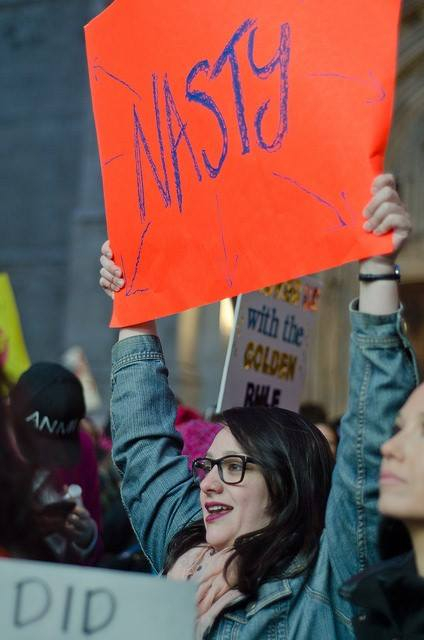
Echoes of the suffragette movement can be seen today, especially in the adoption of terms meant as insults. In 2016, during a presidential debate, Donald Trump interrupted Hillary Clinton to remark ‘Such a nasty woman’. Women across America adopted the phrase, proudly calling themselves nasty women, a tactic similar to the reinterpretation of and self-identification with ‘suffragette’.
New Zealand’s connections with overseas feminist movements also continue. The need and willingness to use violence to make a point, however, is hopefully a thing of the past.
Text: Kate Jordan, 2018.
Image: Melissa Segal (Flickr)