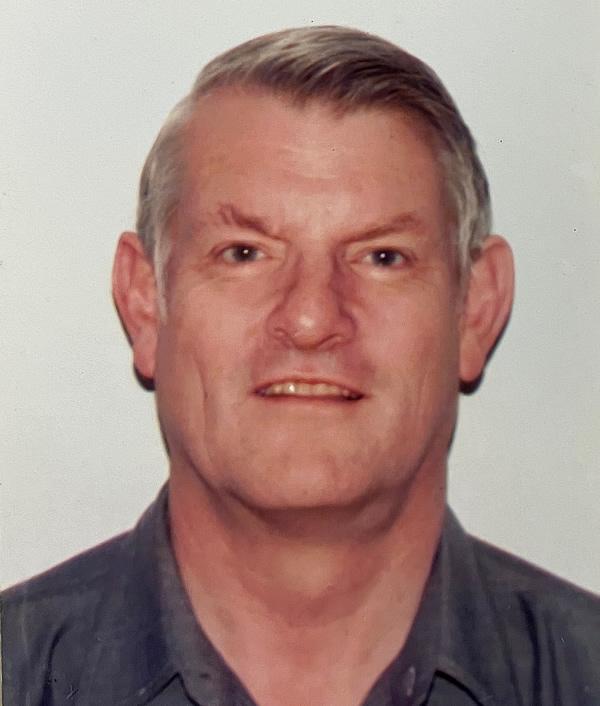
Sherwood Young was based at Police Operation Overdue HQ, Police National Headquarters, Wellington for its duration from November-December 1979. He subsequently served as the Police Commissioner's Protocol Officer where he was involved in the work to have the New Zealand Special Service Medal (Erebus) produced. This award recognised 'the service of those New Zealanders, and citizens of the United States of America and other countries, who were involved with the extremely difficult and very unpleasant, hazardous, and extreme circumstances associated with the body recovery, crash investigation and victim identification phases of Operation Overdue'.
In 1979, I was an Inspector in Police National Headquarters in Wellington. It was nearing the end of the day on Wednesday 28 November when Chief Superintendent Brian Davies told me that I was to be part of a small team to set up a co-ordination centre in Police Headquarters as an Air New Zealand flight to Antarctica was overdue and had probably crashed. We set up a room for this work and were informed that the plane's wreckage had been sighted on Mount Erebus, near Scott Base at McMurdo Sound. There were hundreds of sightseers on board, who had all apparently been killed.
Police Commissioner Bob Walton and senior staff quickly activated this co-ordination centre at Police Headquarters in Wellington. Chief Superintendent Brian Davies, Director, Operations, was given command of the centre. His was a unique role, with widely dispersed operational points established in Antarctica, Christchurch, Wellington HQ, and Auckland.

The centre was staffed around the clock and undertook a wide range of complex tasks. Davies managed the day shift from 8am to 7pm with Superintendent Bob Silk leading the night shift. I was detailed to liaise with the Embassies of the overseas passengers, and to manage international calls relating to the accident. I recall receiving a call from Walter Sollberger, the Chargé d’affaires of Switzerland, asking about Swiss nationals on board. I told him we could not confirm anything at that stage, and for him to give me his contact number so I could advise him when we knew anything more. Undeterred, he said he would come in to see me. Shortly afterwards he arrived with a sleeping bag. When I said I still couldn't help him he said he would go to the corner of the room and sleep and for me to wake him when I knew something. Eventually I was able to confirm Jürg Meier, aged 23, had been killed on the plane, and he left to advise of his death. [1]
The work at the Operations HQ lasted until Saturday 15 December 1979. Tasks included a range of liaison and coordination of various ‘moving parts’ as well as arranging for the Police and Mountain Rescue personnel to go to Antarctica, for a mortuary to be set up in Auckland, and for the bodies to be flown there. This involved a lot of international co-operation. In the end 257 people were confirmed as having perished in this tragedy, codenamed Operation Overdue.
Two Police leaders, Inspector Bob Mitchell, based in Antarctica, and Chief Inspector Jim Morgan, at the mortuary, were awarded MBEs by the Queen for their efforts in 1981. Over time many others involved in Operation Overdue were recognised for their service. [2]
This whole event was to become most controversial, regarding the actions of the airline leadership and the government in the aftermath of the crash.
28 November 2006
Tuesday 28 November 2006 was a wonderful day. The Commissioner of Police, Howard Broad, Assistant Commissioner Jon White and I went to the office of the Minister of Police, Annette King. We were joined by Inspector Alastair (Roly) Williams, of Jon White's Overseas Deployments staff, and Inspector Greg Gilpin. Greg was a key member of the Disaster Victim Identification (DVI) Squad, who had led the body recovery on Erebus as a Sergeant. We all then went to the office of the Prime Minister, Helen Clark. With her were the Deputy Prime Minister, Dr Michael Cullen, and Phil Goff, the Minister of Defence. The Prime Minister officially announced the launching of a Special Service Medal for Erebus, something people had been agitating for over the preceding 27 years. She then presented Greg Gilpin with the very first Medal, but told him she would keep it in the interim, so he could officially receive it on a formal public occasion, with his family present. [3]
Following this meeting we joined the Prime Minister and Ministers Cullen and Goff to celebrate 25 years since they had all been elected to Parliament on this day in 1981. Another remarkable coincidence. This was a very memorable occasion indeed. And the cake tasted good.
Identifying and locating eligible recipients for this medal was going to be a huge task with potential recipients living here and in many other parts of the world. On Monday 4 December 2006, I went to Assistant Commissioner Peter Marshall's office to brief him on the full situation regarding this medal. The efforts to trace all of those eligible for this medal went on into the late 2010s, more than a decade into the future. Some of those eligible had since died, others had changed their names – you name it, it had happened – in the years that had elapsed since the crash. An entire generation had passed.
New Zealand Special Service Medal (Erebus)
On Thursday 22 March 2007, at a ceremony in the Grand Hall at Parliament, the first 22 recipients were presented with their medals by the Minister of Police, Annette King. Eleven of the recipients that day were police members – four received them for their work in Antarctica and seven for their efforts in the Auckland mortuary. The 11 other recipients that day included members of the New Zealand Defence Force, the Office of Air Accident Investigations, the New Zealand Airline Pilots' Association, Face Rescue, the NZ Antarctic Research Programme’s Hugh Logan, who was one of the three New Zealand mountaineers who confirmed there were no survivors of the crash, and one of eight Federated Mountain Club volunteers who helped recover bodies, the New Zealand Funeral Directors' Association, a mortuary technician, a forensic dentist and a forensic pathologist. Paul Cavanagh from the New Zealand Press Association was one of the three media representatives sent to the ice to cover the story. This lineup demonstrated just how widely diverse the roles of further recipients would be. [4]
At this ceremony I had the real pleasure of taking photographs of Inspectors Greg Gilpin and Stuart Leighton and Sergeant Mark Penn with Philippa Collins, the daughter of the aircraft's pilot, Captain Jim Collins. Captain Collins had been let down badly by the airline as he had been supplied with incorrect co-ordinates when setting his course for the flight south. This error had sent them all to their deaths.
Additional presentations were held in Christchurch on Friday 30 March, Wellington on Thursday 5 April, and in Auckland on Sunday 27 May.
Sherwood Young, MBE, MA (Hons), Dip Pers Mgmt.
Chief Inspector of Police (Rtd).
Notes
- There were also two other Swiss-born passengers who were living in New Zealand at the time of the accident, Heinz Bürgi and Urs Locher.
- Within months of the disaster the New Zealand Police presented certificates of appreciation to some of the people who had assisted in Operation Overdue. In March 1982, the New Zealand Police commended 10 sworn police officers and non-sworn civilian staff members for their outstanding services during Operation Overdue.
Further recognition finally came in November 2006 with the institution of the New Zealand Special Service Medal (Erebus) ‘to recognise the service of those New Zealanders, and citizens of the United States of America and other countries, who were involved with the extremely difficult and very unpleasant, hazardous, and extreme circumstances associated with the body recovery, crash investigation and victim identification phases of Operation Overdue'. In June 2009 a ceremony was held in Washington, DC at which medals were conferred on 13 Americans involved in the recovery operation, mostly US Navy personnel. Eventually, several hundred New Zealanders and about 40 US citizens were eligible for the medal. - Erebus Special Services Medal to be awarded, official government press release, (29 November 2006)
- Presentation of NZ Special Service Medal (Erebus), official government press release, including names of the first recipients (23 March, 2007).
Note: the memory on this page is in the writer's own words and does not necessarily reflect the views of Manatū Taonga.
Images and text cannot be reused without permission.
Read more memories like this: Reflections on Erebus series.
See also, Operation overdue and passengers and crew from Flight TE901 (Manatū Taonga)
Images and text: Sherwood Young
