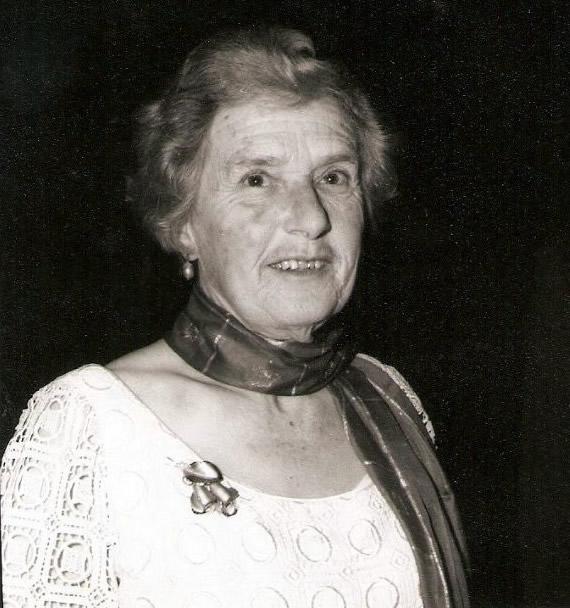
Doug Gibbs shares his memories of the night of the Erebus accident on 28 November 1979. This piece was first written in March 2020 and was revised January 2025.
The evening of 28 November 1979 is firmly etched in my memory. It was our son Tony’s second birthday. We had the kindergarten teachers of his sisters, Kelly, and Shannon, over for dinner at our home in Karori. My wife Joan answered a phone call from a cousin who suggested we should listen to the news. So, interrupting dinner, we heard the news that Air New Zealand flight TE901 from Auckland, on which my mother (Brucie or Bryn, as she was known to her friends) was flying for a sightseeing trip to the Antarctic, was missing. That is to say, there had been no radio contact for quite a while. The poor kindergarten teachers didn't know what to say or do. I guess my reaction was ‘she'll be right, just some technical communication hitch’, and we would just keep up with the news over the evening. It was quite a long evening tuning into the radio's hourly news bulletins. At some stage I rang Ross McWilliams, a cousin and Air New Zealand pilot who had done the flight previously, but he had no new information to give me.
I think at about midnight when there was still no news of contact or location, there was the realisation that the plane had to be down as it would have run out of fuel. I said a little prayer, hoping it had all been a sudden big bang and Mum wasn't lying injured and in pain in the snow or icy water struggling to stay afloat. I think this probably gave me some peace and an acceptance of Mum’s death. I remember in the morning saying to Joan that in a way it was a blessing because Dad had died about a year earlier, and Mum was feeling a little lonely and didn't want to be a burden to anyone. So, if, as it turned out, her death was an instantaneous big bang without any anticipation of the event, then for her, that was OK. Sure, our children then aged from two to five, would miss out on a lovely lady and we would miss enjoying her interaction with them. I often wondered what others thought when expressing my opinion. I found support in the reaction of a long-time friend of Joan’s family when she described it as being ‘a very pragmatic approach’.
And so the long wait began as an investigation and speculation as to ‘why’ began and a recovery operation was started on the slopes of Mt Erebus. We had a visit from the police who wanted to get samples of hair and finger prints from her home. The vicar of her church in Kelburn suggested having a memorial service before Christmas as a sort of closure, especially if no body was recovered, which we did. Over the Christmas and New Year holidays we joined Joan’s family at their bach at Motuoapa Bay, Taupō, where we were again visited by the police. They arrived with a piece of material cut from her clothes and a couple of her rings as aids in confirming her identity. So, we did get her back and had a small funeral, again in Kelburn. Apart from her rings we also got her library card, a Victoria University Women membership card and a $10 note, all smelling of aviation fuel!
On her bus trip (over a couple of days) to Auckland to catch the flight, Mum caught up with several of her siblings and their families. I remember one said afterwards that it seemed as if she was saying good bye. An unusual observation, a bit like my own, when we put her on the bus in the early hours of the morning in Wellington, with our kids in their pyjamas. ‘Good bye’ she said as she climbed aboard. I said, ‘It's not good bye just au-revoir!’’ Now why did I say that, and why did I briefly think of buying some travel insurance for her?
Mum had a warm, relaxed personality, full of fun and a great zest for life. Besides her garden, she enjoyed exercise/dance classes, the arts and had been active in the Play Centre movement.
Family was important to Mum too, and our rich family bonds were developed over many holidays on her siblings’ farms. She was fondly loved and well respected for her modern outlook on life, particularly by her nieces, for whom she could be a neutral sounding board as they grew up. This applied especially to my half-brother’s daughter, Dianne, for whom the loss of the wisdom and love of a grandparent has been a continuing sadness.
What took this woman, brought up as the sixth child in a family of eight on her Deroles' family hill country farm near the remote village of Rangiwahia, on this trip? I guess marriage to my father Gordon Gibbs took her away from a quiet rural back-country life to a city life, and overseas travel. This included living in the USA for around three years in the late 1930s, followed by six years in the Falkland Islands (1940–46), where my agriculturalist father, seconded from the DSIR, worked as the Director of the Department of Agriculture.
Though widowed in 1978 Mum’s interest in travel and new things was still strong. After talking with friends from an earlier Antarctic flight, and with her Falkland Islands experiences, her curiosity about the Antarctic must have been aroused. Her arranging this new adventure was unsurprising.
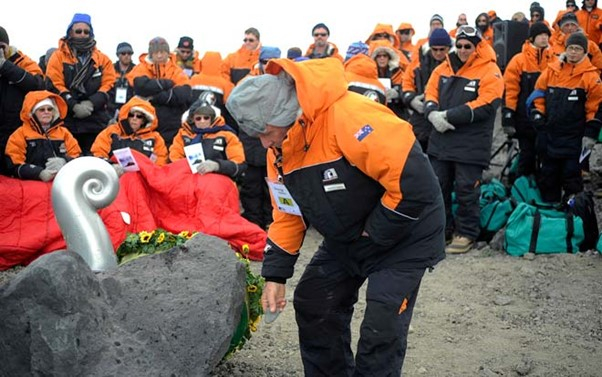
In February 2011, I was fortunate enough to be among a group of around 100 family members of those killed in the Erebus accident to take part in a special flight to Antarctica. (1) Our Royal New Zealand Air Force Boeing 757 flew around Erebus, but we were too high to identify the actual crash site, which was a disappointment for me. Nevertheless, the flight was quite an experience visually.
My lasting impression after we landed near Scott Base was the silence. A clear day and no wind, just as it should have been all those years ago. A memorial stone was unveiled at New Zealand's Scott Base that day under which I tossed a small stone from Christchurch, having forgotten one I had specifically collected from the Rangitikei River in the area near my mother’s childhood home.
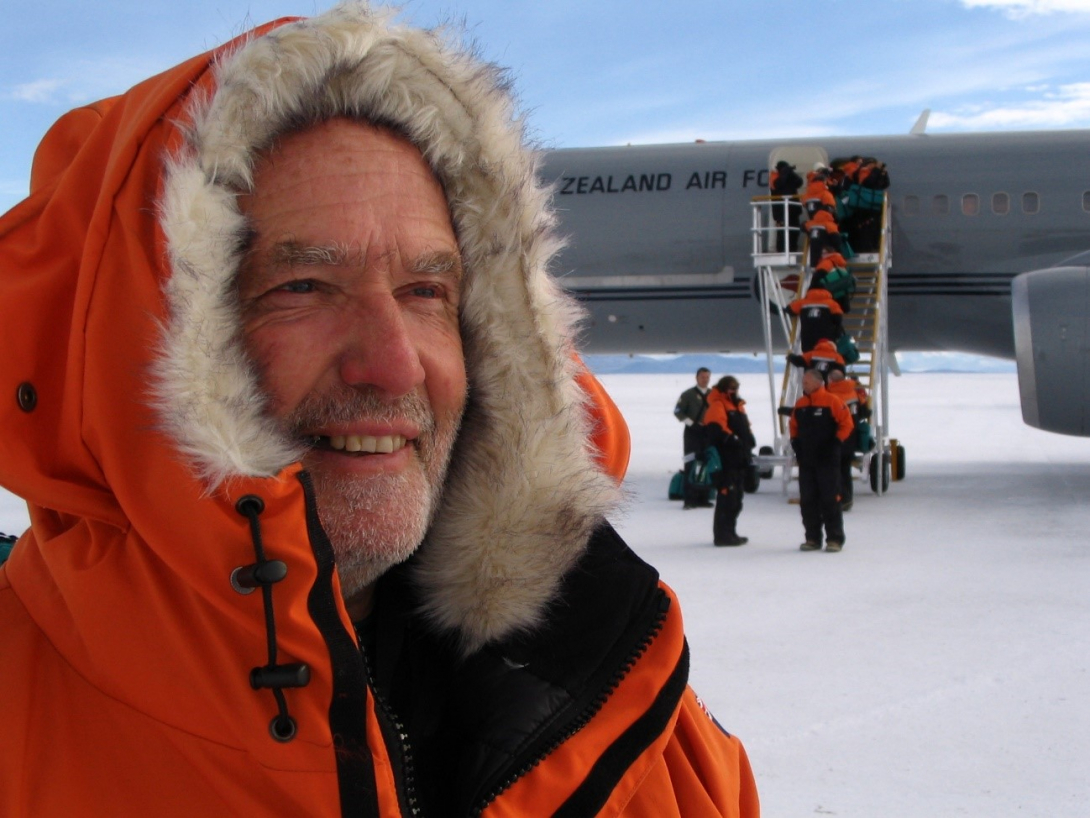
We were met by staff from America's McMurdo Station with their large Snow Cat vehicles to transport us across the ice to Scott Base. Our cat's driver, ‘Shuttle Bob’ (Bob Lewis), was a delight to meet, wonderfully sympathetic, and entertaining on the drive across the ice. When we were leaving, Bob took a great photo of me with the plane in the background. I sent him a thank you email both for the photo and his personality. His reply, I think, gives some insight into the thoughts of those on the other side of the trip, and with his sentimental-philosophical comments I found it quite moving:
‘Forgiveness, well sometimes it seems humanly impossible and painful. But without forgiveness the ability to love is stifled and hindered. If the purpose of this life is to love and appreciate ourselves and share that love with others, then it makes sense to endure the pain that forgiving yourself or someone else might bring to you and grow in love. Remember you may be ready to ask for forgiveness, but the other person may not be ready to forgive you, or they may never be ready or willing to. All things to their time. Have courage, forgive and accept whatever is shown to you. Love your life and share it with others. (Bob Lewis)
Looking back at the time, I didn't feel any ill will towards the pilot or Air New Zealand, especially after the formal apologies of the government and Air New Zealand during the 4oth Anniversary Commemoration in Auckland, November 2019. Reading Paul Holmes’ Daughters of Erebus, I understand how this dreadful, needless accident occurred, and that it was not the result of pilot error. Bob Lewis later told me via email how ‘there is beauty in forgiveness and to make yourself beautiful. When you are ready to die make sure that there is no love left unsaid to those you love. Say it now and say it often.’
Note: the memory on this page is in the writer's own words and does not necessarily reflect the views of Manatū Taonga.
Images and text must not be reused without permission.
Read more memories like this: Reflections on Erebus series.
See also, passengers and crew from Flight TE901 (Manatū Taonga)
Private collection
