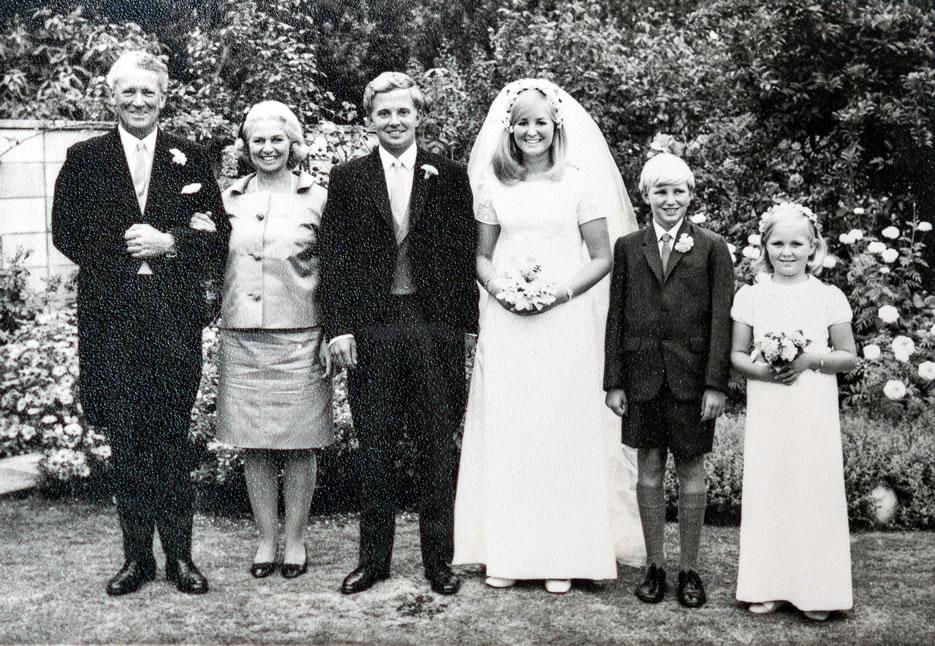
Michael’s parents, Malyon and Marjorie Allan, were on flight TE901, as was his younger sister, Jane. Malyon, a former naval office, taught geography at William Colenso College in Napier, where Michael had previously attended and Jane a current student. Flight TE901 would have a profound impact on not only the Allan family, but their close circle of friends and wider Hawke’s Bay community.

Malyon Allan was born in Auckland. He joined the Royal Navy in England as a Special Entry Cadet at the age of 18, in 1938, just prior to the Second World War. He returned to New Zealand in 1948 for approximately two years serving as First Lieutenant of HMNZS Kiwi. He returned for further service in England. After several years at sea after the war, he lectured at Greenwich Naval College before moving into the Intelligence section of the Cabinet Office in London. He attained the rank of Commander. Because of all these moves, David was born in England in 1947, Sally was born in New Zealand in 1949, and I was born in England in 1959. Jane was born after we returned permanently to New Zealand. He returned to New Zealand on loan from the Royal Navy in 1961 to be Training Commander at HMNZS Philomel in Auckland. He retired from the navy in 1963 and became a teacher in Hawkes Bay. Peter Mulgrew, who provided the onboard commentary for flight TE901 had attended Malyon’s lectures at Greenwich while serving in the Royal New Zealand Navy.
As a geographer, my father was fascinated with maps and charts. He had a sense of adventure and saw Antarctica as the “last frontier”. His enthusiasm for the flight to Antarctica rubbed off on Charlie Jennings, his colleague and Head of Geography at Colenso, who was also on the flight. Charlie had been my geography teacher at Colenso in the 7th form, two years before Erebus. Our close family friends Jan and Bill Williams and Bill’s sister, Jan, were also on board the flight.
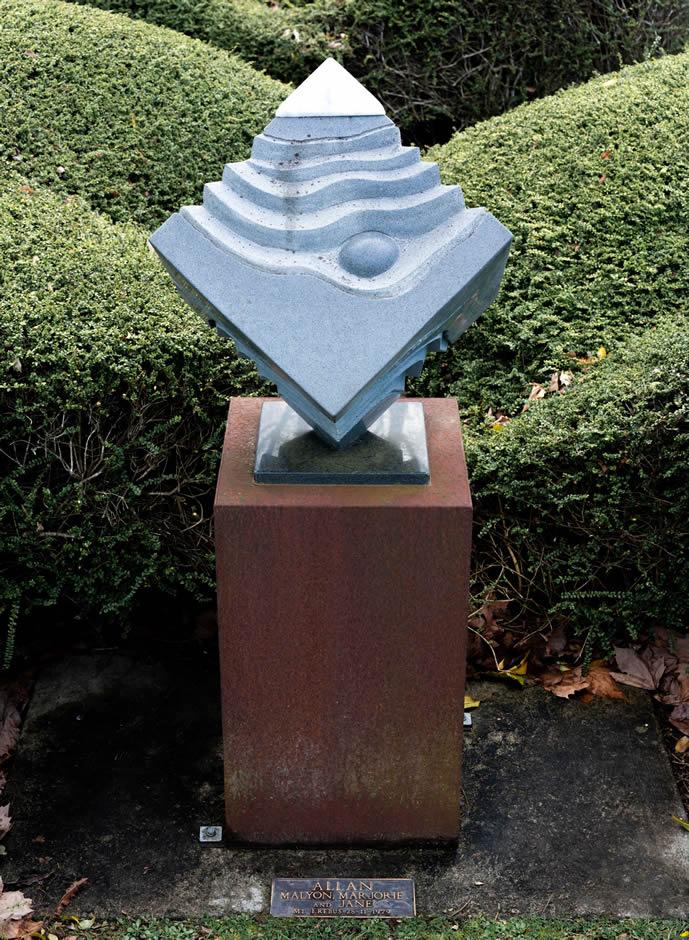
Allan family memorial
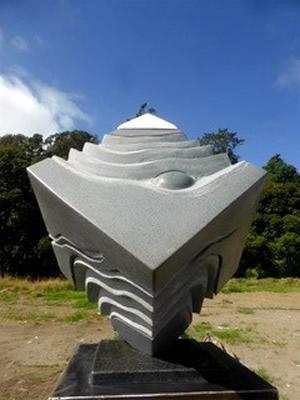
Sculpted by Renate Verbrugge, the memorial was commissioned in late 2015 and completed in February 2016. It replaced a mulberry tree that had been planted as a memorial but after some years had died. It was decided that it was time for something more permanent.
The wavy lines/ridges are very like the pressure ridges of ice near Scott Base where the sea ice converges with the permanent ice. There are three small round mounds on three faces of the sculpture, to represent each of the three family members lost. The Carrera marble depicts the icy environment where they were lost.
My family had already experienced loss from an air accident. In 1940, my grandfather, Squadron Leader David Allan, a flying instructor, fell 850 metres to the ground from a Tiger Moth flying near Māngere aerodrome. His harness had failed when his student did a roll.
I had just finished a less than successful second year at Victoria University in Wellington when Erebus happened. As a 20-year-old I was considering my next steps. When the accident happened, I just tried to get through it all, but it was different for my brother David. He was older than me, married with kids. As the eldest, I think David felt a sense of injustice that had to be righted. David was incensed by the lack of sensitivity shown to the families of those who died. The behaviour of the government of the time and Air New Zealand was totally untasteful. It had a terrible impact on families who seemed to have to fight for everything. It had a terrible impact on my sister’s marriage, which fell apart.
David and his family moved from Auckland back to the family home, Farndon, at Clive in Hawke’s Bay. A plaque and a small mulberry tree was placed in the garden at Farndon as a memorial to my parents and sister. With the compensation I received I purchased the fishing cottage my parents had at Kinloch on the shores of Lake Taupō. In acknowledgement of them a pier light on the jetty was dedicated to them. I eventually sold the lodge.
I became a winemaker, which I did for 30 years. I would travel overseas for about two months of the year running wine tasting events and marketing. I was in New York the day of 9/11 in 2001. I saw both planes hit the twin towers. I know what a plane looks like when it crashes at speed, and the noise. It’s not pretty.
I remember later running a wine tasting in a pub in the west of Ireland. There was a memorial to a number of New York firefighters who had died in 9/11. A lot of New York firefighters were of Irish descent, and this was how their homeland acknowledged their loss. I couldn’t help but compare this with how we treated those involved in Operation Overdue.
This is the first time I have really talked to anyone about Erebus. I know that the “blame game” that followed the accident numbed people. People overlooked what had actually happened and its impact on the families. My brother David has his own way of dealing with Erebus and I support his fight for a national memorial. I share my brother’s view that Erebus is an ignored tragedy.
The question is, how many years can we devote to fighting for this memorial?
Note: the memory on this page is in the writer's own words and does not necessarily reflect the views of Manatū Taonga.
Images and text cannot be reused without permission.
Read more memories like this: Reflections on Erebus series.
Images and text: Michael Allan
