
Peter Tanton (1919–1979)
During the Second World War, Peter Tanton flew 30 bombing missions over occupied France, the Baltics and Germany while serving in the Royal Air Force. Having survived these missions, it seems cruelly ironic that he would later die in a civilian sightseeing flight to Antarctica.
Written and submitted by the Tanton and Gilberd families, 2024.
Peter Alec Tanton was born in Kent, England in 1919. He was descended from many generations of Kentish millers. He was a keen sportsman and grew up in Broadstairs on the southern coast of Kent, facing across the English Channel to Europe. From early in life, he expressed a deep love of nature, flora and fauna. In his first professional role he worked briefly in the family firm with his father Arthur as a land agent. When playing hockey, he played in goal and on the cricket field he had a wicked fast ball.
He first met Molly Hetherington, who was to become his wife, in 1937, but she was promptly sent away to finishing school in Switzerland. Peter and Molly stayed in touch, writing letters whilst Peter trained as a pilot and land agent. Molly said, ‘I had letters from Peter telling me how he was getting on with his work and he also wrote lots about cricket and hockey. which he loved and was good at.’ Peter was a vibrant and adventurous human being.
Marriage and the Second World War
Molly returned home from Switzerland when the Second World War started. Peter at age 19 joined the Royal Air Force. Molly recounted how they ‘did not see each other for quite a while, and then we met by chance when I was helping serve in a Forces canteen in Huntingdon, Cambridgeshire, near a bomber station where he had been posted. We got on very well, as always. One day In April 1941 Peter said, “Why don’t we get married?’ So, we went to the Huntingdon parish church to see the vicar and fixed it up. The only people present at our wedding were the five men who were the air crew of Peter’s plane.’
After they married, Peter returned to his base. Molly eventually joined the Women’s Air Force, working in radar and communications following a brief nursing career at the Children’s hospital on St Michael’s Hill, Bristol. One night a bomb went right through the roof of the hospital and destroyed the mortuary. Many people died in that attack. Molly was lucky to survive. By this time Peter was well into the 30 missions he would eventually fly over occupied France, the Baltics and Germany. One day he smuggled Molly onto the base and into the plane and they did a few circuits so she could feel the excitement of flying in the big black Stirling bomber he flew.

Peter and Molly had their first child, Patricia (Pat) in August 1942. Rynne arrived in 1944 and Bridget in 1951.

Peter was awarded the Distinguished Flying Medal by King George Vl at Buckingham Palace for successfully getting his plane and crew home safely after a daylight bombing run in July 1941. On approach to the target, a factory in Lille, France, the outer starboard engine of his aircraft was hit by anti-aircraft fire and ceased working. He continued his run and dropped his bombs with the formation, but later became separated from the rest. When nearing the French coast his aircraft was attacked by an enemy fighter who wounded the rear gunner and took out the inner starboard engine. The 19 August London Gazette account of the incident noted:
in spite of these great hardships, Sergeant Tanton coolly and skilfully enabled his rear gunner to engage and shoot down the attacker. With only two port engines functioning, the aircraft would not maintain flying speed with the undercarriage or flaps lowered but, with exceptional skill and judgement, the undercarriage was put down a moment before impact with the ground and a remarkable landing was effected without further damage to the aircraft.
Cyril Aynsley, who was on board that day, recalled some of Peter’s words to his crew as they limped homeward. ‘We’re in a spot of trouble, lads. Keep your parachutes handy!’
In 1943, having completed his requisite 30 operational missions, he was given the option to join the Public Relations Branch of the RAF. This work involved many visits to factories encouraging wartime workers to keep calm and carry on! Peter was promoted to Flight Lieutenant on 27 March 1945. Peter’s eldest daughter, Pat, said her father ‘wouldn’t hurt a bee, his activities during the war did not sit well with him.’
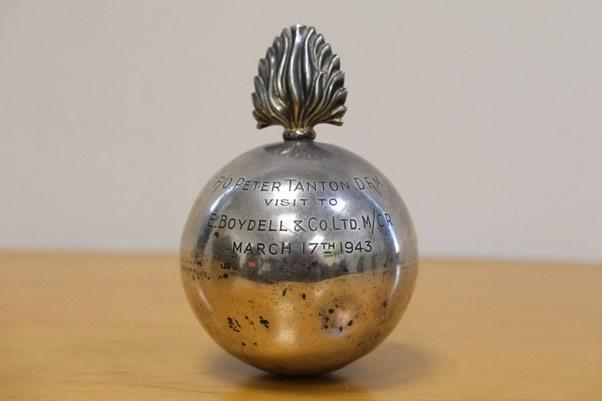
This commemorative Sterling Silver ‘bomb’ was presented to Peter to thank him for his visit to the E. Boydell and Co. factory in 1943. The mechanical engineering company produced a wide range of heavy-duty vehicles to support the war effort. Such motivational visits were commonplace to encourage workers by having serving military staff visit and thank those working in factories for their contribution to the war effort.
Migration to New Zealand
In 1953, for a range of reasons, Peter and Molly decided to leave post-war Britain. People simply didn’t talk about things like mental health or the impacts of trauma in those days, but it was clear that the war had an impact on Peter and his moods. It was perhaps helpful to leave behind many of those wartime memories and make a fresh start in New Zealand.
Initially they settled in Whangārei. Peter worked for Wrightson’s helping Northland people buy and sell farms. It was here that Peter began to develop a Christian faith through attending church with Molly. Later they moved to Epsom in Auckland, where both Peter and eventually Molly worked for Barfoot &Thompson real estate. Peter became the first manager of the new Royal Oak real estate office. When one of his first salesmen, John Baker, arrived at the office, Peter noticed that John was not wearing a suit and alluded to it. John admitted to being unable to afford one. Peter, liking the look of the young man, decided a suit was a good investment for the office and bought him one. John went on to great success, eventually founding his own firm.
In 1960, having regularly attended St Andrew’s church in Epsom, Peter decided to enter theological training, whilst still working, and renovating the house the family was living in. While at St John’s theological school, Peter met a young student, Bruce Gilberd, whom he took a liking to. Peter introduced Bruce to his eldest daughter Pat. This was clearly a good match as they eventually enjoyed 60 years of happy marriage together. Bruce recalled from his time at theological college how ‘Peter threw himself into college life with characteristic enthusiasm, studying well, making friends, singing in the choir, playing cricket and even running the marathon.’ Amongst that cohort were a number of future church leaders including Ben Te Haara, who would later become a revered and much-loved Bishop.
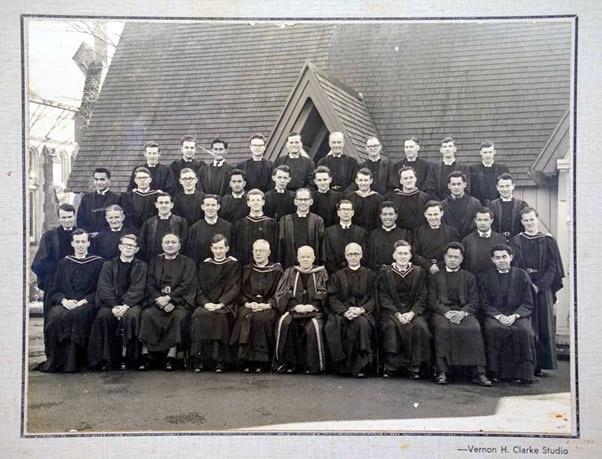
On 30 November 1960, Peter was ordained an Anglican priest. He undertook his ministry in a range of places, notably Kawakawa in Te Taitokerau, where his Warden was the young Sir James Henare. Peter’s last parish was at Waiuku. We understand he had some sort of disagreement with the church administrators about the ethics of the church’s investments and money-making activities and he resigned. He then went on to run a very successful plant and tree nursery and landscaping consultancy, called Bushy Park Nursery. He was in his element!
In 1967 the remote seaside village of Tairua was made more accessible to Auckland, Hamilton and Tauranga with the opening of a new road from Kopu to Hikuai. Peter and Molly purchased some land on Paaku mountain, the ‘guardian’ of Tairua harbour. Ever the man of action, by the end of 1968 Peter had designed and built (with his son Rynne’s help) a house looking out across the sea to the east. This was a restorative and happy place, enjoyed by all the family and many friends and colleagues. This beautiful and peaceful place remains to this day the spiritual home of the family. Peter and Molly retired to Manly on the Whangaparāoa Peninsula and built a beautiful garden using their substantial knowledge of landscaping and plants, and Peter’s fine-tuned concreting skills.
Excerpt from correspondence between Peter Tanton (Poppa) and his granddaughter, Catherine Gilberd
Peter's eldest grandchild, Catherine Gilberd, was 14 years old at the time of his death in November 1979. Over the years prior, Peter (known as ‘Poppa’) and Catherine corresponded with each other, during which time Peter and Molly moved from Bushy Park Nurseries in Waiuku to Big Manly beach on the Whangaparāoa Peninsula, north of Auckland. Catherine kept his letters and shares Peters own words here:
19th November 1979:
Dear Cathy, ... I am catching up on letter writing and listening to our lovely set of records by Bert Kaempfert and James Last. We haven't been for a swim for three days now. Every afternoon the weather changes before high tide and it becomes colder, and we think it's not worth it. But I have been in 15 times this year which is more than I have been in since the 1950's. It's rather nice to stroll across the road and into the water and amble back here and sunbathe in the garden... Our garden here is really quite remarkable considering how long we've been here. We are now eating strawberries, lettuce, radish and silver beet and soon we shall have cabbages, caulis, beet, carrots, beans, tomatoes, parsnips etc .... These records really are great – you must come and see us and listen to them. Trouble here is we can't find time to do everything. We are working hard to finish the garden as it will take years if we don't make up our minds and do it now. Also, we are getting older and someday I should slow down I guess ... Have finished the fish pools and flax garden which Bid will tell you about. It really looks lovely, and people stop and call in to have a look at the garden.... We have an extraordinary assortment of bird friends here and also quail and a dear little hedgehog lately.... Hope you will come up and see us often when you are in Auckland... It's a lovely spot for a quiet weekend or a few days ... our love to you all and also to Biddy and Hannah please. Poppa xxxP.S. I'm flying over McMurdo station and Scott Base on Wednesday week... will land at Christchurch on way back. 5,824 miles in one day!!! Will tell you all about it in my next letter. Peter.
A sixtieth birthday celebration
Peter decided to celebrate his sixtieth birthday with a scenic flight to Antarctica. The family pulled together to help pay for the trip. These Air New Zealand flights had commenced in 1977. Molly was not keen to go, so Peter went instead with his dear friend Mike Potter. They boarded Flight TE 901 on the 28th of November 1979. Molly later told the family how on the morning of the flight Peter expressed concerns about the flight and felt he didn’t want to go after all.
Is it not ironic that Peter, who survived 30 bomber raids over Europe in the Second World War, would, 40 years later, die in a civilian sightseeing flight to Antarctica? Family members report that on occasions he had said to them, ‘I’d like to go with a bang!’
Peter’s body was recovered, at a mid-point in the wreckage site, by those brave and steadfast members of the recovery mission. On December 28th, 1979, we held Peter’s funeral at St Stephen’s church at Whangaparāoa, with Bishop Paul Reeves (later Archbishop of New Zealand, and Governor-General, 1985–1990) presiding.
Some of the words that were said at his funeral:
We all feel grief – natural human sorrow – for Peter – for all who died in the Antarctica accident, and their loved ones. It is right to grieve. Yet there is a note of triumph – a life has been completed; the tape has been breasted. A very interesting and full life has suddenly been completed. And Jesus, on his cross, did not say ‘I am finished’ but ‘IT is finished’. The task, the job, I came to do is now done. There is a solemn joy undergirding our whole present experience – based on Jesus’ own words again: ‘I am the resurrection and the life’. This is where we must look – to LIFE. To that strong gracious vibrant life that Christ alone gives. This is what will impel us to go on in OUR pilgrimage – yours, mine – in the years that remain to us.
Peter’s remains were cremated and scattered in Cornwall Park, Auckland near the cricket ground he had played on so many times.
Peter was a man of strong views, attractive energy, and personality. He could be great fun, creative and very generous. But he was also capable of hurtful sarcasm and punishing silences. When Peter was onto a new project, we would all be enlisted to help. Peter was a leader, a husband, a father, pilot, land agent, sportsman, gardener, and a priest. His varied life overflowed his 60 years.
His was a life well lived. We are grateful for having had him with us for 60 years.
Final note
As a family we offer our sincere thanks to all members of Operation Overdue, the recovery teams, the New Zealand Police, and those such as Justice Mahon who tirelessly quarried for and disseminated the truth of the accident.
With many others who were impacted by this event, we are grateful to know each other. This event may have brought us together unexpectedly, but it does not define the lives of those we lost. We live in hope that sometime soon the names of all our people will be gathered together again, in one place, in a memorial. We sit round this campfire of hope, together with many supporters with us, some invisible in the darkness beyond the firelight.
Note: the memory on this page is in the writer's own words and does not necessarily reflect the views of Manatū Taonga.
Text and images on this page may not be reused without permission.
Read more memories like this: Reflections on Erebus series.
See also, passengers and crew from Flight TE901 (Manatū Taonga)
Images and text: Tanton and Gilberd families
