
Thomas James (Jim) Collins, 19 April 1934 – 28 November 1979. Photo of Jim on the flight deck in the 1970s.
Kathryn Carter reflects on the loss of her father, Captain Jim Collins. An experienced and well-respected pilot, Jim was a committed and loving family man to his wife and four daughters. ‘When home from flying, Dad would be “back to normal” and we could be a family again.’ Kathryn speaks of never being able to fully articulate what his loss meant.
Dad
I recall the night of the Erebus accident clearly. Dad was so excited to be flying to the Antarctic. For the crew and passengers this was the trip of a lifetime. Only the most experienced pilots were eligible to apply to fly the trips down. Dad had fully researched his route and the sights the passengers would see. We spoke to him about this flight the night before he went. I asked him if he was going to land down there. He said no, as the military ice runway at Williams Field (United States Antarctic Program airfield in Antarctica) would be too soft at that time of year to take the weight of a DC10.
We were shocked as we had no idea that no one would come home that day. He had been so enthusiastic and had prepared so thoroughly for the flight, even obtaining military maps of the Antarctic from the United States. Our lives were changed forever after that flight, but we knew he was doing something he loved when he died. He was a very responsible pilot, what happened didn’t make sense to us. It was extremely distressing. He was such a good person. Our Mum, Maria, was 44 years old. I was 15 and I felt that my childhood had ended. My sisters Elizabeth, Philippa and Adrienne were 14, 9 and 6 years old respectively.
The following day, 29 November, I sat my School Certificate science exam. I did it for him because he had helped me with the syllabus and would have wanted me to do it. I passed the exam and passed my School C (I found out later) on my own merits without any special consideration of the circumstances I faced, but I knew my life had changed forever and felt numb with loss at that time. It was very hard.

We all loved Dad. He was youthful, fit and healthy. He smiled spontaneously, emanating a warmth of good spirit that made us feel happy to be around him. He had olive skin, blue sparkling eyes, and very fine, jet-black hair that was parted to one side. It would fall forward over his forehead if he didn’t slick it back. He always carried a steel-toothed comb just in case he needed to comb it into place. Dad smelled of Old Spice, a popular cologne, and of travel and planes when arriving home after flying.
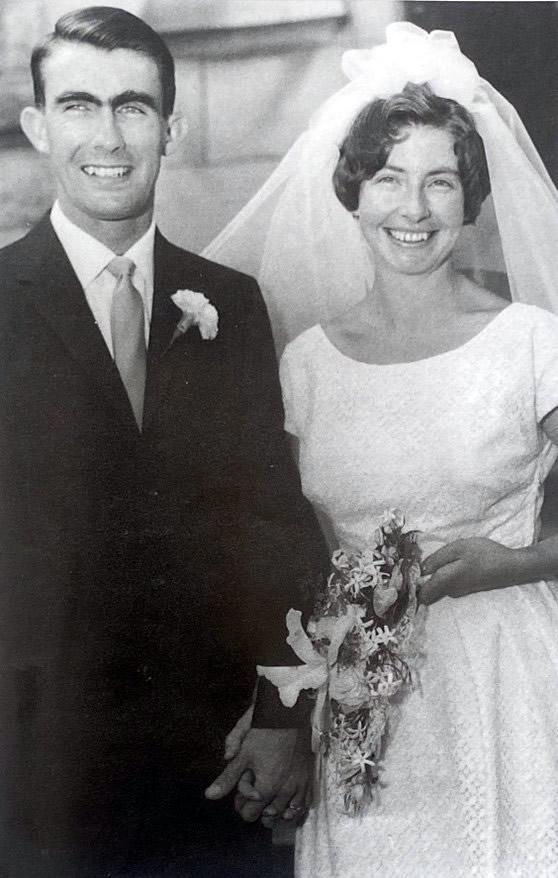
When home from flying, Dad would be ‘back to normal’ and we could be a family again.
Dad liked the simple things in life. When he wasn’t flying, we ate meals together. Dad liked the routine, and Mum’s cooking. He enjoyed taking the boat to a beach on a fine summer day or a winter morning. He loved music and dancing. His record collection ranged from classical to the Carpenters and the Beatles, as well as big-band music like James Last, especially Trumpet a Gogo. His gift to me on my 15th birthday was the Beatles album Sgt. Pepper's Lonely Hearts Club Band. He was amused contemplating if we would still need him or look after him ‘when I’m 64’, as the song goes. Whether playing the harmonica or a simple duet on the piano, his interaction with us was infinite.

At home, Dad would help Mum with household jobs. He didn’t distinguish between which job was whose and would explain that it was best to work as a team. He would vacuum or do the ironing and would ask us to help Mum when he was away. With us four girls he would jokingly complain that he was surrounded by women and that even our tortoiseshell cat Jenny (nicknamed Puss Puss) was female.
We all had chores such as putting out the empty glass bottles for the milk delivery, setting and clearing the table and doing the dishes. We would play ‘flick the tea towel’ with him when drying the dishes as we didn’t have a dishwasher. I was also expected to put the rubbish out. We had a wall chart to remind us of all of our chores.
In his comfortable ‘at home clothes’ he loved tinkering about in the garage or on the boat, doing fix-it jobs round the house or in the garden mowing the lawn. Sometimes he used a hand mower. He taught me how to mow the lawn, put the catcher on or rake the mowed grass. He taught me other life skills such as how to mend a fuse, change a lightbulb and hammer a nail. He taught us to look after machinery and not be impatient with it.
When Mum was training as a marriage guidance counsellor, Dad would look after us. One day while making scrambled eggs and tomato for us he realised he didn't have any tomatoes, so opened a can of beetroot instead to add the ‘red element’. We ate pink scrambled eggs but didn’t comment on the unusual colour!
Dad had a great sense of humour. He enjoyed the Goons, Monty Python, the Two Ronnies, Dave Allen, Benny Hill and John Cleese. He liked silly stories like Spike Milligan’s Badjelly the Witch. He joked with us once how he was called out to fly for another pilot who had broken his leg ‘trying to jump into his trousers!’ He enjoyed small things like when my little sister Adrienne would take bites out of his favourite boysenberry jam toast and he would pretend not to notice. He would then act surprised that a mysterious teeth-marked gap had appeared in his toast.
Dad kept his old air force overalls hanging on a peg in his workshop in the garage. This reminded us of a time before we were born. Dad joined the Royal New Zealand Air Force (RNZAF) in 1951 at the age of 16. He was selected for pilot training and gained his ‘wings’ in 1955. He spent time at Ōhakea air force base and other bases around the country. Initially indentured for 25 years with the RNZAF, he was offered an honourable discharge after eight years because the RNZAF had a surplus of pilots at that time. He joined Tasman Empire Airways Limited (TEAL), which in 1965 became Air New Zealand.

When he got back from long-haul flights or long trips away with Air New Zealand, he would sleep during the day. I remember creeping quietly into my parents’ room and seeing him there and hoping he would wake up soon so that we could catch up on news. He didn’t wake for ages sometimes, so he must have been very tired. He’d sleep through the noise of a neighbour mowing the lawns. Mum would tell us not to disturb him and to be quiet and wait till he woke up. We had to be patient.
Mum and Dad had lots of good friends as they were generous to other people. Dad enjoyed the company of all sorts of people from different walks of life. If they had friends over for dinner we were allowed to pass around the nibbles and have a glass of Coke as a treat when the guests arrived. We would go to bed to the sounds of muted adult laughter over the dinner table.
Dad seemed to enjoy our happiness when he brought us little gifts back from his overseas flights. Examples included fresh pineapple and papaya from Tahiti and gold-beaded sandals and slip-on leather shoes from Hong Kong. He sometimes brought orchids for Mum from Singapore or frangipani from Fiji, in floristry boxes.
He enjoyed the child’s play of piggy back rides and clowning around at home with us. Our joy of having him at home and having him pick us up from school was palpable. We felt pride at knowing he was on the school Parent Teacher Association, or that he was coming on the next school camp with us because he had leave. The other adults and kids liked him. He always got on well with people.
Dad was good at drawing. He could draw anything we asked him to, especially horses and cars. He drew the donkey for us to pin the tail on at birthday parties on a large piece of fibreboard.
He would make us sandcastle sports cars on summer holidays in Northland. They could seat all four of us girls. They were complete with steering wheel and bonnet! The sand-car would stay intact until the tide came in. These creations provided us with hours of fun.
Dad explained the world to us and helped us to understand it.
Dad taught us about the wider world, from the geography of countries and locations on maps to how to read globes and the placement of cities and how they were connected to their peripheral landscape. When driving to Rotorua to see our grandparents, he would explain how the power lines came and went from town to town and why they stretched across the country in black suspended lines. He taught us about flight by teaching us to make paper darts and explained how wind and lift affected wings to make planes airborne.
We learnt how to look out for others and not judge people for their lifestyles or choices, because you didn’t always know the full story. He impressed on us to be considerate of others above all. He taught us to be inquiring and educate ourselves if we didn’t know something or had a query.
A favourite line of his was Fred Dagg’s, ‘you don’t know how lucky you are’. We had to remember that even later when it was difficult to think it after he died so suddenly.
Dad took great pride in all our individual achievements. He was a good listener. I recall, when aged about 10, describing in great length a movie plot to him. He didn’t get bored or uninterested or impatient with me. He always had time to listen, so that we all felt special in his company.
He made us a boat called the Abercrombie in his workshop. The name came from the children’s book Borka: The Adventures of a Goose With No Feathers. He painted it to match the colours of the boat in the story.In making the boat we saw his craftsmanship and practical knowledge as he explained the gluing and use of clamps. He taught us how to be safe on a boat.
He made balsa-wood model aeroplanes from kitsets, as well as kites which we would fly on windy days. Sometimes the kites and planes got lost high in the poplars at Cornwall Park.
In 1979 Dad started to teach me how to drive. He would make me go forward and backwards while outside our garage, changing gear in a manual drive stick-shift Mini. He drove us to ballet lessons in the Mini when other Dads drove bigger cars. I asked Dad why he drove a Mini and he said, ‘a Mini is good around town and I fly a DC10 which is the most sophisticated aeroplane, so I don’t really need a big car round town – It just adds to congestion’. Our station wagon (a Ford Falcon 500) was for long-distance travel to Rotorua or up north to Matapōuri.
In 1977, the DC10 Dad was piloting was hit by lightning while coming out of Los Angeles. A panel near the cockpit fell off. Dad said it was like a firecracker going off by his left ear in the cockpit. He got the aircraft safely back to LA. I later learned the crew received an ovation from the passengers when they landed. Years later a passenger from that flight who was a five-year-old child at the time contacted me to say that he believed Dad had saved their lives. We are still in touch.
We were blessed with two good parents but didn’t know it really at that time. Our parents were very happy together and the tragedy of Dad’s loss hit us hard. I can never fully articulate his loss. You try to cope without him in some way by trying to hear his voice in your mind as you get older and to imagine what he would have advised us to do or wanted us to be. Dad was only 45 years old when he died. Life changed abruptly for us as even though work had meant that he sometimes missed birthdays or Christmas, this time he didn’t come home ever again.
It is such a pity we didn’t have more time with him. We still mourn his loss all these years later but have got on with life as he would have wanted. That was all we could do. There was no advice on how to do it, so we had to trust our instincts, work hard and remember that despite everything we still had Mum, who saw us through the days after Erebus with great strength of character and bravery. She is fortunately still with us and so has carried on for him as solo parent to us, and grandmother to their six grandchildren in his absence.
We will never forget Dad and his generosity of spirit, patience, intelligence, sense of humour and respect for others. We still feel his presence around us.
Kathryn Carter (Collins)
July 2024

Front: Maria, Pip, Kathryn
Back row: Elizabeth, Jim, Adrienne.
Note: the memory on this page is in the writer's own words and does not necessarily reflect the views of Manatū Taonga.
Text and images on this page may not be reused without permission.
Read more memories like this: Reflections on Erebus series.
See also, passengers and crew from Flight TE901 (Manatū Taonga)
Images and text: Kathryn Carter
