Using this page
This page offers teachers ideas and strategies for using film (movies, documentaries, or episode-based videos) to teach history to intermediate and senior ākonga (students). The intention is to encourage ākonga to develop critical thinking skills so they can analyse concepts such as narrative, representation, perspectives, and evidence.
Related curriculum
New Zealand Curriculum | Key competencies | Using language, symbols, and text
New Zealand Curriculum – Tāhūrangi New Zealand Curriculum
Aotearoa New Zealand's histories | Do Inquiry processes | Interpreting past experiences, decisions, and actions
Content overview Aotearoa NZ's histories – Te Poutāhi Curriculum Centre
Key concepts
- Narrative
- Representation
- Evidence
- Perspectives
- Accuracy.
Author
Ricky Prebble, Senior Educator/Historian
The influence of film and television is massive. Films colour our imaginations and shape the way we think. When asked to picture a Roman gladiator, for instance, who doesn’t conjure up Russell Crowe wrestling a lion? And as for the Titanic … don't get me started.
Harness the power of film
Films are an integral part of youth culture, so it makes perfect sense to bring them into the classroom. Films can motivate students to learn about the past. They can introduce controversial issues and offer alternative perspectives and can be used as sources of knowledge.
I learned the facts of life by watching The facts of life.
Chip Douglas, from the 1996 film, The cable guy
The educational power of film is considerable, but the medium is not without pitfalls. When it comes to ‘historical films’ and documentaries, it's important to remain alert to the way narratives are shaped, and messages are conveyed. After all, the motion-picture industry produces films primarily for profit rather than education.
In preparing to watch a film people might say, ‘Oh, you have to suspend your disbelief.’ But when using film in the classroom, we don't want to be suspended, we want to be active and alert to the different ways films represent people, places and events. In this way students can develop a critical literacy that allows them to explore, deconstruct and reflect.
Approaches and strategies
For films to be ‘educational’, teacher intervention is needed. What follows are some ideas and strategies to keep in mind when planning to use film in the classroom.
Framework for analysing films
The following framework was developed by Scott Alan Metzger, Associate Professor of Social Studies Education and Scholar of History Education, Penn State University.
Period representation | Content coverage
How does the film represent a historical period; what historical knowledge is included, left out or altered? (This point is less about spotting factual mistakes than seeing how films manipulate historical issues and recreate past eras.)
Historical construction | Social construction
How does the film build historical narratives using evidence and interpretation, and how does it define and express messages about people in the past, including through dimensions such as identity, power, conflict and cooperation?
Empathy | Moral response
How does the film involve viewers emotionally, and what are the conclusions it reaches about people, events and perspectives?
Evaluating films using LEGIT
LEGIT is a mnemonic framework through which to analyse and evaluate texts.
Evaluating information with LEGIT – Te Akomanga | NZHistory
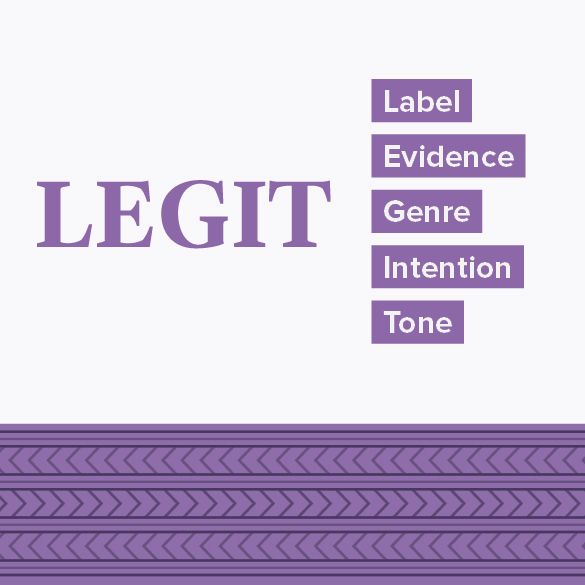
Evaluating information LEGIT resource (PDF, 95KB)
A good place to start with younger ākonga is to emphasise Label. With senior students, start with Label, Intention, and Tone.
Label
Gets ākonga thinking about who made the film (were historians involved?) as well as the context. For example, when the film was made and who funded it.
Intention
Considers the purpose of the film. While this is almost always to entertain and make a profit, it may also be to raise awareness, inform and educate. What was the motivation of the film-maker in making the film? Why this subject or topic? Film-makers often want to impart a moral judgement. A long-standing moral lesson is the triumph of good (justice) over evil or wickedness. Audiences often expect a satisfying conclusion that makes sense of the issues and events in the narrative.
Tone
Films often convey stories through the experience of an individual – a hero/protagonist who undergoes some kind of struggle before a resolution. This means films are a good way to explore the historical relationship of specific/general – to what extent is the hero’s story similar to and/or different from that of other people at the time?
Issues and considerations when using film
What is the kaupapa/purpose of watching this film?
Having clear learning goals/outcomes when watching a film is important.
Use the film intentionally, as you would any other text, to enhance learning and build understanding. The educational power of film is enhanced by active guidance from a teacher operating within a purposeful lesson structure.
Remember films don't teach, and they are not lessons. Teachers create lessons, and films are just one possible resource.
When to show a film?
Where will a film fit in your unit of learning? Do you use a film (or a scene from a film) as a hook to spark interest, or do you build context first?
Accuracy
Asking questions of a film can help separate ‘fact’ from ‘fiction’. For example, when watching a film, ask, ‘Were those uniforms really that colour back then?’
Period representation | Content coverage – Scott Alan Metzger framework
Use LEGIT or other evaluative frameworks to support students to evaluate the film.
Evaluating information with LEGIT – Te Akomanga | NZHistory
Films can be long and take several lessons to complete
Select excerpts (it will take time to choose appropriate scenes in advance).
Be clear about what you want students to focus on. Don't be afraid to pause mid-scene if there's something you want to highlight.
If you are watching the film over several lessons, consider when it's a good time to pause and ask questions that will encourage students to reflect on what they have seen and predict what they think might happen next.
Structure and viewing film
How will you introduce a film? Take the time to consider the director, writer, producer.
Evaluating films using LEGIT | Label – Te Akomanga | NZHistory
Think about what you want students to do before, during and after a film to make the most of its educational value.
Before viewing a film: what are students’ expectations – how accurate do they think it will be?
At the end of a topic: what surprised them? How accurate do they think the film is? How does the film compare with other evidence? To what extent has the film helped them understand the historical context?
When I was a student-teacher I remember watching an experienced practitioner break down a documentary about the Boyd incident. It was a master class in structured viewing, with the film stopped and started multiple times to allow questions, discussion and the presentation of other sources of information. This helped deconstruct the film and enhanced understanding of the historical event.
Give students activities during the viewing that will help them gather information or focus on aspects of the film that align with your intention.
A graphic organiser such as a list of questions (time-stamped in chronological order) will help students record information and enable better discussion once the film is finished.
Give students a glossary of key terms/concepts, especially if it's a documentary or a show such as The Aotearoa History Show.
The Aotearoa History Show – RNZ
Consider when and how to use a film in combination with other sources that either support or contradict the film’s narrative/account.
Ensure multiple perspectives from other sources are included, as films may amplify/silence certain voices.
Use screenshots of characters – students can use these when analysing perspectives, writing key ideas/perspectives/questions around the character’s image.
Reflect on the meaning of a film – most films will contain moral messages about the past.
Empathy | Moral response – Scott Alan Metzger framework
It’s important to have time and resources for meaningful discussions/activities during and after viewing the film. Use the Learning through talk resource on Te Akomanga to support classroom conversations.
Learning through talk: support for classroom conversations –Te Akomanga | NZHistory
Violence, sexual content, themes and language all need to be carefully considered
Ensure that you preview and potentially censor films – skip scenes that are not appropriate or offer trigger warnings prior to showing the scene.
Using film to develop empathy and 'perspective recognition'
Empathy is the ability to imaginatively enter into the experience of others while understanding the limits to which this is possible. As philosopher Henry David Thoreau wrote: ‘Could a greater miracle take place than for us to look through each other's eyes for an instant?’
Historical empathy is not easy. It's common to make sense of the past using the values and norms of present-day culture and society. According to history educators Barton and Levstik (2004), there are two types of empathy:
- Empathy ‘for caring’: where students develop their understanding and have tolerant views towards others, especially those who may be different from them.
- ‘Perspective recognition’: asking students to evaluate the thinking, decision-making and experiences of individuals and groups in the past. It's important that teachers are clear about which perspectives they want students to recognise, and about the limits on how much can be understood from a film.
Teacher prompt: Perspective/empathy questions to ask about a film
- Why are certain perspectives emphasised and others de-emphasised or ignored?
- Who do the film-makers want the audience to cheer for or against?
- What moral reactions about the past does the film aim to evoke, or provoke, in viewers?
Ākonga activity: Hot seating
This is a dramatic approach to perspective taking whereby students are invited to assume the character of a person/group they have studied. You can create a panel-like discussion during which the class ask questions of those in character.
Historical empathy – Te Akomanga | NZHistory
Accuracy and representation – 'never let the truth get in the way of a good story'
There's a tendency for commentary surrounding historical-based cinema to focus on accuracy and whether events shown on screen really happened in the way they’re represented. Giacomo Lichtner (Associate Professor of History and Film at Victoria University of Wellington) says that while it's important film-makers are honest about any inventions, judging films only on their supposed accuracy is to view them through too narrow a lens. ‘A film can be inaccurate in terms of what it represents, but accurate in terms of the meaning of history that it conveys, just as it can convey true events through invention and imagination’, Lichtner says.
Historical construction | Social construction – Scott Alan Metzger framework
The film Muru (2022), based on the 2007 police raids on the Ngāi Tūhoe community of Rūātoki, exemplifies Lichtner’s comment around representation, accuracy and meaning. Muru may not necessarily strive to represent history completely accurately, but it captures the meaning of what the events meant for the community. In the first few minutes of the film, a declaration is typed on the screen: ‘This film is not a recreation … it is a response.’
Ākonga activity: Film and past events discussion
Discuss the idea of using film to ‘respond’ to past events rather than ‘recreate’ them.
Muru strays from the historical facts, but is that a problem? – The Spinoff
'Man in the hole' – The shape of stories
This four-minute clip of science fiction writer Kurt Vonnegut summarising common approaches to storytelling is recommended viewing and would be a great starting point for classroom discussion.
Kurt Vonnegut on the Shapes of Stories – YouTube
The Bechdel Test
The Bechdel Test is a useful tool that can be used to call attention to gender inequality. It involves asking whether a film satisfies three basic requirements:
- It must have at least two women in it who,
- Talk to each other about,
- Something other than a man.
Does the film you are watching as a class pass this test?
The Bechdel Test – Everything You Need To Know – YouTube
Conclusion
The question is not whether films should be used in the classroom, but how to use them, and to what ends. Remember that films don't teach, teachers teach – without intervention by teachers, films can distort and mislead. It's important to be mindful of ‘Disneyfied History’, history that exists in popular culture that can present misleading or black and white versions of events. Using film in combination with other sources can be a powerful way for students to understand historical contexts alongside developing critical thinking skills such as analysing narratives, representations and evidence.
NZ On Screen
Remember to search NZ On Screen for possible film and/or documentary options.
Further reading
Are movies a good way to learn history? – The Conversation
The Power of Films in History Teaching: My Personal Reflections – Sir Macky's World
Teaching People's History with Film – Zinn Education Project
How Films Can Teach History – JSTOR Daily
Muru strays from the historical facts, but is that a problem? – The Spinoff