
On 27 May 2019, Caesar the bulldog became the first New Zealand animal to be awarded a Blue Cross medal for his service and bravery during the First World War.
Ceasar is one of thousands of New Zealand animals who have been involved in war, either serving actively or fulfilling the role of mascot and providing companionship and comfort to service personnel. Recognition of animals’ war service has increased in recent years, including by the unveiling in 2018 of a New Zealand War Animal memorial at the National Army Museum in Waiōuru. The stories of these animals provide valuable insights into the nature of war – extremely challenging physical conditions, danger and loss, but also relationships formed and lighter moments enjoyed. The National Army Museum at Waiōuru have made a video about Caesar and Auckland War Memorial Museum holds his collar in its collection.

Auckland War Memorial Museum, W3074
Collar belonging to Caesar the bulldog, mascot of 4 Battalion, New Zealand Rifle Brigade during the First World War.
Many of us with much-loved animals at home find it hard to imagine volunteering them for war service. However, between 1914 and 1916 more than one thousand horses were donated to the New Zealand government for service in the First World War. Thousands more were sold to the government, with transport horses fetching a higher price than riding horses. In total, the government had acquired more than 10,000 horses for war service by late 1916, when pressure on shipping meant that they could no longer be sent overseas. Many men brought their own horse with them when they enlisted for service, and if it was accepted for purchase it was often issued back to them. Just like men and women volunteering to serve, the horses underwent medical and other checks before they were accepted.
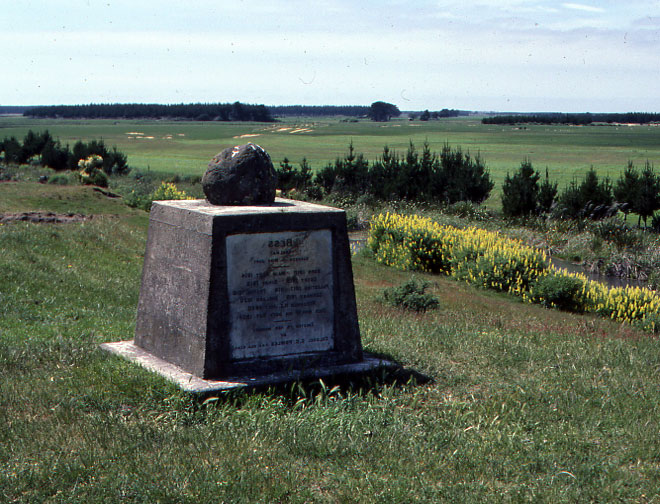
The most famous New Zealand war horse was a black thoroughbred named Bess, who served throughout the First World War with Captain Charles Guy Powles of the New Zealand Mounted Rifles. After service in Egypt, Sinai, Palestine and France, Bess was one of only four horses to be shipped back to New Zealand after the war. When Bess died in 1934, Captain Powles erected a memorial to her at Flock House, near Bulls in Manawatū. Along with almost 4000 other horses sent with the main body of the New Zealand Expeditionary Force in October 1914, Bess had endured cramped conditions during the six-week voyage to Egypt. She then survived extreme heat, burning sand, cold nights, ticks, fleas and biting flies in the Middle East, wet and cold on the Western Front, and shortages of food and water. Today, many animals find the sound of fireworks distressing. Bess and her fellow war horses were often close to gunfire and exploding bombs.
Jock Phillips and Chris Maclean
Memorial to Bess the horse, 1986.
Mounted troops in the First World War rode their horses into the battle zone, then dismounted to fight as infantry. Troopers’ horses carried loads of up to 130 kilograms, including their rider, weapons, ammunition, blankets and food and water (for themselves and their rider). Many horses became weak and unwell or were injured by enemy artillery fire or aerial attacks and had to be evacuated to hospital. A New Zealand Veterinary Corps was created to look after the horses, but thousands of them died. It is not known how many New Zealand horses survived until the end of the First World War. A shortage of transport and quarantine restrictions because of animal diseases prevalent overseas prevented them returning to New Zealand. Horses in good condition were sold locally, while the rest were shot. Many men developed a strong bond with their horses, which became a source of comfort and companionship. When the fighting ended, some men worried that their horses would be mistreated by their new owners and tried to get them declared unfit for sale and killed. As a senior officer, Captain Powles was able to arrange for Bess to return home to New Zealand, where she continued to work with him while he was commandant of Trentham Camp and then Principal of Flock House, an agricultural training school.
The First World War was not the first time New Zealand sent horses overseas for war service. Approximately 8000 horses were sent from New Zealand to South Africa during the South African War (1899–1902, also known as the Boer War). Horses were also used during the New Zealand Wars of the 19th century. In 1864, 1000 horses were shipped to New Zealand for use by the Colonial Defence Force. The Māori prophet and military leader Te Kooti Arikirangi Te Turuki and his men rode horses and also captured many of their enemies’ mounts. Te Kooti’s white horse – in one tradition named Pōkai Whenua (travel the land), in others Te Panerua – was believed to have spiritual power. The Kaimanawa wild horses that still live on the North Island’s Central Plateau may be descended from horses that were abandoned or escaped during the New Zealand Wars.
During the First and Second World Wars, animals were kept by New Zealand military units as mascots – symbolic figures that represented the group and hopefully brought it good luck. Some animals went to war with their owners, but many were strays picked up along the way. While dogs were the most common military mascots, others included cats, donkeys, monkeys, lizards, pigs, goats and birds. Caesar the bulldog was both a mascot and a trained Red Cross dog. Wearing his official collar, he led a parade down Queen Street in Auckland before the Rifle Brigade left New Zealand. Caesar’s Red Cross training included learning to navigate a replica battlefield littered with logs, branches, upturned wagons and bomb craters. A small harness around his torso held bandages, water, and pencil and paper so that wounded soldiers could write notes for Caesar to deliver.
Caesar helped rescue wounded troops during the Battle of the Somme in 1916. Finding Rifleman Johnson buried alive after an explosion, Caesar dug around his head so that he could breathe, before running to get help from the stretcher-bearers. Caesar was killed in action in 1916, alongside a soldier who died with his hand resting on Caesar’s head. The two were buried together. Caesar’s collar is held in Auckland War Memorial Museum. Caesar the Anzac dog, a picture book, was published in 2003. When Caesar was awarded the Blue Cross, the great-niece of his handler, Rifleman Thomas Tooman, attended the ceremony at the National Army Museum.
During the Second World War, C Company of 28 (Maori) Battalion acquired a small dog who was named Spittie because she arrived around the same time a Spitfire fighter came down in the English countryside nearby. Spittie enjoyed army life and never missed a route march, but struggled to obey all the rules. One day Spittie insisted on inspecting the troops alongside Colonel George Dittmer rather than lining up for inspection herself. Everyone struggled to keep a straight face when Spittie inspected the commanding officer’s car and cocked her leg to signal her approval in the usual manner.
With their excellent sense of smell, dogs were especially useful for detecting enemy gas attacks and helping stretcher-bearers find wounded soldiers in no man's land at night. Able to quickly and quietly navigate trenches and difficult terrain, they were also used as messengers. Dogs were not the only non-human messengers. Homing pigeons were used during both world wars to carry messages. Usually released in pairs, with both pigeons carrying the same message to increase the chance of successful delivery, the pigeons are said to have had a 95% success rate. Near the end of the First World War, New Zealand sent several hundred homing pigeons to the Western Front as reinforcements. It is unclear whether any of these birds saw active service.
Today the use of animals within the New Zealand Defence Force is steadily rising. Explosive detection dogs and military working dogs are used in both local and international operations. Military working dogs support the infantry in non-tactical operations such as search and rescue, and tactical operations involving tracking, detecting and apprehending the enemy. They work independently or with a handler and often wear cameras on their backs that provide a live feed of action on the ground. Recognition of the war service of animals has also increased in recent years. The first Blue Cross medals for war animals were awarded to war horses in 1918 by the Blue Cross charity in England, which continues to recognise the bravery and service of animals.

New Zealand Defence Force
New Zealand War Animal Memorial, National Army Museum, Waiōuru
The War Animal Memorial at the National Army Museum, gifted by the Australian War Animal Memorial Organisation and American artist Susan Bahary, was unveiled on 24 February 2018. The museum encourages New Zealanders to recognise 24 February as New Zealand War Animal Memorial Day. A purple poppy can be worn as a symbol of remembrance analogous to the red poppy worn on Anzac Day. Some people like to wear both, to symbolise the close relationship between service personnel and war animals and the importance of remembering both.
Cherie Jacobson
Discussion / teaching points
- What military roles do animals perform today?
- What qualities would a good service animal have, both in wartime and today?
- Why do you think animals make such good companions?
- Not all mascots are animals. Do you know of a team or organisation that has a mascot? If so, what is it and why do you think that particular mascot was chosen?
- Who was another famous historical figure named Caesar? Why do you think a military dog might be named Caesar?
- What kinds of tasks could animals perform during war that humans might not be able to? What might they be better at than humans?
- Is it fair to send animals to war? What are some arguments for and against sending animals to war?
Further information
Caesar the Anzac dog (Auckland War Memorial Museum)
Animals during World War 1 (Ministry of Education)
NZ Army puts trainee dog handlers to the test (NZDF-Medium)
'Dog days in 1RNZIR', Army News Issue 488 (November-December 2017)