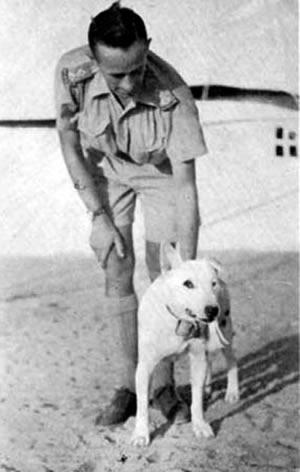
Major Major with Lieutenant J.E. May, July 1942.
Major Major, No. 1 Dog, 2NZEF, 19 Battalion and Armoured Regiment
Major was a white bull terrier, Australian by birth. He was given as a pup to Errol Williams, a New Zealand cadet at the Royal Military College, Duntroon, and moved to New Zealand with his master in 1938. After war was declared in 1939 Captain Williams was appointed to the Special Force which was then being formed, and eventually became adjutant of 19 (Infantry) Battalion.
Major was a dog of no rank at this stage, but when he too joined the Special Force he was registered as No. 1 New Zealand Dog. He paraded through Wellington with his unit before it left for the Middle East and listened patiently to the good wishes of Prime Minister Michael Joseph Savage at a gathering in Parliament grounds.
Captain Williams and Major arrived in Egypt with their unit in February 1940 and trained at Maadi camp. They were then sent into the Western Desert to take part in the long, hot, dusty business of digging the defences in the Baggush Box. Major, still a young dog, took part in this work eagerly.
Major did not serve in the Greek and Crete campaigns because he was at Middle East Officer Cadet Training Unit (OCTU) in Cairo with Captain Williams. His time at OCTU was busy. He made the acquaintance of many local dogs and did not escape unscathed. In June 1941 he was photographed with his left ear flopping down. It continued to do so for the rest of his life.
Promoted to 2nd lieutenant, the terrier joined Wellington West Coast Company of 19 Battalion, which Williams commanded. In August 1941 he went with the battalion on exercises to the Canal Zone, relieving the monotony via a liaison with a Pekinese from a British ship. Major followed his company into Libya in November 1941, but after several days of fighting he was sent back behind the lines. During the advance on Ed Duda, Captain Williams was killed in action. Major took this hard.
In December 1941 Major passed into the care of Captain Bill Aitken and returned to Maadi. He was promoted to lieutenant and then captain before leaving for three months in Syria. When the Germans advanced into Egypt in June 1942, 2 New Zealand Division was called back and entered the line at El Alamein. In July, after about 10 days fighting, Major was wounded in the thigh by shrapnel. His wound was dressed at the RAP truck, where he was given a field medical card, before being evacuated to an advanced dressing station. From there he was invalided back to Maadi.
In the meantime, Captain Aitken, 'the keeper of the dog', was taken prisoner. When Major returned to his unit he was attached to Major Tony Everist. In September 1942 the bull terrier was promoted to the rank of major, and in the same month he finished second in the 33 1/3 yards dog-paddle at the battalion's swimming sports.
While training as an armoured unit in February 1943, 19 Regiment – as it became – was inspected by Lieutenant-General Bernard Freyberg, commander of 2 New Zealand Division. Major wore his special jacket with unit colours and emblem. The general noticed Major: 'Ah, the old dog. You've been on every parade yet.'
The regiment sailed for Italy at the end of 1943, the old dog now accompanied by his new keeper, Lieutenant Steve Whitton. Major served until his death on 17 December 1944, probably from pneumonia. He was buried with full military honours at Rimini.
Regimental Sergeant Major Dave Rench wrote that 'When we laid Major to rest at Rimini, I think perhaps some of the later members of the unit found it hard to appreciate the deep sentiment shown by the old hands for the old Dog. However, it was not only as a unit mascot that Major was so affectionately remembered, but as a link with his first fine soldier master, Capt E.W.S. Williams, killed in action 28 November 1941 – a man to whom the 19th owed much, and who we buried on the rocky slopes of Ed Duda in November 1941 – and indeed to many other good men who had followed him as Keeper of the Dog who now shares with two of them a place on the 19th's Roll of Honour.'
No trace of Major's grave remains, but his exploits live on in the official history of 19 Battalion and Armoured Regiment and in the book The four-legged major by Graham Spencer.
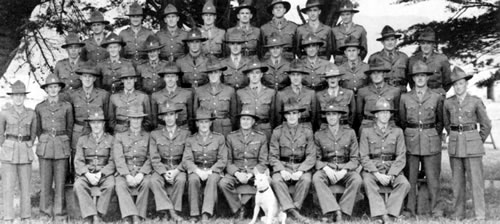
Officers of 19 Battalion, including Major Major. See the full image on the New Zealand Electronic Text Centre website.
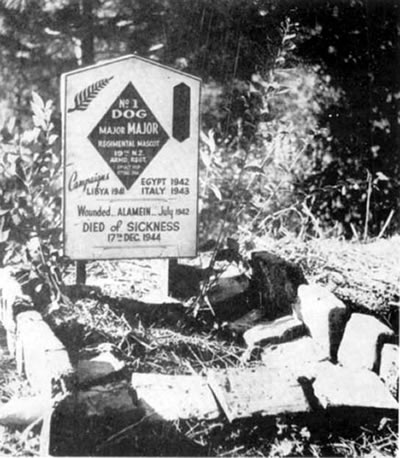
Major's grave in Italy. See full image on the New Zealand Electronic Text Centre website.
Images from Sinclair, D.W., 19 Battalion and Armoured Regiment Official History, 1954 (NZETC website)
