Explore some of the key moments and events in New Zealand’s political and constitutional development since the 1830s (for more content on Māori society and leadership prior to the 1830s, see Te Ara). Follow the links for more detail.
1833
James Busby arrives in the Bay of Islands as British Resident in New Zealand – a junior consular representative with little power. See Governing New Zealand, Frontier of chaos and Taming the frontier.
1834
Northern chiefs gather at Busby’s house at Waitangi to choose a Flag of the United Tribes of New Zealand to fly on New Zealand-built ships.
1835
A Declaration of Independence of New Zealand is drawn up by Busby without authorisation from his superiors. This asserts the independence of New Zealand, in which sovereign power and authority rests with hereditary Māori chiefs and tribes. The declaration is eventually signed by 52 chiefs. See also Background to the Treaty.
1839
The British government appoints William Hobson as consul to New Zealand, with instructions to obtain sovereignty over part or all of its territory with the consent of a ‘sufficient number’ of chiefs. See Land and ideals – background to the Treaty.
1840
The Treaty of Waitangi is signed on 6 February by about 40 chiefs. By September nearly another 500 chiefs in different parts of the country have signed. On 21 May Hobson, now Lieutenant-Governor, proclaims British sovereignty over the North Island on the basis of cession through the Treaty of Waitangi, and over the southern islands by right of discovery. New Zealand becomes a dependency of New South Wales, a British Crown Colony currently governed by Sir George Gipps.
New Zealand’s first capital is Russell (now named Okiato) in the Bay of Islands, but within months Hobson decides to move the capital to Auckland.
1841
News reaches New Zealand that it has become a separate Crown Colony, ending its connection with New South Wales. Communicating with London takes many months.
1842
The Chatham Islands become part of New Zealand.
1846
New Zealand is divided into two provinces, New Ulster and New Munster.
1852
The New Zealand Constitution Act (UK) establishes a system of representative government for New Zealand. Six (eventually 10) provinces are created, with elected superintendents and councils. At the national level, a General Assembly is established, consisting of a Legislative Council appointed by the Crown and a House of Representatives elected every five years by males over the age of 21 who own, lease or rent property of a certain value. See The House of Representatives.
1853
The House of Representatives’ first 37 members are elected.
1854
The First Parliament meets in Auckland.
1856
‘Responsible’ government begins in New Zealand, with an executive that needs the support of a majority of the members of the House of Representatives. The governor retains responsibility for defence and Māori affairs.
1858
The Waikato chief Te Wherowhero becomes the first Māori King, taking the name Pōtatau. The rise of Te Kīngitanga reflects the desire of many Māori for a leader able to unite the tribes, end land sales and make laws for Māori.
1864
The colonial government asserts its responsibility for Māori affairs.
1865
Wellington replaces Auckland as the capital of the colony.
1867
Four Māori parliamentary seats are created (initially as a temporary measure for five years), with universal suffrage for Māori males aged over 21. The first Māori elections are held in 1868. See Māori Members of Parliament and Māori and the vote.
1876
The provinces are abolished, leaving central government as the single legislative authority. Hundreds of local bodies soon come into being.
1879
Universal suffrage is introduced for males aged 21 and over.
1893
Universal suffrage is introduced for women aged 21 and over (including Māori women). New Zealand becomes the first self-governing country to grant the right to vote to all adult women.
1901
The Commonwealth of Australia is established. New Zealand declines several invitations to become a member.
New Zealand annexes the Cook Islands and Savage Island (Niue), and appoints Resident Commissioners to govern these territories.
1902
New Zealand adopts its official national flag.
1907
New Zealand becomes a dominion. Prime Minister Sir Joseph Ward reads a proclamation announcing that New Zealand has ceased to be colony and is now a dominion.
1911
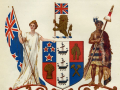
New Zealand Coat of Arms warranted. On 26 August the first New Zealand Coat of Arms (officially the Armorial Bearings of the Dominion of New Zealand) is authorised by Royal Warrant.
1914
New Zealand occupies German (Western) Samoa and installs a military administration.
1917
The title of governor is changed to governor-general. See The governors.
1917–18
The Imperial War Cabinet (IWC) meets in London, attended by Prime Minister William Massey. The IWC resolves to convene a postwar imperial conference to readjust the internal relations of the Empire on the basis of full recognition of the dominions as autonomous nations with a voice in imperial foreign policy.
1919
Women gain the right to stand as candidates for Parliament. See Women Members of Parliament.
1920
New Zealand administers Western Samoa under a League of Nations (later United Nations) mandate.
1923
At British request, New Zealand extends its jurisdiction to cover the Ross Dependency in Antarctica.
1926
New Zealand formally takes over administration of the Tokelau Islands from Britain.
The Balfour Declaration defines the (white) dominions as ‘autonomous Communities within the British Empire, equal in status, in no way subordinate one to another in any aspect of their domestic or external affairs, though united by a common allegiance to the Crown, and freely associated as members of the British Commonwealth of Nations.’
1931
The British Parliament passes the Statute of Westminster, which removes London’s right to legislate for the dominions unless they ask it to do so. New Zealand declines to ratify the statute until 1947.
1934
Waitangi Day is formally commemorated for the first time.
1939
Britain appoints its first high commissioner to New Zealand; by early 1941, the last of the governor-general’s ambassadorial functions have been removed. See History of the Governor-General.
1940
The New Zealand Centennial celebrates the signing of the Treaty of Waitangi as the nation’s founding moment, but the celebrations focus mostly on material progress.
1944
New Zealand signs the Canberra Pact with Australia.
1945
New Zealand joins the United Nations as ‘New Zealand’, dropping the term ‘dominion’. See Dominion status.
1947
New Zealand finally adopts the Statute of Westminster 1931.
1948
The Tokelau Islands become New Zealand territory.
1949
New Zealand citizenship comes into existence under the British Nationality and New Zealand Citizenship Act 1948.
1950
An act is passed to abolish the Upper House of Parliament, the Legislative Council (with effect from 1 January 1951).
1953
New Zealand’s name changes in official usage to ‘Realm of New Zealand’.
1956
New Zealand Coat of Arms updated. Changes include the addition of St Edward’s Crown to symbolise Queen Elizabeth II as Queen of New Zealand.
1962
Western Samoa becomes an independent state. In 1997 it becomes Samoa.
1965
The Cook Islands becomes self-governing. New Zealand retains responsibility for foreign affairs and defence, and Cook Islanders remain New Zealand citizens.
1969
The voting age is lowered to 20.
1974
The voting age is lowered to 18.
The Royal Titles Act 1974 gives primacy to the title ‘Queen of New Zealand’ in New Zealand.
Waitangi Day (then known as New Zealand Day) becomes a national holiday.
Niue becomes self-governing. New Zealand retains responsibility for foreign affairs and defence, and Niueans retain New Zealand citizenship.
1975
The Treaty of Waitangi Act establishes the Waitangi Tribunal as an ongoing commission of inquiry to hear grievances against the Crown concerning breaches of the Treaty (initially, only those occurring after 1975). See The Treaty debated.
1983
Letters Patent ‘patriate’ the governor-generalship as a purely New Zealand office. See History of the Governor-General.
1985
The Waitangi Tribunal is empowered to investigate Treaty claims dating back to 1840. Māori have since lodged numerous claims against the Crown, and many major reports have been released and settlements reached.
1986
The State-Owned Enterprises Act is the first of many statutes to refer to the principles of the Treaty of Waitangi. This practice has given the Treaty far-reaching recognition in national and local government.
The Constitution Act removes the last faint provision for the British Parliament to make laws for New Zealand.
The Royal Commission on the Electoral System recommends (among other things) that a referendum be held on changing the voting system from first past the post (FPP) to mixed-member proportional representation (MMP).
1987
The Order of New Zealand is instituted as the country’s highest honour.
1989
Wide-ranging local government reforms drastically reduce the number of local authorities.
1990
The Bill of Rights Act safeguards New Zealanders’ democratic and civil rights.
1993
A binding referendum changes New Zealand’s voting system from FPP to MMP.
1996
An entirely New Zealand system of royal honours is established.
The first general election held using the MMP voting system results in the first coalition government since 1935.
2004
The Supreme Court Act 2003 comes into effect, abolishing the right of appeal to the Judicial Committee of the Privy Council in London and establishing a New Zealand-based court of final appeal, the Supreme Court.
2011
A consultative referendum supports the retention of New Zealand’s MMP voting system.
2015-16
A two-part consultative referendum endorses the retention of New Zealand’s existing flag.
See also Women’s suffrage milestones.