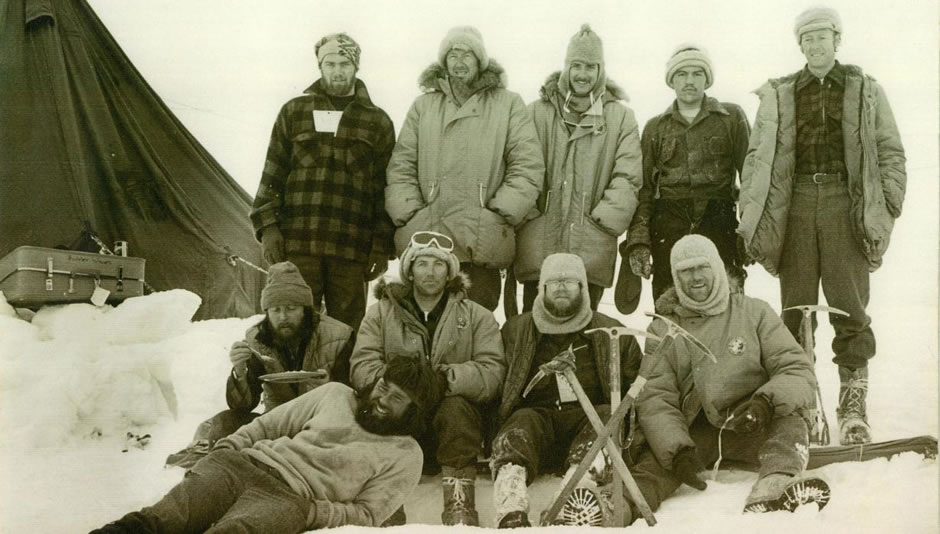
Recovery Teams 1 & 2. Roy Arbon is lying in the front. Police Museum Collection.
In 1979, Roy Arbon was working as a field assistant for the Antarctic Division of the Department of Scientific and Industrial Research (DSIR). Having both outdoor and drilling experience, he was working on the McMurdo Sound Sediment and Tectonic Study (MSSTS) seeking deeper sediment samples and a record of the early history of the East Antarctic Ice Sheet. During his time with the recovery mission, Roy was nicknamed ‘Mountain Man’ by the police personnel he worked with.
We had a good campsite on the ice some 50 km out in the Ross Sea, but the ice was starting to break up. It was getting unsafe. We were winding the drilling down and began packing up the camp. On the day of the accident, the plane (Flight TE901) was flying down McMurdo Sound. The pilot spoke to both my colleague, Garth Varcoe and me, asking what the weather conditions were like. We told him they were rubbish – couldn’t see anything. I then went to bed. Then we heard the plane was overdue. With the time that had elapsed by then we realised the plane did not have enough fuel to return to New Zealand and assumed the worst.
I went back to Scott Base. It had been two months since I had been back at Scott Base, so it was good to have a bed to sleep in and have a shower.
I recall Hugh Logan, Darryl Thompson and Keith Woodford were the three mountaineers employed by DSIR to run survival training for everyone, Americans included, while working at Scott Base. They were sent to the crash site to recover the aircraft’s black box, which they found. [1]
I don’t remember much about when all the tents and cooking gear was sent or taken to the crash site. I do remember Scott Base filling up. I believe at one stage over 80 people were there. I arrived at the crash site about three days after the wreckage was found. On the crash site there were surveyors, photographers, police, mountaineers and McDonnell Douglas Corporation (manufacturer of the DC-10) engineers. We lived in tents set up on site. We were there for 10 days. I do not remember a bad day, weather-wise. It was a little chilly, but we were dressed for it.
The surveyors had to make sure the crash site was mapped out into grids or squares. Search teams used these grids and when a body or remains were found, it was photographed, and I guess was recorded somehow. Then the body was placed in a large plastic bag, labeled as DEAD OHMS (On Her Majesty’s Service). These body bags were then placed in a cargo net and lifted off by the helicopter. It was my job to place all the bodies into the cargo net and hook them up to the helicopter. Occasionally I got it wrong and had to take some out due to the net being too heavy to lift.
Conditions were dangerous. We were working on a glacier, and we did not know where the crevasses were. When these were found they were marked with a flag. I remember carrying a suitcase with all the paraphernalia in it with an ice axe in the other hand probing for crevasses.
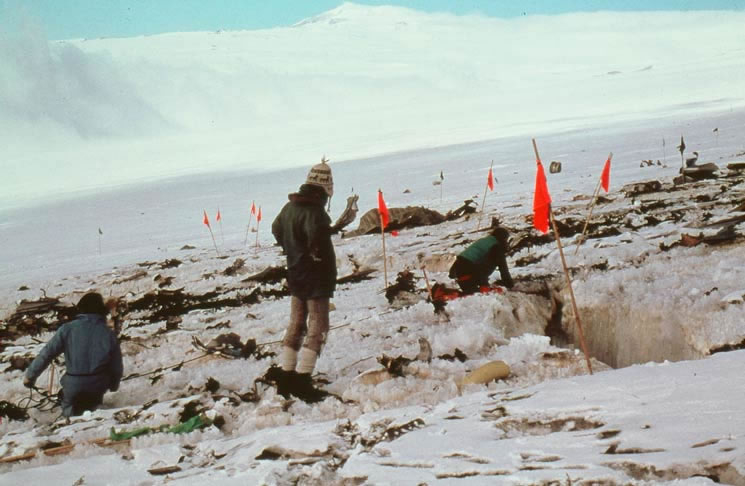
I was with the McDonnell Douglas engineers while they were looking at the engines. They told me that the aircraft must have been on a climb at the point of impact, as the engines were on three-quarter power. Some of the passengers were found with their clothes missing but had no obvious injuries. I do not think anyone would have survived the impact.
Some of us were given a titanium ice axe by McDonnell Douglas which had an inscription on it. It is well worn now after years of use. Some of us were later given medals as well.
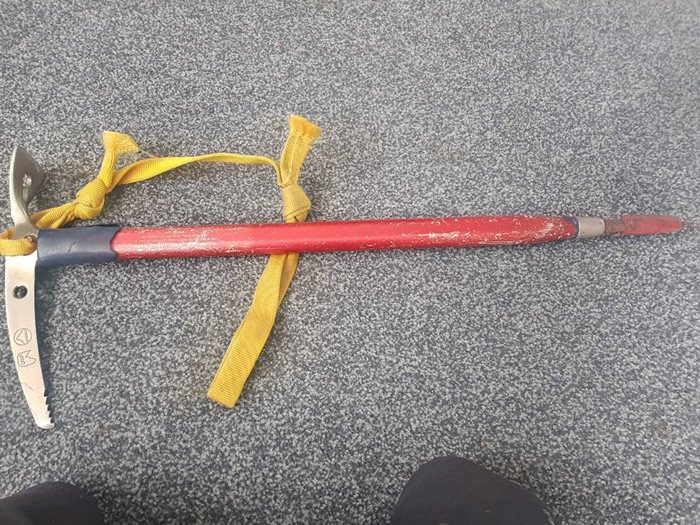

The inscription reads:
Roy Arbon. In appreciation for your efforts in the recovery operation on Mt Erebus. Douglas Aircraft Company December 1979.
One thing that has stayed with me is the smell of unburnt aviation fuel. When the plane went down there was a blast from the aviation fuel but not all of it burnt off. I remember going into the cockpit with one of the lead mountaineers, John Stanton, to recover any remains. Some had been badly burnt, so it was very hard to get their remains into a bag. I do remember finding intact Leopard beer cans that were on board the plane. Once these had thawed out, I remember ripping the tab off and drinking it after I had put the body in the bag and labelled it. I am sure I had more than one. Others soon joined in. While the cockpit was burnt out, the mid-section of the plane was intact. Here we recovered bottles of Marque Vue and Cold Duck wine which were later consumed at the end of the job. I remember at the end we pushed the wheels down the cliff into the sea. Boys will be boys.[2]
This was the first incident where the newly developed police DVI (Disaster Victim Identification) kits had been used. I was very impressed with the two police officers I worked with, Mark Penn and Al Windleburn. Very professional guys.
Another task we had was to try and collect all the cash blowing around the crash site and recover any of the cameras belonging to passengers.
When I returned to Scott Base after the recovery phase, I was asked to help erect a memorial cross on the site. This was done in a gale-force wind so bad the helicopter could not shut down. I believe this was because the wind was blowing so hard, they wouldn’t be able to get the machine started without damage to the main rotors.
The back-up afterwards was as good as could be expected. The psychologist from Wellington met me and gave me a questionnaire to fill out. He also met with my wife-to-be and asked her a lot of questions. This job didn’t affect me at the time. It was not until the 40th anniversary of the accident in 2019 when Air New Zealand flew family and Operation Overdue members up to Auckland. I met a woman from Canada at Christchurch airport on my way to the function in Auckland. I asked her where she was going. She told me she was attending the same thing as me and that her sister had been on the flight and had left behind a daughter. That is when it struck me. A child with no mother.
Notes
[1] Eight Federated Mountain Clubs volunteers helped recover bodies after the accident. Their skills in mountain rescue were needed because of the site’s icy conditions and crevasses. You can listen to accounts from Hugh Logan and Keith Woodford here:
[2] Mark Penn, one of the police recovery team working on the crash site, in a later interview for the docudrama, Erebus-Operation Overdue, described how at the conclusion of the body recovery phase there was a ‘bit of a session’ as those involved needed to ‘let off steam’.
Note: the memory on this page is in the writer's own words and does not necessarily reflect the views of Manatū Taonga.
Images and text cannot be reused without permission.
Read more memories like this: Reflections on Erebus series.
See also, Operation overdue and passengers and crew from Flight TE901 (Manatū Taonga)
Roy Arbon
