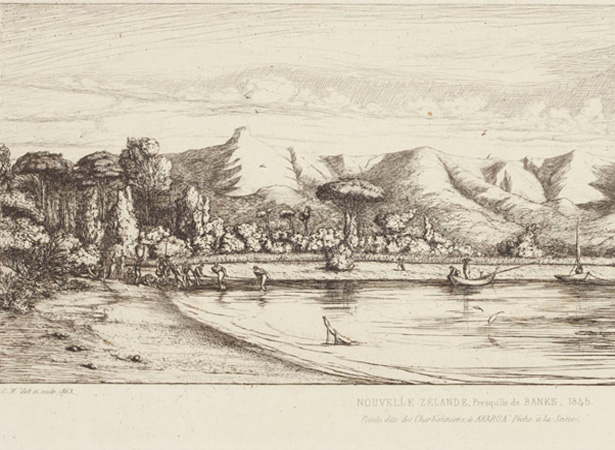
HMS Britomart arrived at Akaroa, Banks Peninsula, a week before a shipload of French and German colonists landed there. Britomart's captain raised the Union Jack to emphasise the United Kingdom's claim to sovereignty over the area.
In August 1838 Jean François Langlois, captain of the French whaler Cachalot, 'bought' Banks Peninsula from Kāi Tahu for 40 pounds in one of a number of such purchases. In November 1839, what became known as the Nanto-Bordelaise Company was formed with the goal of establishing a settlement at Akaroa as the nucleus for a French colony in southern New Zealand (Te Waipounamu) that would be linked with a penal colony in the Chatham Islands. The French government agreed to recognise this enterprise and give it financial assistance.
Captain Charles François Lavaud, who was to be the French government's commissioner in the fledgling colony, sailed for New Zealand on 19 February 1840 on the corvette Aube. A month later, two weeks after running aground on a mudbank while leaving Rochefort, the Comte de Paris set off for Akaroa. It carried between 50 and 60 French and German emigrants who were to form the nucleus of a settlement, and was heavily laden with all manner of animals, plants, tools, building materials and agricultural implements, as well as arms and ammunition.
In the period between the dubious land purchase and the departure of the would-be colonists, the situation had changed radically: Britain had moved to colonise New Zealand. The signing of the Treaty of Waitangi (including by Kāi Tahu rangatira Iwikau and Hōni Tikao at Akaroa on 30 May 1840) and Lieutenant-Governor William Hobson’s declaration of sovereignty over the whole country on 21 May confirmed that New Zealand was, at least in European eyes, a British colony.
Until Lavaud arrived in the Bay of Islands in early July 1840 he was unaware of these developments. While Hobson was friendly enough to Lavaud, he sent HMS Britomart, under the command of Captain Owen Stanley, to observe French activities at Akaroa. Britomart left the Bay of Islands on 23 July and reached Akaroa on 10 August. Aube left the Bay on 30 July and entered Akaroa Harbour five days after Stanley. Lavaud now accepted that he could not realistically hope to create a French colony in Te Waipounamu.
By the time the Comte de Paris arrived at Akaroa on 17 August with its advance party of settlers, the Union Jack had already fluttered over several British court sessions there. But Hobson recognised the sensitivity of the situation. Lavaud was permitted to administer French law to the settlers, and the Union Jack was not flown again on land at Akaroa until February 1843, after the commissioner had left to return to France.