
New Zealand's First World War Centenary (WW100) programme marked the First World War centenary from 2014 to 2019 through a range of events, activities, and projects in all parts of the country.
Manatū Taonga Ministry for Culture and Heritage (MCH), New Zealand Defence Force (NZDF), and the Ministry of Foreign Affairs and Trade (MFAT) worked together to deliver the official WW100 programme. A programme team based at MCH was responsible for planning, coordinating and communication of centenary projects.
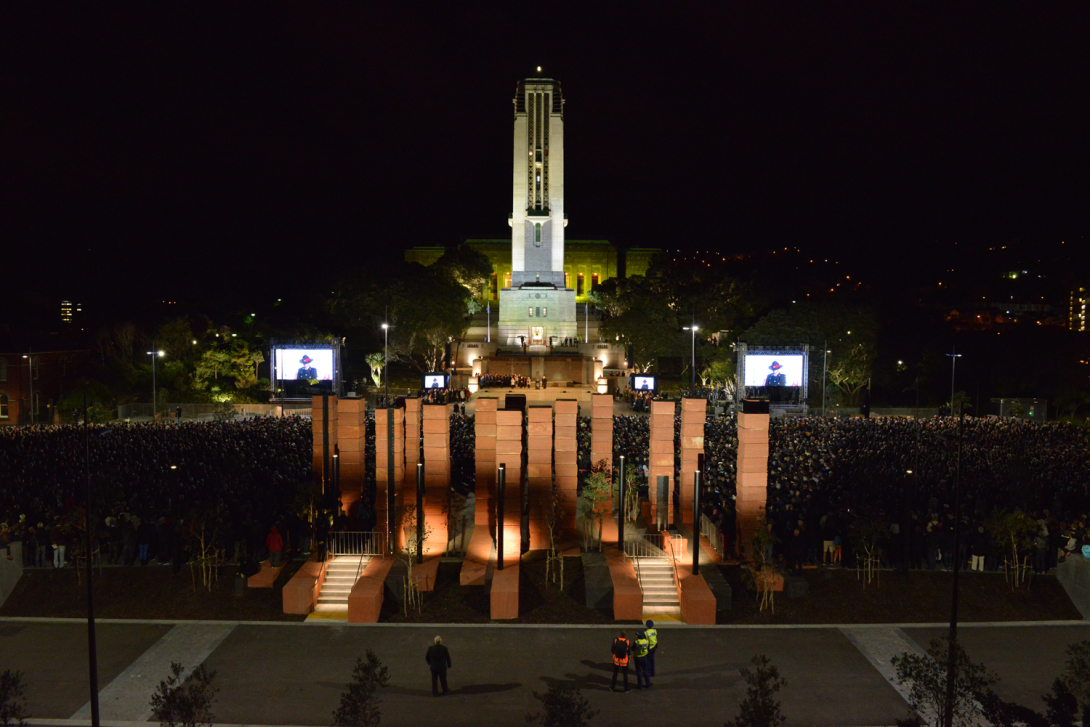
Government-led projects included the completion of the Pukeahu National War Memorial Park in 2015, a series of First World War book publications, national and international commemorations of significant battles, the Ngā Tapuwae heritage trails at Gallipoli and the battlefields of the Western Front in France and Belgium, and the development of the Walking with an Anzac Education Programme.
Two major exhibitions – The Great War Exhibition (Peter Jackson) and Gallipoli: The Scale of Our War (Te Papa/Weta Workshop) – opened during the centenary, and Archives New Zealand and the National Library of New Zealand digitised around 153,000 First World War military personnel records, and 250 letters and diaries, respectively.
First World War’s impact on New Zealand
One of the most momentous events of the 20th century, the First World War (1914−1918) had a profound and enduring impact on New Zealand. Around 10% of New Zealand’s population (then 1.1 million) served overseas. More than 18,000 died, and over 40,000 were hospitalised due to injury and sickness. The war impacted families and communities around the country.
Remembering service, sacrifice, and opposition
The centenary commemorations honoured the service and sacrifice of those who fought overseas, and those people who remained at home. With a generation of men overseas, women took on new roles that began to change our workforce and society. WW100 also acknowledged the courage of those who – at a time of intense pressure to conform – opposed the war, including conscientious objectors.
Commemorative themes
‘WW100' became a shared identity for New Zealand First World War centenary projects and activities, from official state ceremonies and legacy projects to community initiatives and personal projects. They followed a series of commemorative themes across 2014 and 2019 chosen to match the chronology of events between 1914 and 1919, including:
- 2014: Duty and adventure
- 2015: The Anzac connection
- 2016: Transition − a national war effort
- 2017: The grind of war
- 2018: The darkness before the dawn
- 2019: Finding our way back
WW100 website
The centenary programme’s digital hub was the WW100 website: https://ww100.govt.nz/.
An archived version of the website remains accessible to the public, and includes the following sections:
Discover WW1
Did you know?
Lesser-known aspects of New Zealand's First World War experience.
- New Zealand at the 1919 Paris Peace Conference (David Green)
- Over the Rhineland – the New Zealand occupation of Germany
- A discontented electorate – 1918 by-elections (Jim McAloon)
- Influenza on the SS Tahiti (Ryan McLane)
- “E kore au e whakaae kia haere aku tamariki ki te whakaheke toto” – Ko tā Waikato ātete atu ki te Ture Puruma i te Pakanga Tuatahi o te Ao (Monty Soutar)
- “I will not agree to my children going to shed blood” – Waikato Resistance to Conscription in the First World War (Monty Soutar)
- Faith, Hope and War – religion in New Zealand during WW1 (John Milnes)
- Clive Collet’s pioneering parachute jump (Adam Claasen)
- New Zealanders in the Crucible of History (John Milnes)
- The very picture of generosity (Caroline McBride)
- When the war came to New Zealand waters (Michael Wynd)
- The New Zealand Cyclists at Messines (Jamie Mackay)
- The arrest of Rua Kēnana (Mark Derby)
- Niue joins the New Zealand war effort (Margaret Pointer)
- A wartime world cup (Clive Akers)
- Maheno, New Zealand’s mercy ship (Gavin McLean)
- Returning home from war (Imelda Bargas)
- Dentistry under fire – the New Zealand Dental Corps (Rebecca Nuttall)
- Te Hokowhitu a Tū – Marking the departure of the Maori Contingent (Monty Soutar)
- 'Massey's Tourists' – New Zealand's Expeditionary Force in Egypt (Matthew Tonks)
- The New Zealand Expeditionary Force sets forth (Matthew Tonks)
- What New Zealanders left behind in Arras, France
- The enemy at Gallipoli wasn’t the ‘Turks’ (Virginia Gow)
- Where Britain goes, we go? (Steve Watters)
- Pigeons of war (Virginia Gow)
What is it?
A look at the First World War through memorials, photographs, and objects.
- Building a legacy – New Zealand's 'battle exploit' memorials (Laura Dunham)
- Le Quesnoy in images
- Horse-hair watch-guard a memento of prison life (Margaret Lovell-Smith)
- ‘We are sending you a “home portrait”’: The Dominion Museum’s Collection of Photographs of New Zealand’s Great War (Kristie Ross)
- Private Terekia Taura’s trench art (Deborah Ancell)
- ‘Actively engaged, often under fire’ – Two New Zealand Nurses in the French Flag Nursing Corps (Kristie Ross)
- Reinhold Fätsch’s dog tag (Seán Brosnahan)
- Objects from a desert war (Jock Phillips)
- Reigning over Rangītikei (Margaret Tennant)
- The taonga of HMS New Zealand (Marguerite Hill)
- Meet the Objects: The Daily Life of a Soldier at Gallipoli (Georgia Brockhurst)
- The first glimpse of Gallipoli
Then and now
Contrasting events of 1914–1919 with those a century later.
- Remembering Elizabeth's acts of compassion
- The New Zealand-Messines connection (Steven Reynaert)
- Death and Taxes (David Green)
- The Menin Gate Last Post ceremony – An enduring tradition (Matthew Tonks)
- The week we went to war (David Green)
- The centenary of the last ordinary 25 April (Virginia Gow)
- Battlefield of Messines (Archives New Zealand)
Hands-on history
Researching the First World War and new analysis about New Zealand’s experience.
- Writing a Great War family history (Paul Barker)
- Virtual tunnels – the LiDARRAS project (Paul Gorman)
- How many New Zealanders served on Gallipoli – some new answers (David Green)
- Movie-going during the First World War (James Taylor)
- How many New Zealanders landed on Gallipoli? Some new evidence (David Green)
- Following in their footsteps – the making of Ngā Tapuwae (Denise Stephens)
- Telling the story of the 1914 occupation of German Sāmoa (Janneen Love)
- Photographing New Zealanders at war (Melanie Lovell-Smith)
- Featherston camp death register (Imelda Bargas)
- How many New Zealanders served on Gallipoli? (David Green)
Rich questions
Historians take a closer look at people, places, and events of the First World War.
- What happened at Surafend? (Terry Kinloch)
- 'A run of bad luck' – How Kiwi soldiers described their wounds (Anna Rogers)
- Who were the peace babies? (Imelda Bargas)
- 1917 – A German Perspective (Martin Beyer)
- Counting the cost of Passchendaele (Ian McGibbon)
- News from the front: Before and after Passchendaele (Carolyn Carr)
- Why did some New Zealanders fight to stay at home? (David Littlewood)
- Troupes at war (Amy Hackett)
- The toll of the Somme (Ian McGibbon)
- A century of Anzac Days (Neill Atkinson)
- The evacuation from Gallipoli in the soldiers’ own words (Matthew Tonks)
- No ordinary transport: The sinking of the Marquette (Anna Rogers)
- Could the attack on Chunuk Bair have succeeded? (Richard Stowers)
- New Zealanders and Australians on Gallipoli: ‘Pig Islanders’, Toughs and Wild Men (Kate Hunter)
- What was life like on board the troopships? (Gavin McLean)
- Why don't we commemorate 'Passchendaele Day'? (Steve Watters)
Personal stories
The stories of New Zealanders who experienced the war overseas and at home.
- Victor Low – the Chinese Anzac who laid out the Bulford Kiwi (Colleen Brown)
- Pardon for soldiers executed in the Great War (Mark Peck)
- Khaki weddings (Matthew Tonks)
- Desert Riders
- Fraser and the First World War (Jim McAloon)
- Fraught with serious even terrible possibilities’: Conscription in WW1 (Kristie Ross)
- Keeping the home fires burning (Fiona Baverstock)
- Solomon Isaacs’s courage and commitment (New Zealand Post)
- An Anzac Armistice (Matthew Tonks)
- News from Gallipoli (Imelda Bargas)
- John James Jackson's story (Sarah Lang)
Viewpoints
People share their reasons for commemorating the First World War in New Zealand.
- Monumental – Memories inscribed in stone (Steve Watters)
- Monumental – A Community Effort (Ashley Mackenzie-White)
- Monumental – New Zealand's 500 First World War memorials (Jock Phillips)
- Lessons of Compassion (Brooke Kinajil-Moran)
- "Why do we commemorate?" – The educator (Steve Watters)
- “Why do we commemorate?” – The peacemakers (Margaret Lovell-Smith)
- "Why do we commemorate?" – The military historian (Matthew Buck)
- “Why do we commemorate?” – The RNZRSA (Mark Compain)
Monumental
Understanding New Zealand’s First World War memorials.
NZ at war timeline
Timeline of significant First World War events.
Unsung Heroes
Stories of New Zealanders who served at Gallipoli in 1915.
- The Bravery Awards system (Matthew Buck)
- Lieutenant-Colonel William George Malone (John Crawford)
- Chaplain Major William Grant (Zane Kidd)
- Courage under Fire: Stories from the Auckland Infantry Battalion (Peter Cooke & John Crawford)
- Unsung Heroes of a Forgotten Battle: Hill 60 (Terry Kinloch)
- Unsung Gallipoli Heroes of the Canterbury Mounted Rifles (John Crawford)
- 'Needless to say, we hung on…’: The Otagos at Gallipoli (Seán Brosnahan)
- Bearing the Wounded (Peter Cooke & John Crawford)
- Looking after Your Brother: the Breeze and Pyle brothers
- Getting the Line Through (Mark Brewer)
Sites & sources
Sites and sources for learning about the history of the First World War from a New Zealand perspective.
For teachers∗
Activities and ideas for teachers and families examining the experiences of New Zealanders in the First World War, and the wider issue of commemoration.
∗ For up-to-date teaching and learning resources related to New Zealand and the First World War visit Te Akomanga.
Censorship
Subject experts share their perspectives on censorship, state control, media, and the truth during the First World War and the 21st century.
- Censorship and State Control in WW1 (Jared Davidson, Archivist)
- Censorship in the age of social media (Megan Whelan, Digital Editor)
- Little can be taken for granted when it comes to the truth (James Hollings, Academic)
- Censorship in modern New Zealand (Harry Talbot, Censor)
- Information overload (Sharon Murdoch, Cartoonist)
WW100 by the numbers
Centenary activities during 2014–2019 focused on family connections, places, stories, and the freedoms we enjoy. In terms of numbers, the WW100 programme saw:
- 13 First World War centenary anniversaries marked with national commemorations.
- 9,851 New Zealanders register for the ballot to attend Anzac Day at Gallipoli in 2015.
- 60,000-plus children engage with Walking with an Anzac school kit in 2018 and 2019.
- 247 First World War diaries and letters digitised by the National Library of New Zealand as part of the WW100 digitisation project.
- 199 grants awarded for community projects by Lottery WW100 Commemoration, Environment and Heritage Committee.
- 1,297 Last Post Ceremonies held at Pukeahu National War Memorial Park.
- 152,896 First World War personnel files digitised and made available online by Archives New Zealand.
- 84 films with New Zealand First World War connection repatriated by Ngā Taonga Sound & Vision.
- 33-plus hours of First World War content funded by New Zealand On Air
- 96,000 pieces of user-generated content added to the Auckland War Memorial Museum’s Online Cenotaph.
- 1,135 activities listed on the WW100 website by community groups.
- 164,000-plus watch livestream of one of the domestic national commemorations
- 50 tonnes of chalk dropped on Bulford Kiwi in the UK as part of a restoration project.
- 48 youth ambassadors from New Zealand and the Pacific attended official overseas commemorations through the Ministry of Foreign Affairs and Trade and New Zealand Defence Force.
- 4 years of work by carvers, tutors and students of the New Zealand Māori Arts and Crafts Institute produced an 8-metre tall pou maumahara (memorial carving) gifted to the community of Zonnebeke, Belgium.
- 400-plus flags gifted to sub-branches of the Returned Services League of Australia and other community organisations for use in commemorations.[1]
Overall, 93% of New Zealanders engaged in the First World War centenary commemorations. Young people (15−24-year-olds), Māori and Pacific peoples took part in similar proportions as all New Zealanders. Most New Zealanders (83%) emerged from the commemorative period with a better understanding of New Zealand’s involvement in the First World War.[2]
[1] Manatū Taonga Ministry for Culture & Heritage, WW100 First World War Centenary Programme Final Report, April 2019: https://ww100.govt.nz/sites/default/files/files/mch-ww100-report-ART-FINAL-WEB-RES.pdf (accessed 14 May 2025)
[2] Ibid.
Ngā Tapuwae New Zealand First World War Trails website
Ngā Tapuwae New Zealand First World War Trails is a First World War Centenary (WW100) legacy project that guides visitors through key Gallipoli and Western Front sites. Meaning ‘the footsteps’, Ngā Tapuwae lets people follow the paths of New Zealand soldiers, explore historic landscapes, and deepen their understanding of New Zealand’s First World War experience through audio, articles, and historical images – either on location or remotely.
The Ngā Tapuwae Trails website (https://ngatapuwae.govt.nz/) was created in 2016. An archived version of the website remains accessible to the public via the National Digital Heritage Archive (NDHA) at the National Library of New Zealand. It includes the following sections:
Explore Gallipoli
The war that changed everything (YouTube) – note this video is not available via NDHA version.
Explore the trails
- Take the guided tour
- Stories & insights:
- Take the guided tour
- Stories and insights:
- Take the guided tour
- Stories and insights:
- Take the guided tour
- Stories and insights:
- Take the guided tour
- Stories and insights:
Discover the Western Front
The war that changed everything (YouTube) – note this video is not available via NDHA version
Explore the trails
- Take the guided tour
- Stories and insights:
- Take the guided tour
- Stories and insights:
- Take the guided tour
- Stories and insights:
- Take the guided tour
- Stories and insights:
- Take the guided tour
- Stories and insights:
- Take the guided tour
- Stories and insights:
- Take the guided tour
- Stories and insights:
- Take guided tour
- Stories and insights:
- Take the guided tour
- Stories and insights:
- Take the guided tour
- Stories and insights:
- Audio: Staff Nurse Elsie Grey
- New Zealand hospital care
- Medical advances
- Audio: Private Stewart Callaghan
- The logistics of war
- Infographic: Medical advances and injuries
- Audio: Private Thomas Gibson Denniston
- Further reading
- Glossary
New Zealand in the Middle East
Learn about the men who fought in the Sinai and Palestine Campaigns between 1916 and 1918.
Further information
This web feature was written by Gareth Phipps and produced by the NZ History team.
Centenary (New Zealand) – International Encyclopedia of the First World War
Review of New Zealand's First World War Centenary by Jock Phillips and Kingsley Baird.
The WW100 Final Report provides an overview of the five-year commemorations programme, and illustrates how it met its original objectives using a selection of centenary projects.
Videos and live-streamed events relating to New Zealand's First World War Centenary 2014–2019.