Parliament grounds
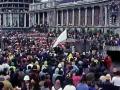
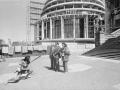
New Zealand is one of the few countries in the world in which the public can walk freely around the grounds of Parliament. On a fine day, people sunbathe or enjoy their lunch on the grass; walkers getting from one part of Wellington to another use the grounds as a short cut; and the rose gardens and sloping lawns make an ideal venue for special photographs, especially with the backdrop of the buildings. The grounds have been a traditional place for groups of people to gather for celebration, to listen to important announcements, for protest or to mourn the death of a major public figure.
The grounds around the first Parliament Buildings in Auckland in the 1850s and 1860s were bare paddocks. The grounds of the Wellington buildings were not much better, and it was not until the 1890s that they were landscaped, with the many hollows and bumps smoothed into a gently sloping hillside. New gates were erected on Molesworth Street – the main entrance – from which a carriage drive swept up to the front of the buildings.
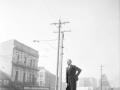
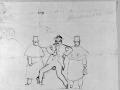
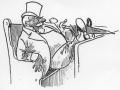
Electric lighting was first installed in the grounds in the 1890s. Until then, MPs and others who worked in Parliament had to fumble their way out of the dark grounds aided by a gaslight that was lit only on evenings when there was no moon and even then was put out at midnight. There were stories of parliamentarians feeling their way along fences with the aid of umbrellas or sticks and walking into posts and poles in the dark. Complaints finally led to the appointment of a gaslighter, who doused the outside lights at 2 a.m. after the last member left.
The 1907 fire made redesign of the grounds necessary, and the basic format created in the 1920s remains largely unchanged today. Lawns and drives were set out, and deciduous trees and pōhutakawa were planted. The main entrance to the complex was now at the corner of Bowen Street and Lambton Quay, where a large elm tree stood sentinel.
Piccolo Charlie
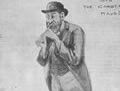
A few people made Parliament grounds their place – somewhere to go to perform or to preach. One famous performer was Piccolo Charlie, who was called this because of the tunes he would play on his musical instrument in the 1890s and early 1900s. With his small dog by his side, Charlie would stand at the bottom of Molesworth Street and play the favourite tunes of politicians as they went by: 'Hard times come again no more' for Joseph Ward, 'The wearing of the green' for Richard Seddon, a Maori lament for James Carroll. Charlie was eventually moved along to the other end of town after someone complained about his music.
Statues
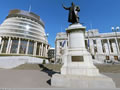
Parliament grounds include two statues of former premiers. A bronze statue of Richard Seddon, premier between 1893 and 1906, stands outside Parliament House. It was designed by British sculptor Sir Thomas Brock and was erected in 1915. Today it is one of the most photographed parts of Parliament grounds. Outside the Parliamentary Library is a statue of Seddon's predecessor as premier, John Ballance. This marble statue, unveiled in 1897, originally stood on Parliament's front lawn. It was moved after the First World War when the grounds were re-landscaped.