Whatungarongaro te tangata, toitū te whenua: People disappear, the land remains
Pukeahu offers a hands-on opportunity to explore a range of themes related to teaching and learning about Aotearoa New Zealand’s histories. Co-constructed with teachers to meet their needs and those of their students, it features:
- Place-based learning drawing on stories from the land that connect local and national histories
- A space to think critically about perspectives and issues that affect young people and society today
- Opportunities to consider how history is constructed – how events are remembered and what silences exist.
Pukeahu is a hill in Wellington city moulded between two streams. One stream runs down Taranaki Street to the vicinity of Te Aro pā. The other stream begins near Wellington hospital and runs down Adelaide Road. Both flow into the moana, Te Whanganui a Tara. They were part of a rich landscape for local Māori, who cultivated their gardens and lit their fires on this land. You can’t see either of these streams now because they’ve been channelled through underground pipes, but they remain, much like the stories of this land.
With the arrival of European settlers, Pukeahu was renamed Mount Cook. In the years since, a range of functions have shaped the hill’s form and identity. It was first seized for military purposes and the building of police barracks and a prison. This activity saw the hill lowered by some 25 metres, dramatically changing the landscape. The National War Memorial opened in 1932, with the addition of the Hall of Memories in 1964 and the Tomb of the Unknown Warrior in 2004. Pukeahu National War Memorial Park was built to create a space around the existing National War Memorial as part of the government’s acknowledgement of the centenary of the First World War.
Below are just some of the features in and around Pukeahu that can be explored as part of a field trip. Find out more about these memorials in the Pukeahu Park Guide (Manatū Taonga)
Te Reo Hotunui o Te Moana-nui-a-Kiwa

Use Michael Tuffery’s stunning artwork Te Reo Hotunui o Te Moana-nui-a-Kiwa to explore whakapapa connections between Aotearoa and other Pacific Islands. The bronze shell evokes the history of a conch left in the Arras tunnels by Kuki Airani (Cook Island) soldiers of the New Zealand Māori (Pioneer) Battalion, who were stationed in and beneath the town of Arras in 1916 and 1917.
Image: Pacific Islands Memorial – Te Reo Hotunui o Te Moana-nui-a-Kiwa
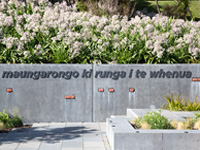
The Kāhui Maunga gardens acknowledge the long association of Māori with Pukeahu. Much of the land around Pukeahu was occupied by ngakinga (gardens) for Te Akatarewa pā on the ridgeline Te Ranga-a-Hiwi, directly west of Pukeahu. This was a major pā for the Ngāi Tara iwi. They developed numerous garden sites around Pukeahu. These gardens were also used by Taranaki iwi who lived at nearby Te Aro pā from the early 19th century. Three toka (rocks) sourced from Taranaki, Tongariro and Ruapehu bring together the people connected with the Kāhui Maunga story. They are etched with whakairo (carvings) that tell many histories.
Image: Ngā Tapuwae o te Kāhui Maunga gardens (Wraight + Associates).
Hinerangi
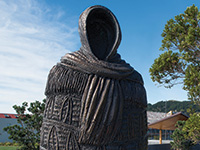
A central feature within the Kāhui Maunga gardens is Hinerangi. This captivating bronze sculpture, made by Darcy Nicholas, is alive with symbolism and can be used when teaching about connections to land and people. Hinerangi faces the Tomb of the Unknown Warrior; she represents the spiritual realm and reminds us of the impact of war on women and families.
Image: Hinerangi sculpture (Katie Cheer).
Mt Cook prison
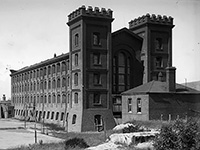
In 1882 a huge prison was built on Pukeahu. The prison was four stories high and had 381 cells. Archibald Baxter and other First World War conscientious objectors spent time there. The prison brickworks produced 18 million bricks to build the prison using clay from Pukeahu and the prisoners provided free labour. Prison-made bricks were marked with an arrow that can still be seen in the buildings and walls around Pukeahu. This is history connected to colonisation, justice, law and religion.
Image: Alexandra Barracks, former Mt Cook Prison, 1929 (Museum of New Zealand Te Papa Tongarewa).
Parihaka
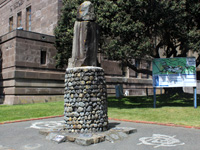
Pukeahu is linked to a history of raupatu (land confiscation) and state oppression of Māori. Neighbouring the Pukeahu War Memorial Park, this sculpture, placed by Taranaki iwi, stands in memory of the men from Parihaka who were imprisoned in the Mount Cook Barracks following their peaceful resistance against land alienation. The men were never tried. Instead, they were shipped to the South Island, taking them further away from their home community. This site invites students to consider ideas related to mana motuhake, rangimarie, colonisation, intolerance and resistance.
Image: Parihaka Memorial (Wellington City Libraries).
William Wakefield memorial
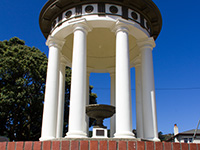
What do we do with colonial markers that stand in celebration of people (mainly men) who are now viewed as responsible for creating long-standing grievances? Remove them? Add new interpretations? Build something new? A memorial to William Wakefield, from the New Zealand Company, stands on the eastern embankment at the Basin Reserve across the road from the Pukeahu Education Centre. It can be used to tell stories connected to colonisation, Māori land alienation and Te Tiriti o Waitangi. Students can analyse its interpretive panel and write their own interpretation.
National War Memorial
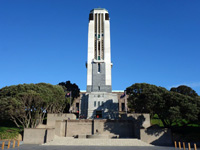
How should we remember New Zealand’s involvement in war? Pukeahu has been the site of the National War Memorial since 1932. It is an ideal place for students to learn about how war is remembered and memorialised. The park can support inquiries into war, its causes and impacts, conscientious objection, war poetry, peace and art. All the different memorials in the park connect to stories and perspectives.
Image: National War Memorial Carillon (jontynz).
'Chinatown'
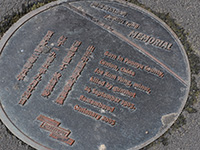
Wellington’s historic ‘Chinatown’, centred on nearby Haining and Frederick Streets, brings into focus social and economic history from the late 19th and early 20th centuries. The memorial to Jo Kum Yung, who was murdered on Haining Street, links to ideas such as white supremacy, racism and immigration.
Image: Jo Kum Yung memorial plaque (Katie Cheer).
The Home of Compassion Crèche
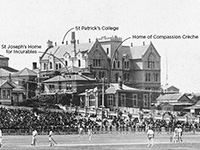
The area surrounding the current Pukeahu Education Centre was once part of a ‘Catholic precinct’ that was developed in the early 20th century. The Home of Compassion Crèche (now the education centre) is all that remains from this time. The crèche was established by Suzanne Aubert and the Sisters of Compassion. Learn more about this history and consider issues such as poverty, culture and changing beliefs.
Image: Home of Compassion Crèche, 1930s (Waka Kotahi NZ Transport Agency). See Manatū taonga website for more information.
Hauwai swamp
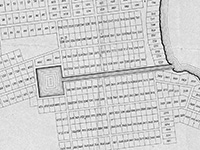
The swamp known as Hauwai (where the Basin Reserve now is) was, for Māori, a supermarket, a pharmacy and a hardware store. The eventual draining of Hauwai connects with natural forces (Rūaumoko/tectonic plates), as well as the ideologies and perspectives of the newly arrived Europeans who dismissed it as a ‘Great Dismal Swamp’.
Image: Plans for Wellington in 1841 (Alexander Turnbull Library. Ref: MapColl-832.4799gbbd/1841/Acc.16266).
Pūoro – working with sound
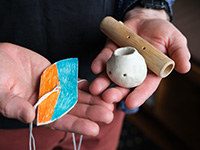
Visits can include working with clay to mirror Pukeahu’s brick-laden history, linking with Hine Ahu-One and stories of creation. Tāwhirimātea is a prevalent force at Pukeahu and his reo can be enacted through the making of cardboard porotiti (musical spinning disks).
Image: Porotiti – musical spinning disk (Katie Cheer)
Layers of history
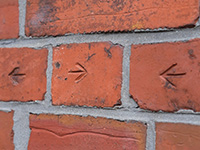
Etched into the buildings and the hillsides of Pukeahu are marks made by prisoners who were used as free labour to build the colony. The Mount Cook police station, built in 1893, and the remarkable brick wall that runs along Tasman Street holding up the sides of the puke, are prime examples. Historic air raid shelters burrow into the belly of the hill, a subterranean presence that evokes the layering of history as well as histories that remain hidden.
Image: Wall made with 'prison' bricks, Tasman Street (Katie Cheer).
History not mentioned
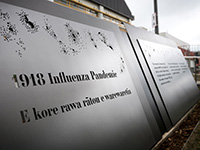
Students can consider what’s included and what’s not included in memorials. This memorial stands in memory of the 1918 influenza pandemic. Should it mention New Zealand’s role in spreading the virus in Samoa, resulting in the deaths of at least 22% of the population? How will people remember the current pandemic? How would you memorialise Covid-19?