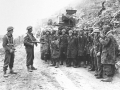
During the Second World War, many New Zealanders became prisoners of war, or went 'into the bag'. Around 9000 people – one in 200 of New Zealand's population – were held in captivity, compared with around 500 during the First World War.
Most Second World War POWs were servicemen taken on the field of battle, but several hundred civilians and merchant seamen were also interned.
When they were captured, most of these prisoners probably knew that their status was covered by international agreements without being aware of the details. The 97 articles of the 1929 Geneva Convention included provision for the adequate sustenance and humane treatment of POWs, and for relief by the International Red Cross Committee. The holding power had the right to put POWs other than those of officer or NCO status to work, though not on tasks of a direct military nature. The Convention offered a substantial degree of protection to POWs – provided it was recognised and applied by the holding power.
At the outset of the war, the British and German governments agreed to treat each other's POWs on the basis of the 1929 Convention; they subsequently agreed to do the same for internees. New Zealand followed suit. Italy also agreed to abide by the Convention when it entered the war in June 1940.
Japan had not ratified the Geneva Convention, but following its entry into the war in December 1941 it conveyed to the Western governments its willingness to observe the Convention 'mutatis mutandis'. This was interpreted to mean that Japan would follow the spirit, if not the exact letter, of the Convention. But in practice the Japanese authorities were largely blind to the Convention's provisions, official indifference being exacerbated by the contempt felt by Japanese soldiers for men who had – at least in their eyes – dishonoured themselves by surrendering.