On 1 February 1901 the Railways Department’s Tourist Office (which had recently been created by the Liberal government’s minister of railways, Joseph Ward), was established as an independent Department of Tourist and Health Resorts – the first dedicated central government tourist department in the world.
Its first superintendent was Thomas Edward Donne, a long-serving Railways official who became a dynamic leader of the developing industry. The department promoted tourist services and attractions to both domestic and international audiences though lantern-slide lecture tours, press articles, the distribution of post cards, photographs, guidebooks and pamphlets, and displays at overseas trade fairs, including the 1904 World’s Fair in St Louis, Missouri. A keen angler and hunter, Donne introduced red deer, wapiti, Canada geese and salmon to make New Zealand a ‘sporting paradise’, and chamois and tahr to add charm to alpine landscapes.
As well as supporting private tourist operators and improving transport links, the department took over a number of struggling facilities, including spas at Te Aroha and Hanmer Springs, the Hermitage hotel at Aoraki/Mt Cook (opened in 1884) and hostels at Te Anau. It soon began establishing scenic reserves and developing amenities at Taupō, Lake Waikaremoana, Te Puia Hot Springs, Waitomo, Milford Sound, Queenstown and elsewhere. Prophetically, in his first annual report in 1902, Donne predicted that then-sleepy Queenstown would become ‘the recognised tourist centre of the South Island.’
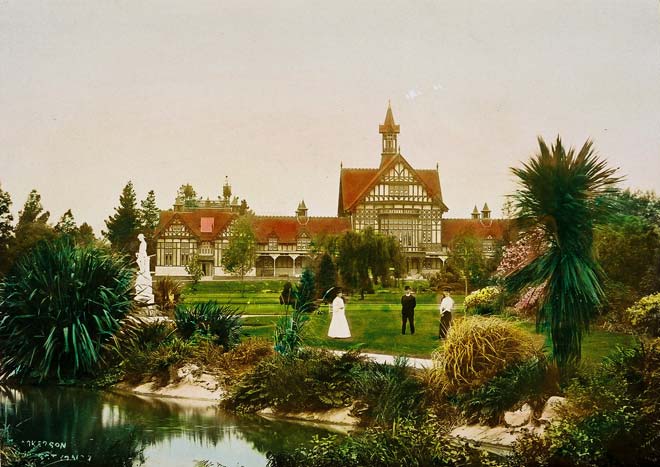
The jewel in the crown of New Zealand tourism at this time, though, was Rotorua, which had long been a centre of Māori entrepreneurship and a contested site of government control. Donne’s department established the town’s electricity supply in 1901, and the newly active Waimangu Geyser – briefly considered the largest in the world – drew a flurry of tourists. In 1902 Arthur Wohlmann, an English physician from Bath, was appointed Government Balneologist to develop and promote the therapeutic potential of Rotorua’s geothermal springs, but he was dismayed by the shabby facilities he found. Donne sought to enhance the town’s attractions by constructing an aviary featuring ducks, swans, peacocks, kea, kiwi and pūkeko, and even added a monkey, ‘the only diving and swimming monkey known’. Two brass bands – one Māori and one Pākehā – entertained visitors twice a week. In 1905 work began on a grand new Tudor-style Rotorua Bath House, surrounded by attractive gardens, which opened in 1908.
More controversially, from 1903 the department began constructing a ‘living village’ at Whakarewarewa to showcase a romantic, ‘primitive’ Māori lifestyle. The project (eventually completed in 1910) was dogged by disagreements over cost, design and authenticity. Local Māori were not initially consulted and resisted being commodified as a tourist spectacle. The model pā languished, but guiding and entertaining visitors remained an important activity for Rotorua Māori.
Tourism would not prove to be the ‘gold mine’ Ward and Donne promised – not yet, anyway. New Zealand’s isolation meant that only a trickle of well-off visitors arrived from Europe and North America. Publicity efforts faltered after 1909 when Donne left for London and Ward (who was now PM) relinquished the tourism portfolio, and then the First World War intervened. Working with Railways and private operators, the department would have more success helping to foster a surge in domestic tourism during the 1920s.