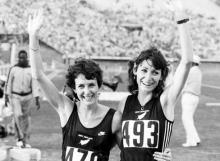
At the age of 37, Lorraine Moller ran the race of her life to place third in the marathon at the Barcelona Olympics.
Running
Events In History
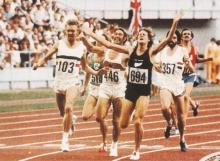
31 July 1976
Following in the footsteps of Jack Lovelock and Peter Snell, Walker won gold in the Olympic 1500 m. Black African nations boycotted the Games in protest at the All Blacks' tour of South Africa
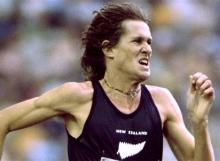
12 August 1975
John Walker became history’s first sub-3:50 miler, running 3:49.4 at Gothenburg, Sweden.
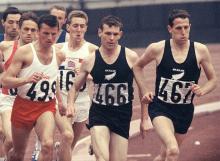
21 October 1964
Snell had successfully defended his 800-m title earlier at the Tokyo Olympics and completed the coveted middle-distance double with gold in the 1500 m. Fellow Kiwi John Davies won bronze.
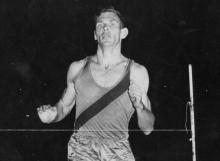
27 January 1962
The 23-year-old Olympic 800-m champion hoped to run the first four-minute mile on New Zealand soil. In fact, he broke Australian Herb Elliott’s 3½-year-old world record by the smallest possible margin, 0.1 seconds.
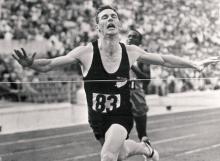
2 September 1960
New Zealand sport enjoyed one of its greatest days in Rome’s Olympic Stadium. Peter Snell won the 800 m and Murray Halberg won the 5000 m.
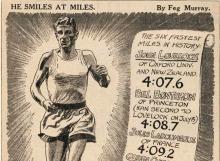
15 July 1933
Jack Lovelock's run at Princeton University broke Jules Ladoumegue’s record for the mile by 1.6 seconds. The race was dubbed the 'greatest mile of all time' by Time Magazine.
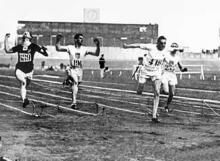
7 July 1924
The character in the Academy Award-winning film Chariots of fire (1981) was based on Arthur Porritt, who won a bronze medal for New Zealand in the 100 m at the 1924 Paris Olympics.
Articles
Sport, 1940-1960
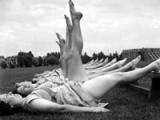
The mid-century decades brought more mass participation in sport, the consolidation of many national competitions, and greater achievement at international level. Read the full article
Page 2 - Lydiard's legacy
The cult of masculinity had one positive spin-off: Arthur Lydiard. A runner of iron will but limited natural ability, he discovered that as he ran further he got fitter.
Biographies
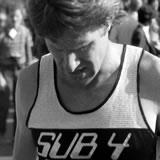
John Walker is one of New Zealand's track heroes. His athletic career was punctuated by memorable performances and noted for its longevity
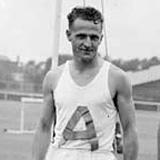
Arthur Lydiard was a marathon runner and athletics coach, whose most notable trainees included Olympic and Commonwealth Games champions.
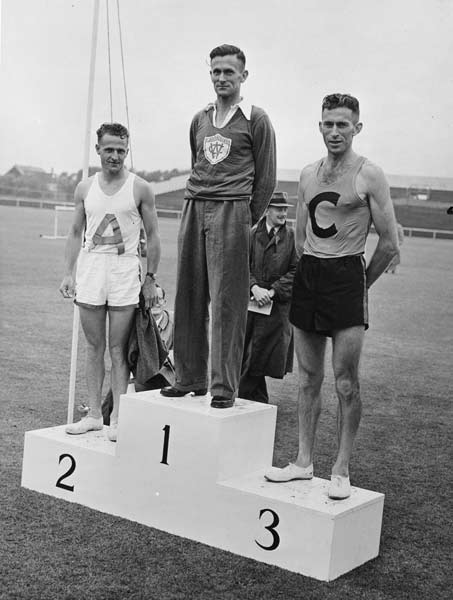
Main image: Arthur Lydiard
Arthur Lydiard was a marathon runner and athletics coach, whose most notable trainees included national, Olympic and Commonwealth Games champions.