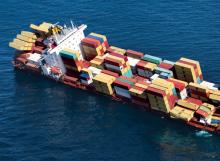
The German-built Rena is the largest ship ever wrecked in New Zealand waters. No lives were lost, but in financial terms it was our costliest-ever shipwreck.
Shipwrecks
Events In History
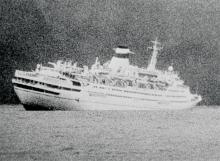
16 February 1986
At 5.37 p.m. on 16 February 1986, the Soviet cruise liner Mikhail Lermontov hit rocks off Cape Jackson in the Marlborough Sounds.
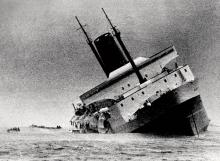
10 April 1968
The sinking of the Lyttelton–Wellington ferry Wahine is New Zealand’s worst modern maritime disaster. Fifty-one people lost their lives that day, another died several weeks later and a 53rd victim died in 1990 from injuries sustained in the wreck.
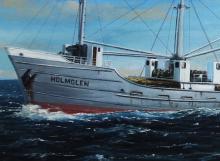
24 November 1959
All hands were lost when the modern coastal freighter Holmglen foundered off the South Canterbury coast. The cause of the tragedy was never established.
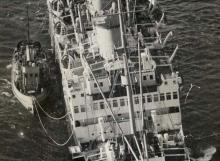
6 February 1947
The liner, carrying 400 passengers, struck Barrett Reef in Wellington Harbour on 19 January. Only an unusually long spell of calm weather - dubbed 'Wanganella weather' by locals - saved it from becoming a total wreck.
20 August 1940
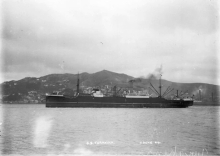
It was the first naval battle in the Tasman Sea. The New Zealand Shipping Company freighter Turakina was intercepted and sunk by the Orion nearly 500 km off the Taranaki coast with the loss of 36 lives. Twenty survivors were taken prisoner.
12 February 1909
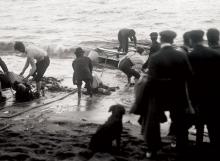
The Picton-Wellington ferry SS Penguin struck rocks in Cook Strait and sank in heavy seas off a rugged, isolated coast. Only 30 of the 102 people on board survived.
29 July 1897
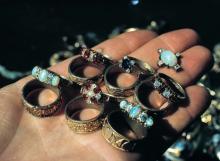
On the afternoon of 28 July, the Huddart-Parker steamer Tasmania left Auckland for Dunedin via Napier, Wellington and Lyttelton. At around 11 p.m. the following night, with a strong south-east gale blowing, the ship struck rocks off Table Cape, Māhia Peninsula.
29 October 1894
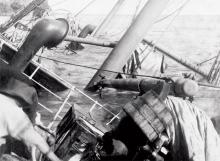
It remains the third deadliest shipwreck ever in New Zealand waters: 121 lives were lost when the steamer Wairarapa struck Miners Head, the north-west point of Great Barrier Island, 90 km north-east of Auckland.
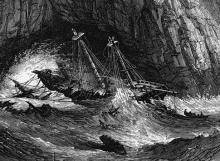
14 May 1866
Sailing from Melbourne to London, the General Grant hit cliffs on the west coast of the main island in the subantarctic Auckland Islands. Fifteen of the 83 people on board survived the sinking, but only 10 of them were ultimately rescued 18 months later.
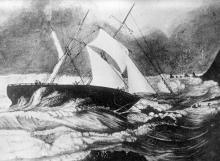
4 September 1863
Soon after leaving Nelson for Napier, the Delaware was wrecked in what is now known as Delaware Bay. Accounts of the incident often focus on the heroism of Hūria Mātenga, one of five local Māori who helped the crew get ashore.
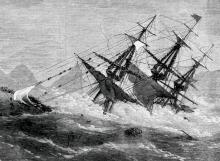
7 February 1863
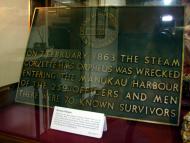
For the British it was the costliest day of the New Zealand Wars – but it occurred far from the battlefield. Bringing naval stores from Sydney, the modern 1706-ton steam corvette HMS Orpheus ran aground on the bar at the entrance to Auckland’s Manukau Harbour.
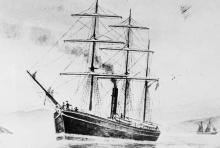
29 June 1862
No human lives but many irreplaceable government records were lost when the steamer was wrecked on the Wairarapa coast
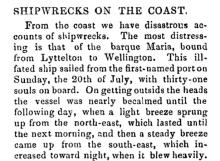
23 July 1851
Twenty-six lives were lost when the barque Maria was wrecked near Cape Terawhiti. This provided more ammunition for Wellington settlers who were trying to convince the government of the need for a lighthouse.
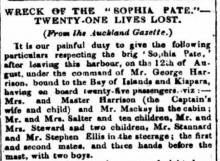
31 August 1841
The fate of the brig Sophia Pate, wrecked on a sandbar at the entrance to Kaipara Harbour with the loss of 21 lives, highlighted the dangers of navigating New Zealand’s poorly charted coastal waters.
Articles
Merchant marine
On 3 September New Zealand honours Merchant Navy Day. Here we explore the little-known but vital role played by the merchant marine during the First World War, when these civilian seafarers often found themselves in the front line of the war at sea. Read the full article
Page 6 - Agony on the Aparima
One of the worst losses of New Zealand lives at sea occurred on the Union Company’s Aparima in
Container shipping

Forty-five years ago, on 19 June 1971, the first all-container ship to visit New Zealand arrived in Wellington. Columbus New Zealand was part of a worldwide revolution in shipping. These simple steel boxes would change our transport industry, our ports and how we work and shop. Read the full article
Page 7 - The wreck of the Rena
On 5 October 2011 the MSC-chartered, Liberian-flagged container ship Rena astonished local mariners by grounding on the clearly marked Astrolabe Reef off Tauranga. Three months
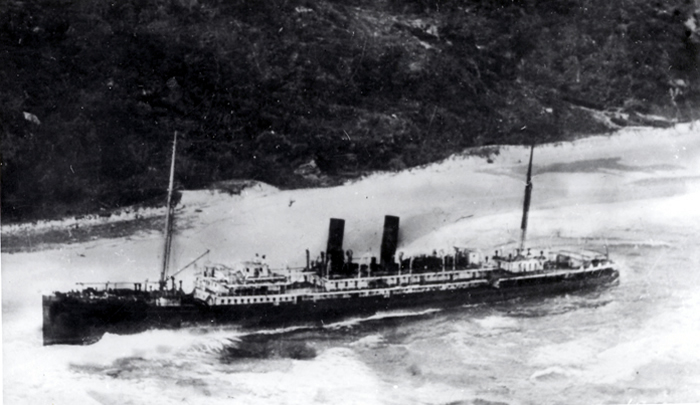
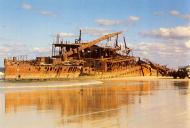
Main image: The Maheno washed up on Fraser Island
Tthe Maheno fetched up high on Fraser Island, Queensland after breaking away the tow to the scrapyard.