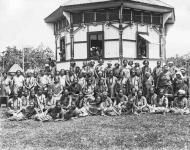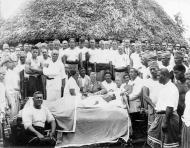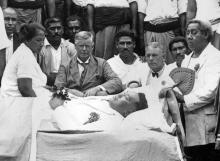
New Zealand military police fired on Mau independence demonstrators in Apia, killing eight Samoans, including the independence leader Tupua Tamasese Lealofi III.
Mau Movement
Events In History
Articles
New Zealand's administration of Samoa, 1920-35

New Zealand was ill-equipped to cope with the Western Samoa mandate it was allocated by the League of Nations in 1920. The Mau movement's passive resistance culminated in the violence of 'Black Saturday', 28 December 1929, which left 11 Samoans and one New Zealand policeman dead. Read the full article
Page 1 - New Zealand's administration of Samoa, 1920-35
New Zealand was ill-equipped to cope with the Western Samoa mandate it was allocated by the League of Nations in 1920. The Mau movement's passive resistance culminated in the
Page 4 - Sowing seeds of discontent
By 1926, anti-New Zealand feeling was strong throughout Samoa.
Page 5 - The rise of the Mau movement
Samoa has a history of opposition to European rule, but the opposition that emerged in the late 1920s was organised and
Page 6 - Stepping up the Mau campaign
In January 1928 Mau policemen dressed in a uniform of a purple lavalava with a white stripe began enforcing a sā - ban - on European stores in Apia.
Page 7 - Black Saturday
One New Zealand policeman and eight Samoans, including Tupua Tamasese Lealofi III, were killed in Apia on Black Saturday - 28 December
Page 8 - Towards independence
On 4 June 2002, New Zealand Prime Minister Helen Clark offered 'a formal apology to the people of Samoa for the injustices arising from New Zealand's administration of Samoa in
Capture of German Samoa

When war broke out in Europe in August 1914, Britain asked New Zealand to seize German Samoa as a ‘great and urgent Imperial service’. Although the tiny German garrison offered no opposition, at the time it was regarded as a potentially risky action. Read the full article
Page 4 - Wartime administration
German officials were replaced by New Zealand military officers, civilians, or British residents. These often lacked the experience or qualifications to do the

Main image: Funeral of Tupua Tamasese Lealofi III
Pall bearers and Mau police carrying the coffin of Tupua Tamasese Lealofi III