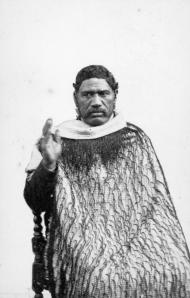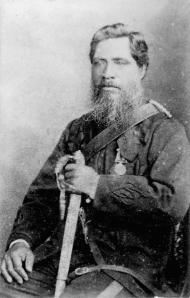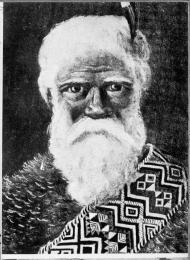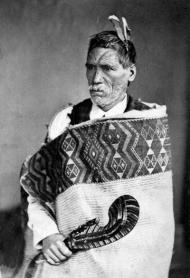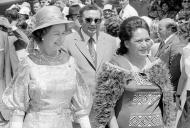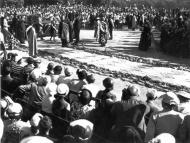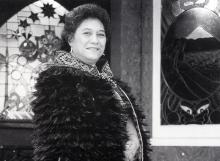
Princess Piki, the daughter of King Koroki, was selected as the sixth Maori monarch − and first Queen − during her father's tangi, in accordance with Kingitanga protocol. She assumed her mother’s name, Te Atairangikaahu.
Maori Leaders
Events In History
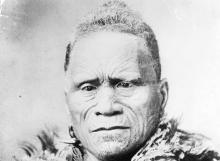
26 August 1894
Tāwhiao had led his people through the traumatic period during and after the wars of the 1860s. He was succeeded by his son Mahuta.
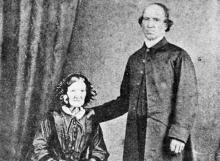
13 February 1869
A Ngāti Maniapoto war party sacked the redoubt at Pukearuhe (White Cliffs) in northern Taranaki, killing military settlers, family members and the missionary John Whiteley.
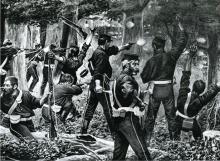
9 June 1868
Ngā Ruahine fighters led by Riwha Tītokowaru killed three Pākehā settlers near Ketemarae, north of Hāwera, signalling the resumption of fighting in south Taranaki.
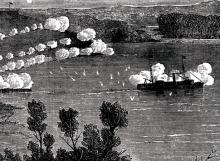
12 July 1863
British troops invaded Waikato by crossing the Mangatāwhiri Stream, which the Kīngitanga (Māori King movement) had declared an aukati (a line not to be crossed).
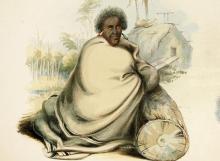
25 June 1860
The Māori King movement came into existence in the late 1850s as an attempt to unite the tribes, prevent land sales and make laws for Māori. Pōtatau Te Wherowhero became the first Māori King in 1858, but died two years later.
Articles
New Zealand's 19th-century wars

War changed the face of New Zealand in the 19th century. Many thousands of Māori died in the intertribal Musket Wars between the 1810s and the 1830s. There were more deaths during the New Zealand Wars of the 1840s to 1870s between some Māori and the Crown, which for many tribes had dire consequences. Read the full article
Page 6 - NZ Wars flags
Many Maori in the 19th century saw the Union Jack as a potent symbol of Great Britain's power in New Zealand. In the New Zealand Wars, Maori who resisted government forces often
Māori King movement origins

In May 2008, thousands of Māori gathered at Ngāruawāhia to celebrate the 150th anniversary of the formation of the Kīngitanga, or Māori King Movement. Read the full article
Page 1 - Origins of the Māori King Movement
In May 2008, thousands of Māori gathered at Ngāruawāhia to celebrate the 150th anniversary of the formation of the Kīngitanga, or Māori King
Page 2 - Overview
On 23 May 2006 the Māori Queen, Te Arikinui Dame Te Atairangikaahu, celebrated the 40th jubilee of her coronation. She was the sixth Māori monarch and the
Page 3 - The land issue
Pressure to sell land was a key factor in the creation of the Kīngitanga. Before European settlement Māori had no concept of selling land and few chiefs had the authority to gift
Page 4 - In search of a king
The Kīngitanga has often been described as a Waikato initiative, yet its origins can be traced to Ōtaki on the Kāpiti
Page 5 - Pōtatau Te Wherowhero
In April 1857, at Rangiriri, Pōtatau agreed to become king. He was crowned and anointed at Ngāruawāhia in June
Page 6 - A challenge to European authority?
Pōtatau established a boundary between the territory in which his authority held sway and that of the governor: 'Let Maungatautari [River] be our boundary. Do not encroach on this
Māori King movement - 1860-94

The reign of King Tāwhiao was dominated by the Waikato War and the fallout from it. Read the full article
Page 1 - Troubled times
The reign of King Tāwhiao was dominated by the Waikato War and the fallout from
Page 2 - Build-up to war
Like his father, King Tāwhiao had no intention of becoming involved in the war in Taranaki. The government, however, remained unconvinced about this. In July 1860 Governor Gore
Page 3 - Response to war
The invasion of Waikato unified the factions within the Kīngitanga, whose forces won some victories despite being at an overwhelming disadvantage in terms of manpower and
Page 4 - Raupatu
Under the terms of the New Zealand Settlements Act 1863 the government confiscated huge areas of Māori land in late
Page 5 - Maintaining Te Kīngitanga
By the early 1870s, the Kīngitanga was struggling. Living conditions within the Rohe Potae (the Māori King's territory) were poor. Allies such as Ngāti Hauā had resumed selling
Page 6 - Tensions ease
It was clear by the 1870s that the Kīngitanga was no longer capable of fighting a war. Attempts were made to improve relations between the king and the colonial
Page 7 - The death of Tāwhiao
Tāwhiao died on 26 August 1894. He was buried at Taupiri after a tangihanga attended by
Treaty biographies

Information about some of the key people who have featured in the story of the Treaty of Waitangi Read the full article
Page 1 - Treaty biographies
Information about some of the key people who have featured in the story of the Treaty of
The 1960s
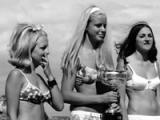
Five decades ago most Kiwis enjoyed a standard of living that was the envy of other nations. During the 1960s the arrival of TV and jet airliners shrank our world, and New Zealanders began to express themselves on a range of international issues, including opposition to the Vietnam War. Read the full article
Page 9 - 1966 - key events
A selection of the key events in New Zealand history from
The 1920s

The 1920s was the decade that modern New Zealand came of age. Despite political and economic uncertainty, the country shrugged off the gloom of war to embrace the Jazz Age - an era of speed, power and glamour. Explore an overview of the decade and a year-by-year breakdown of key events. Read the full article
Page 4 - 1921 - key events
A selection of key New Zealand events from
Biographies
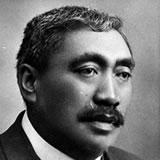
Hēnare Kaihau become deeply interested in Māori politics, and strongly supported the King movement, becoming a principal adviser to Mahuta, the third Māori King.

Coromandel chief, Hāmiora Mangakāhia, was elected Premier of the Kotahitanga (Māori) Parliament in 1892. He petitioned for the abolition of colonial laws relating to Māori land, and asked that Māori be allowed to control their own affairs.
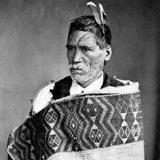
A famous Ngāti Maniapoto warrior, leader and supporter of the King Movement who's exploits in the Waikato War have been immortalised in book and film.
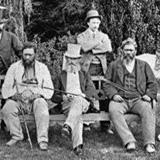
Ngāti Kahungunu chief Hēnare Matua was leader of the repudiation movement, which questioned land sales that it believed had been undertaken fraudulently.
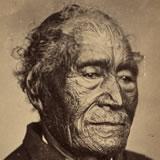
Renowned Ngāpuhi chief, Tāmati Wāka Nene, was an early friend of Pākehā. He was one of its most influential supporters in the debate at Waitangi over the Treaty and he was among the first to sign.
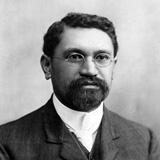
Hōne Heke Ngāpua was elected to Parliament in 1893 and represented the people of Northern Māori almost continuously until his death in 1909.
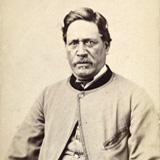
Te Āti Awa leader Wiremu Tako Ngātata was one of the first Māori members of the Legislative Council. He opposed legislation threatening Māori possession of land.
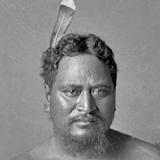
Nireaha Tāmaki, of Rangitāne and Ngāti Kahungunu, is perhaps best known for his bitter struggle to retain lands within the large Mangatainoka block, which the government was determined to purchase for railway construction.
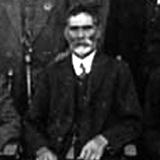
As chairman of the Kāwhia committee, John Ormsby worked on behalf of Ngāti Maniapoto in negotiations with the Native Land Court.
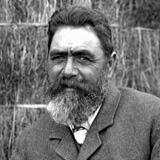
Elected to Parliament as the member for Western Māori in 1871, Wiremu Parata, took part in several high-profile court claims over Māori land.
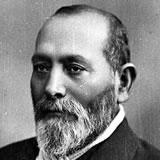
Wi Pere was a strong critic of the government's Maori land policies during his 15 years as a Member of Parliament for Eastern Maori
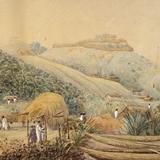
Pōmare II was a prominent Ngāpuhi chief who signed the Treaty of Waitangi. He was later arrested by the British on suspicion of treason but released on the intervention of Tāmati Wāka Nene.
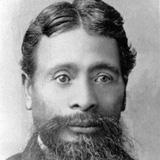
Son of Rawiri Taiwhanga, Hirini Taiwhanga petitioned Queen Victoria to change the laws that breached the Treaty of Waitangi.
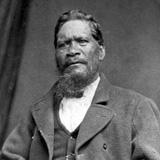
Influential Ngāti Kahungunu chief who fought in the Musket Wars during the 1820s, and later entered Parliament as a member for Eastern Māori.

Aperahama Taonui, of the Te Popoto sub-tribe of Ngāpuhi, was a founding member of the Kotahitanga movement, which evolved into the Māori parliaments of the 1890s.
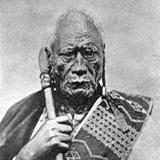
Ngāti Maru and Ngati Tamaterā chief who rejected the intrusion of Europeans in the traditional Māori world.
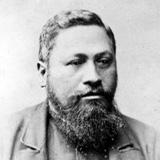
A member of the House of Representatives, Hōne Mohi Tāwhai became disillusioned in the settler-dominated Parliament and helped set up an alternative Māori Kotahitanga Parliament.
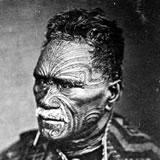
Tāwhiao's father Pōtatau was the first Māori King, and on his death in 1860 Tāwhiao inherited the kingship and the spiritual leadership of his people. He was king for the next 34 years, including the most turbulent period in New Zealand's race relations history.
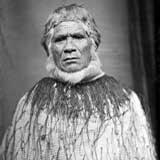
Hawke's Bay chief, Te Hāpuku, signed the 1835 Declaration of Independence and the Treaty of Waitangi. He opposed the King Movement fought against the Hauhau and Te Kooti.
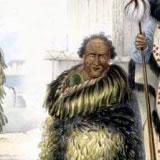
A paramount chief of Ngāti Tūwharetoa, Iwikau Te Heuheu was an ardent proponent of Māori nationalism, supporting the movement to set up a Māori king.
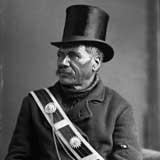
Horonuku Te Heuheu Tūkino IV succeeded his uncle, Iwikau, as paramount chief of Ngāti Tūwharetoa. He gifted the mountains of Tongariro, Ngāuruhoe and Ruapehu to the Crown in 1887 to be part of a national park.
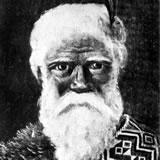
Te Kooti fought on the government side in the New Zealand Wars before being exiled to the Chatham Islands on charges of espionage. He later escaped back to the mainland and fought a long guerilla war against government forces.
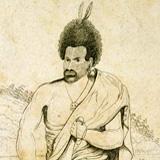
Ngāpuhi chief Te Pahi was the first influential Māori leader to have significant contact with British colonial officers.
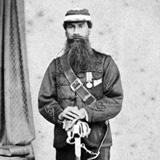
Muaūpoko, Ngāti Apa and Whanganui chief who joined the Armed Police Force and fought in campaigns against the Hauhau, Te Kooti and Tītokowaru during the 1860s.
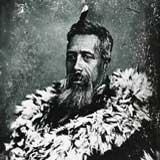
As a major in the New Zealand Militia, Te Keepa Te Rangi-pūawhe led a contingent of the Te Arawa tribe, which pursued the rebel leader Te Kooti into the Urewera region.
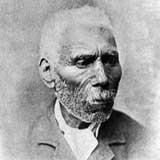
Te Ati Awa leader Wiremu Kīngi Te Rangitāke's refusal to give up his land at Waitara led to the outbreak of the Taranaki War. In later life joined the pacifist community at Parihaka.
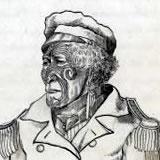
Te Rauparaha was a Ngāti Toa chief and warrior. Sometimes called the 'Napoleon of the Southern Hemisphere', he ruled the lower end of the North Island from his base at Kapiti Island for the best part of 20 years
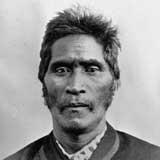
Ngāti Hauā chief who took a leading role in forming the King Movement (Kīngitanga) and the election of Pōtatau Te Wherowhero as the first Māori King.
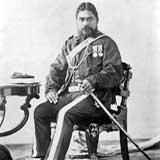
Wiremu Te Wheoro (?–1895) was a chief of Ngāti Naho. He was a stern critic of government policies toward Māori, accompanying King Tāwhiao to England in 1884, where they tried to appeal directly to Queen Victoria for the redress of grievances.
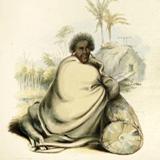
In the 1850s, a movement was set up to appoint a Māori king who would unite the tribes, protect land from further sales and make laws for Māori to follow. Te Wherowhero became the first Māori king in 1858.
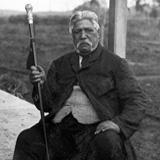
Ngāti Maniapoto leader, Wahanui Huatare, was a notable tohunga (Māori spiritual expert) and an influential chief.
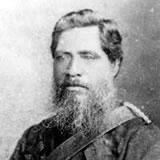
Ngāti Porou leader Rāpata Wahawaha opposed the Pai Mārire religion and sided with the government against its followers. He was later presented with a ceremonial sword by Queen Victoria for services to the Crown during the New Zealand Wars.
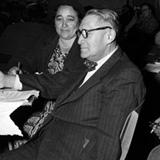
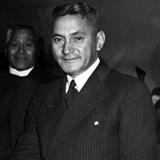
The fifth Māori King, Korokī Te Rata Mahuta Tāwhiao Pōtatau Te Wherowhero struggled to maintain the dignity of the Kīngitanga and obtain recognition during his reign.
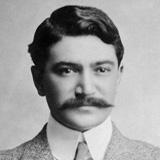
Involved in local and national politics, Rangiputangatahi Māwhete, worked hard for Māori in the Manawatū during the 1930s and 1940s. He was particularly active in the Māori War Effort Organisation during the Second World War.
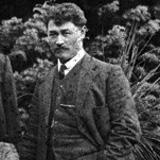
Te Arawa leader Tai Mitchell carried out a wide range of social and economic activities as chairman of the Arawa Trust Board. He was a firm supporter of Āpirana Ngata's land development schemes, and helped persuade Te Arawa to participate in them.
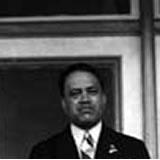
Te Uri-o-Hau Methodist minister and Rātana leader, Paraire Paikea, played a leading role in forging the historic alliance between the Rātana movement and the Labour Party. He was minister in charge of the Māori war effort during the Second World War.
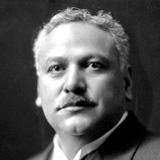
Māui Pōmare was the first Māori doctor. As Māori Medical Officer, toured Māori districts in this role, advising people about public health. Pōmare became a member of Parliament in 1911, and minister of health in the 1920s.
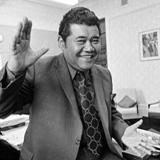
As minister of Māori affairs Matiu Rata helped set up the Waitangi Tribunal in 1975. He later left the Labour Party to form Mana Motuhake, the first modern Māori politcal party.
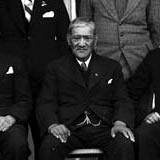
Tahupōtiki Wiremu Rātana, of Ngāti Apa and Ngā Rauru, founded the Rātana Church, which remains a major religious and political force today.
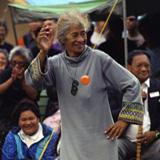
Eva Rickard was one of the most outspoken Māori land-rights campaigners of the 1970s.
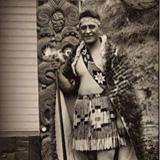
As chairman of the Ngāti Tuwharetoa Trust Board, Hoani Te Heuheu, advised Ngāti Tūwharetoa on taking stock of its resources, both land and people, and planning a future based on economic and social principles.
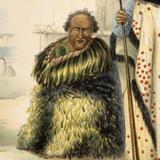
Te Kawau was a Ngāti Whātua leader who signed the Treaty of Waitangi at Manukau Harbour in March 1840. He later worked with European magistrates to settle disputes among Māori.
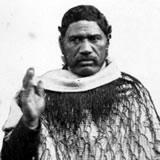
In 1862 Te Ua Haumēne established a new religion, Hauhau based on the principle of pai marire – goodness and peace. Most settlers viewed Hauhau as a anti-European religion that became synonymous with ‘violence, fanaticism and barbarism’.
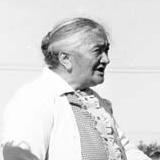
The first Māori woman to be elected to Parliament, Iriaka Matiu Rātana was a passionate advocate for the welfare of her people.
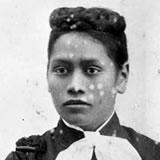
Meri Mangakāhia petitioned the government on land rights and argued for women’s suffrage, and actively participated in the Kotahitanga movement, the Māori parliament based at Pāpāwai, Wairarapa.
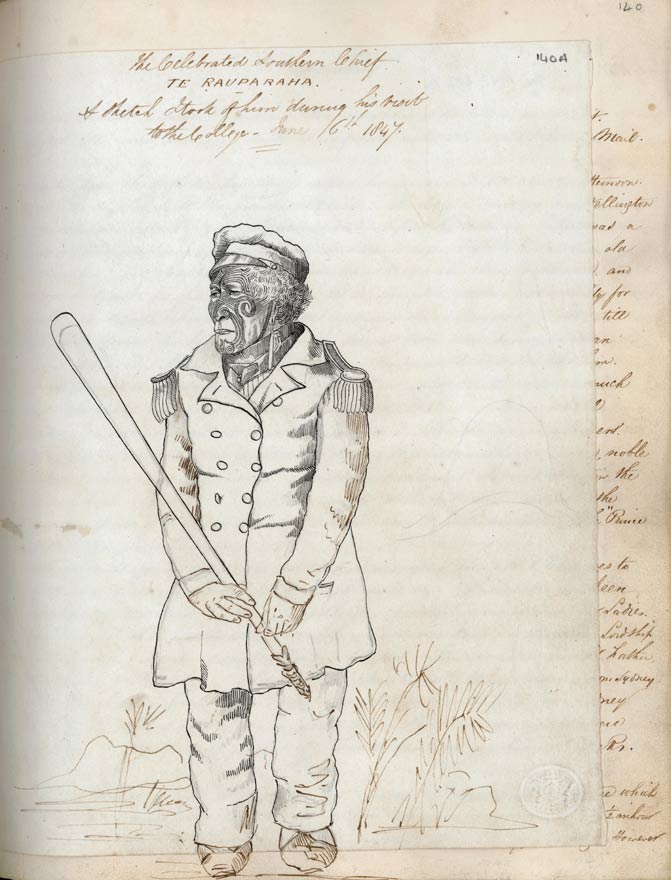
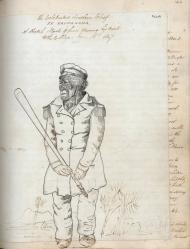
Main image: Te Rauparaha sketch
This 1847 sketch of Te Rauparaha is by William Bambridge. The elderly chief is wearing a naval uniform he was given after his arrest and detention in Auckland in 1846.